
Chapter 1 · Counters · Case 8
Specifics of the VT counter
Patient and episode
Patient
- Patient implanted with a single-chamber defibrillator (EnTrust VR) for dilated cardiomyopathy and hospitalised for palpitations; 3 detection zones were programmed with a VT zone between 400 and 320 ms.
The recording
Tap a number on the trace, or an entry in the list below
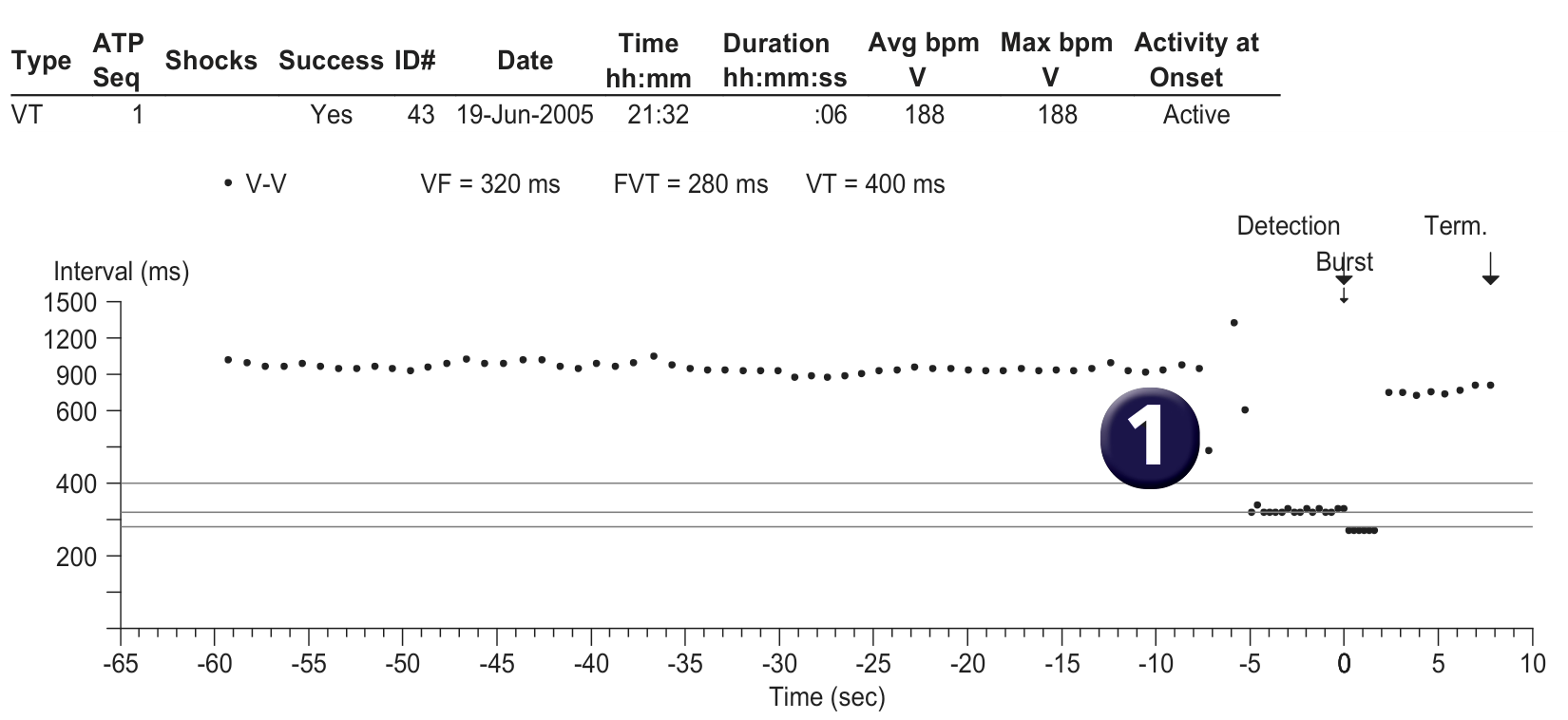
Rate / interval plot
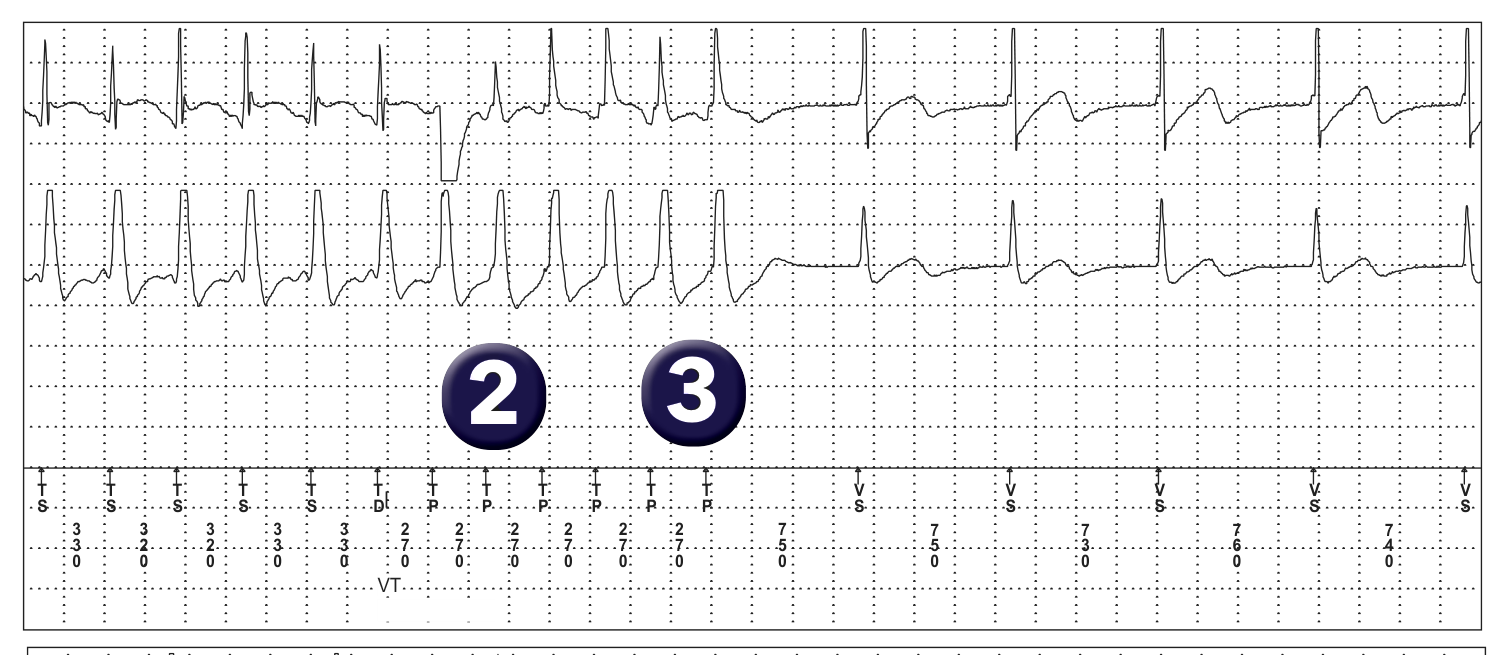
EGM
- What diagnosis are you suggesting on this graph? The plot shows an initial rhythm that appears normal, followed by sudden acceleration, and detection of a regular tachycardia in the VT zone that is effectively treated by a burst of anti-tachycardia pacing.
- What is your diagnosis? Probable VT; on the EGM, there is sudden acceleration with a regular tachycardia where all cycles are detected in the VT (TS) zone.
- What therapy is delivered? After 16 consecutive cycles classified as TS, the device diagnoses VT; a burst is delivered; it is effective with return to sinus rhythm followed by an end-of-episode diagnosis (Termination) after 8 consecutive cycles classified as VS.
Points to remember
- The specific features of the VT counter must be perfectly integrated to allow optimum programming; in fact, for MedtronicTM devices, the method of counting differs completely between the VT zone (consecutive cycles) and the VF zone (probabilistic counter), which is not the case for other vendors’ defibrillators.
- A cycle classified in the VT zone increments the VT counter by +1; a cycle classified in the VF zone does not modify the VT counter (no increment, no decrement); a long cycle classified as VS resets the VT counter to 0.
- This counter has been specifically developed to provide optimal performance for tachycardias with a rate less than 200 beats/minute, with a dual objective: 1) to effectively detect episodes of regular, monomorphic ventricular tachycardia; 2) to provide a first level of «discrimination» during an episode of atrial fibrillation, which often includes one or more slow cycles that reset the counter to 0.
- The VT counter is filled after a programmable number of consecutive cycles falling in the VT zone (VF cycles do not modify the counter); a single cycle classified as VS resets the VT counter to 0, which has several consequences: 1) inappropriate resetting of this counter to 0 can occur following ventricular under-sensing (common in polymorphic ventricular tachycardias); this counter is probably inappropriate for tachycardias greater than 200 beats/minute which include polymorphic arrhythmias with signals of variable amplitude; 2) this counter improves the specificity of diagnoses, an episode of atrial fibrillation being frequently associated with repeated long cycles (frequent return of the counter to 0).
Practice out loud
Just describe the tracing. What do you think is going on? Describing the numbers can help.
00:00
0%
—
From Medtronic ICD — clinical cases by P. Bordachar, A. Thiyagarajah, L. Fontagne, M. Strik, S. Ploux. Published by Cardiocases. Every numbered marker on a recording is explained in the list beneath it; tap a marker on the trace or an entry in the list.
Order hardcopyon Amazon