
Chapter 1 · Counters · Case 9
AF and the VT counter
Patient and episode
Patient
- Patient implanted with a dual-chamber defibrillator (Evera XT DR) for ischaemic cardiomyopathy presenting with multiple episodes of paroxysmal atrial fibrillation; 2 detection zones were programmed with a VT zone between 350 and 270 ms.
The recording
Tap a number on the trace, or an entry in the list below
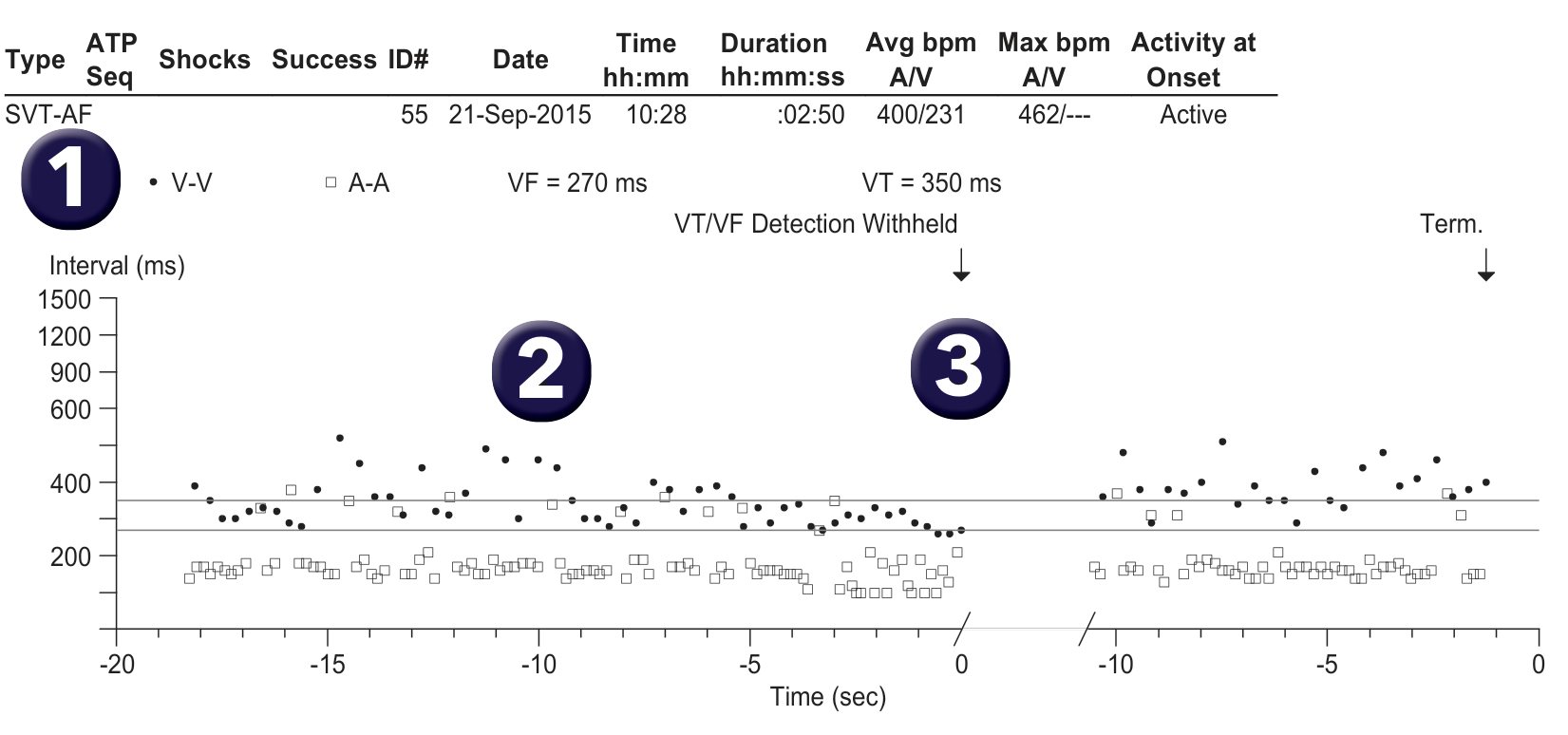
Rate / interval plot
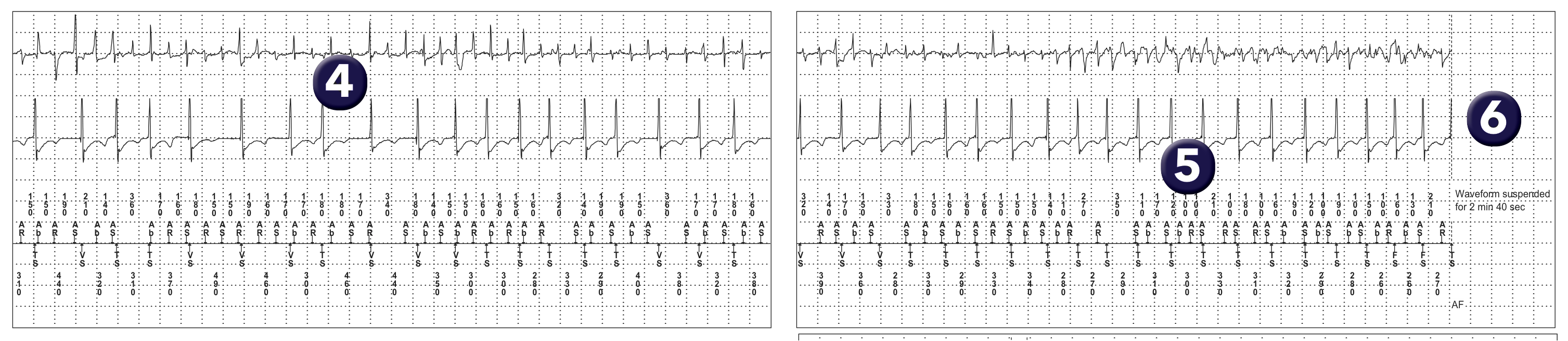
EGM
- What diagnosis is suggested by the interval plot? The episode was diagnosed as SVT/AF by the device (1); the interval plot initially shows a very rapid and irregular atrial rhythm associated with a rapid and irregular ventricular rate (alternating cycles detected in and out of the VT zone) compatible with an episode of conducted AF (2); in a second phase, the ventricular rate stabilises in the VT zone; the VT counter is filled but no therapy is delivered (3).
- What is your diagnosis? On the EGM, there is very rapid and irregular atrial activity in favour of atrial fibrillation, as well as irregular ventricular cycles classified as either VT or VS; the VT counter is repeatedly reset to 0 following the detection of ventricular cycles classified as VS.
- How does the tachycardia develop? The ventricular rate accelerates and stabilises in the VT zone.
- How do you explain the fact that no therapy is delivered? The VT counter is filled after 16 TS cycles and 2 FS cycles (counter programmed at 16, FS cycles do not modify the VT counter); no therapy is delivered, the PR Logic discrimination algorithm leading to a diagnosis of AF.
Points to remember
- This tracing demonstrates the usefulness of the MedtronicTM VT counter in preventing inappropriate therapies during an episode of conducted AF; this patient had multiple episodes of relatively rapid conducted AF which were not stored in the device memory, the presence of repeated long cycles allowing the VT counter to return to 0, thereby preventing the counter from being filled and the episodes from being stored; in rare cases, as in this trace, the ventricular rhythm stabilises in the VT zone, with PR Logic providing effective discrimination and preventing inappropriate therapies.
- This specificity is a major advantage of this type of counter; the risk of inappropriate therapies for atrial fibrillation is significantly reduced, especially since there has been a trend in recommendations towards increasing the number of cycles required to diagnose VT; for an AF episode occurring at a rate corresponding to the VT zone to result in inappropriate therapies, a combination of the following is required: 1) a number of consecutive cycles in the VT zone (30 in the new recommendations) without any long cycle classified as VS, which is relatively rare when the lower limit of the VT zone is programmed between 150 and 160 beats/minute; in fact, a single cycle classified as VS resets the VT counter to 0; 2) a discrimination error by PR Logic and Wavelet which operate in a second phase and can correct a diagnostic error; this explains why the risk of inappropriate therapies for conducted AF falling in the VT zone is relatively low.
Practice out loud
Just describe the tracing. What do you think is going on? Describing the numbers can help.
00:00
0%
—
From Medtronic ICD — clinical cases by P. Bordachar, A. Thiyagarajah, L. Fontagne, M. Strik, S. Ploux. Published by Cardiocases. Every numbered marker on a recording is explained in the list beneath it; tap a marker on the trace or an entry in the list.
Order hardcopyon Amazon