
Chapter 1 · Counters · Case 7
No confirmation for a second shock
Patient and episode
Patient
- Male implanted with a single-chamber defibrillator (Visia AF XT VR) for ischaemic cardiomyopathy.
The recording
Tap a number on the trace, or an entry in the list below
Rate / interval plot
EGM


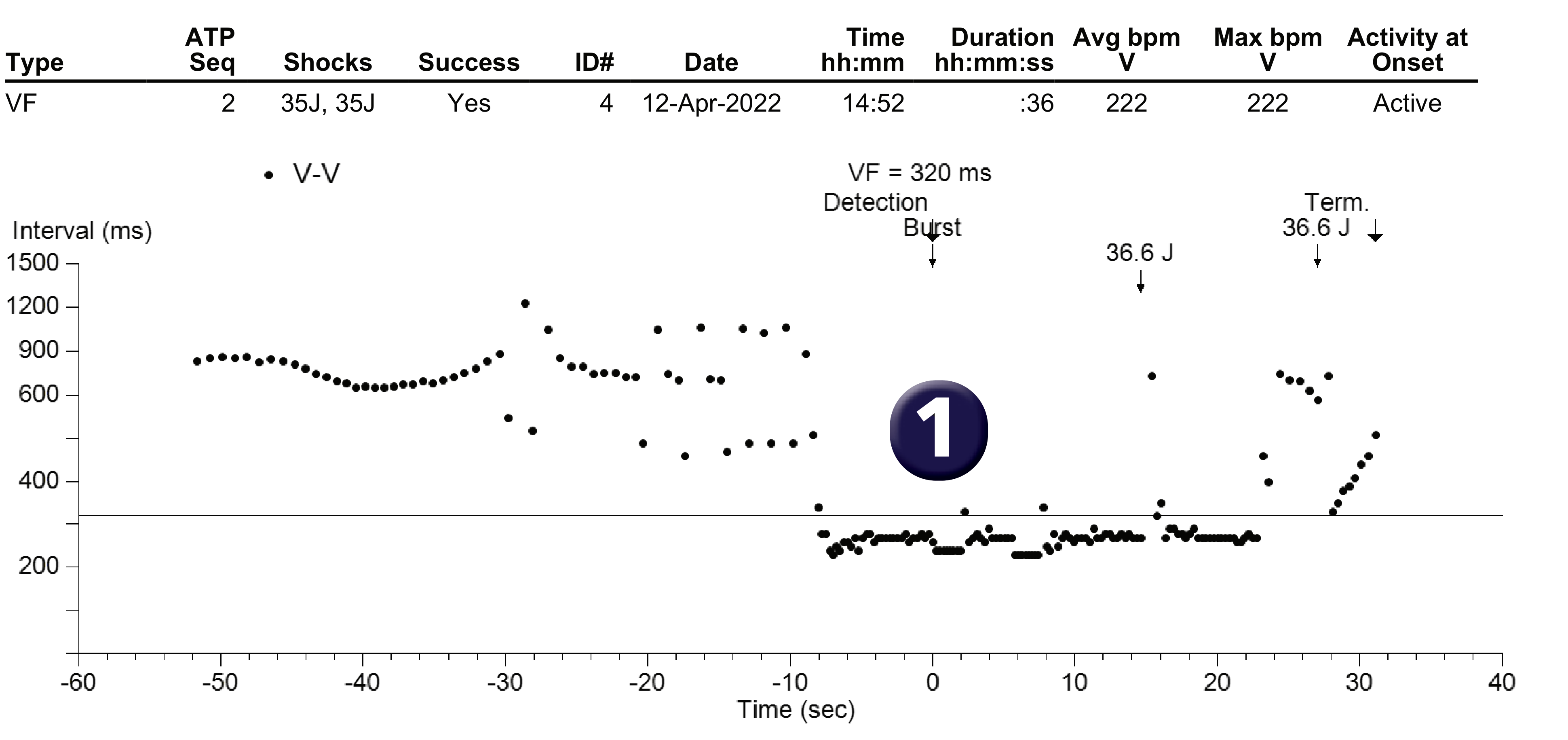
- What diagnosis are you suggesting on this graph? The plot shows a sudden acceleration of the ventricular rhythm with rapid cycles detected in the VF zone; a burst and then a shock are delivered; the first shock seems ineffective with persistence of the arrhythmia which terminates in a second phase; a second shock is delivered just as the rate seems to have normalised.
- What is your diagnosis? The tracing shows a rapid, monomorphic ventricular arrhythmia detected in the VF zone.
- What therapy is delivered? This is a burst before the charge.
- What therapy is delivered? This is a burst during the charge, the first burst having been ineffective.
- What therapy is delivered? This is a maximum output shock delivered when the 2 bursts have proved ineffective.
- What is the effect of the shock? The shock was ineffective and a monomorphic ventricular arrhythmia persisted; the redetection counter was filleded (12/16).
- How do you explain the delivery of this second shock? The ventricular arrhythmia has spontaneously terminated during charging; once the re-detection counter was filled, therapy (second shock) cannot be abandoned; at the end of charging, the device synchronises with the first ventricular complex detected and the shock is delivered.
Points to remember
- In the VF zone, the defibrillator operates differently between the first shock in a series and any subsequent shocks (shocks 2 to 6).
- For the first shock, charging can be interrupted or abandoned; following initial detection, charging can be interrupted if the arrhythmia terminates spontaneously during charging (evidence of at least 4 slow cycles out of 5); similarly, if the arrhythmia terminates spontaneously at the end of charging, the charge can be abandoned (evidence of at least 4 slow cycles out of 5 after the CE marker).
- Conversely, for shocks 2 to 6, when the redetection counter is filled, charging can no longer be interrupted or abandoned and the shock will be systematically delivered, with an attempt to synchronise to a ventricular sensed event at the end of the charge; in fact, if the redetection counter was filled, the device considers that the shock was ineffective and starts charging the capacitors; if it diagnoses reversion when charging has begun, the shock is still delivered at the end of charging ; this is to avoid withholding essential therapy in the event of under-sensing that can result in an incorrect diagnosis of arrhythmia termination.
Practice out loud
Just describe the tracing. What do you think is going on? Describing the numbers can help.
00:00
0%
—
From Medtronic ICD — clinical cases by P. Bordachar, A. Thiyagarajah, L. Fontagne, M. Strik, S. Ploux. Published by Cardiocases. Every numbered marker on a recording is explained in the list beneath it; tap a marker on the trace or an entry in the list.
Order hardcopyon Amazon