
Chapter 1 · Counters · Case 6
Initial counter and redetection counter
Patient and episode
Patient
- Patient implanted with a dual-chamber defibrillator (Evera XT DR) for ischaemic cardiomyopathy; hospitalisation for syncope.
The recording
Tap a number on the trace, or an entry in the list below
Rate / interval plot
EGM

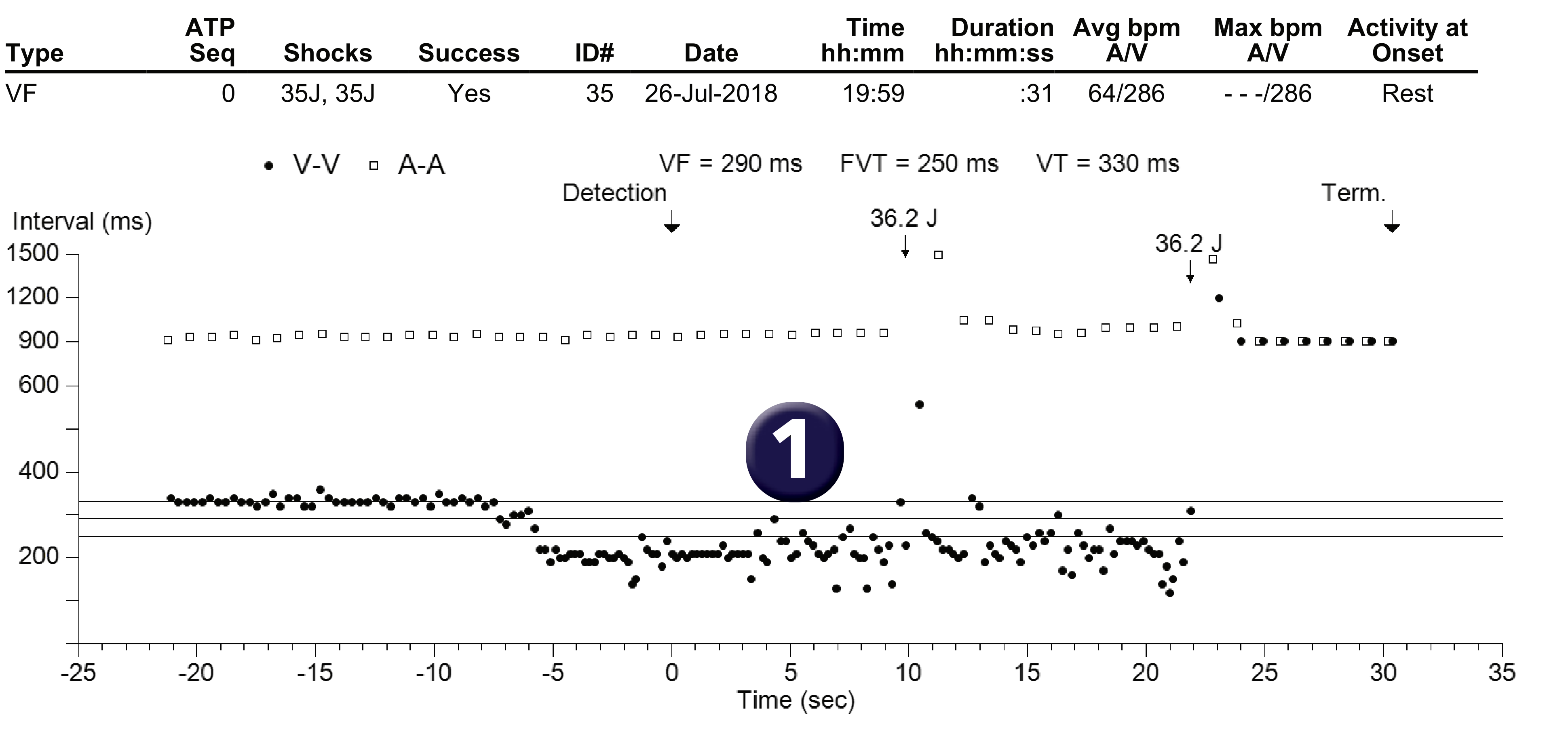
- What diagnosis is suggested by the interval plot? Three detection zones are programmed; initially, the plot suggests the presence of VT (atrioventricular dissociation) at the lower limit of the VT zone; in a second phase, the ventricular rhythm accelerates with irregular cycles in the VF zone; a first maximum output shock is delivered but does not terminate the arrhythmia; a second maximum output shock appears effective; the diagnosis is therefore VT degenerating into VF requiring 2 shocks.
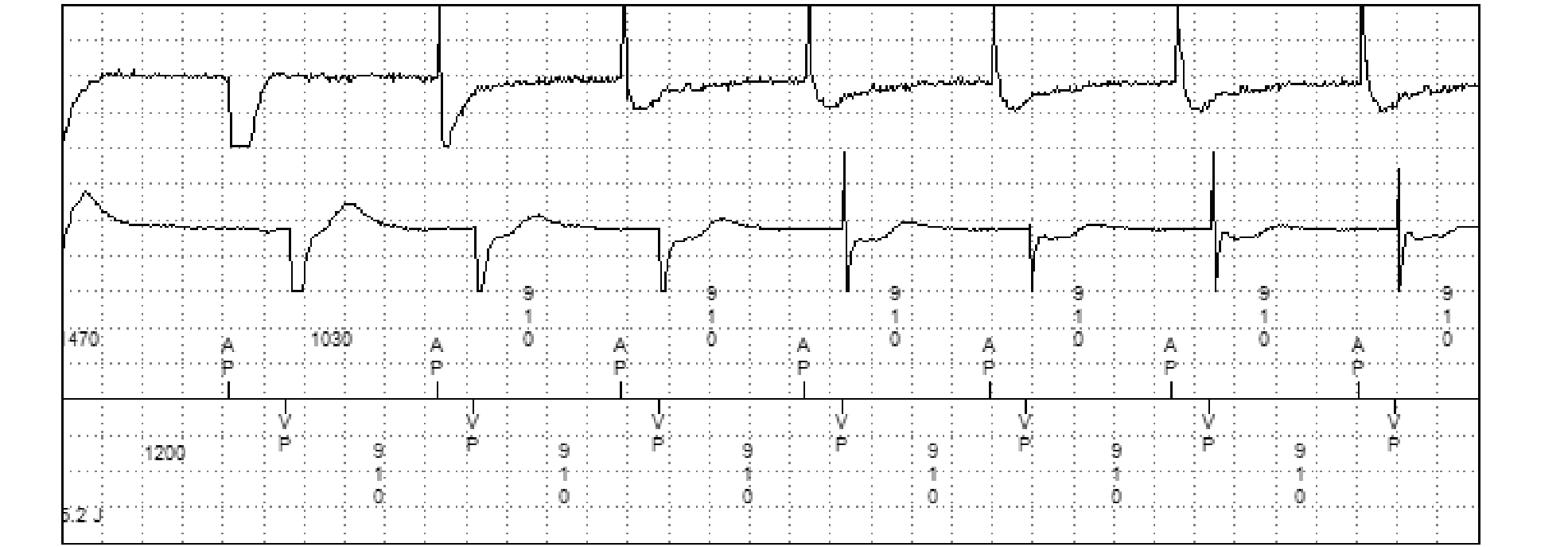
- What is your diagnosis? The tracing shows a rapid, polymorphic ventricular arrhythmia consistent with VF.
- How does the device work at the end of this first charge? It is set to 30/40; the TF. and FS cycles implement the same counter.
- How does the device work at the end of this first charge? The shock is said to be “non-committed”, so there is a confirmation phase; the shock is delivered on the second rapid cycle following the CE marker.
- What was the effect of the shock? The shock was ineffective and the arrhythmia persisted.
- What does the FD marker mean? The redetection counter programmed to 12/16 is filled; following the shock, 12 cycles are classified as FS and 2 cycles are classified as VS.
- How does the device work at the end of this second charge? The second shock of the same episode is said to be “committed”, i.e. it is committed to being delivered if the re-detection counter has been filled; at the end of the charge (CE), the device synchronises to the first sensed QRS complex.
Points to remember
- This VF trace is used to discuss the operation of the defibrillator once the first shock has been delivered.
- A blanking phase of 520 ms, during which no sensing is possible, occurs systematically following all shocks to avoid oversensing of the polarisation induced by the shock.
- The device must then differentiate between 1) termination of the episode and 2) an ineffective shock with continuation of the arrhythmia and competition between 2 counters: I) the redetection counter which is programmable; like the initial counter, this is a probabilistic counter with a threshold of 75% short cycles (6/8, 9/12 ... 30/40); the number of cycles required applies to all subsequent shocks (from 2 to 6) during the same episode; it is usual to program a lower number of cycles required for redetection than for initial detection, as the risk of undersensing increases with the duration of the arrhythmia; II) the end-of-episode counter which is based on 2 criteria: a) the device diagnoses the end of the episode when 8 consecutive VS or VP cycles slower than the lowest programmed detection zone (VF or VT) are recorded; b) it also diagnoses the end of the episode if, for 20 seconds, the median of 12 consecutive cycles is slower than the lowest programmed detection zone (VF or VT).
- It should be noted that once the redetection counter has been filled, the shock will be automatically delivered at the end of the charge by synchronising with a sensed complex or asynchronously if no complex is detected («committed» shock; no confirmation phase at the end of the charge).
Practice out loud
Just describe the tracing. What do you think is going on? Describing the numbers can help.
00:00
0%
—
From Medtronic ICD — clinical cases by P. Bordachar, A. Thiyagarajah, L. Fontagne, M. Strik, S. Ploux. Published by Cardiocases. Every numbered marker on a recording is explained in the list beneath it; tap a marker on the trace or an entry in the list.
Order hardcopyon Amazon