
Chapter 1 · Counters · Case 5
Increasing counters and preventing avoidable therapies
Patient and episode
Patient
- Patient implanted with a single-chamber defibrillator (Visia AF XT VR) for congenital long QT syndrome; episode of syncope.
The recording
Tap a number on the trace, or an entry in the list below
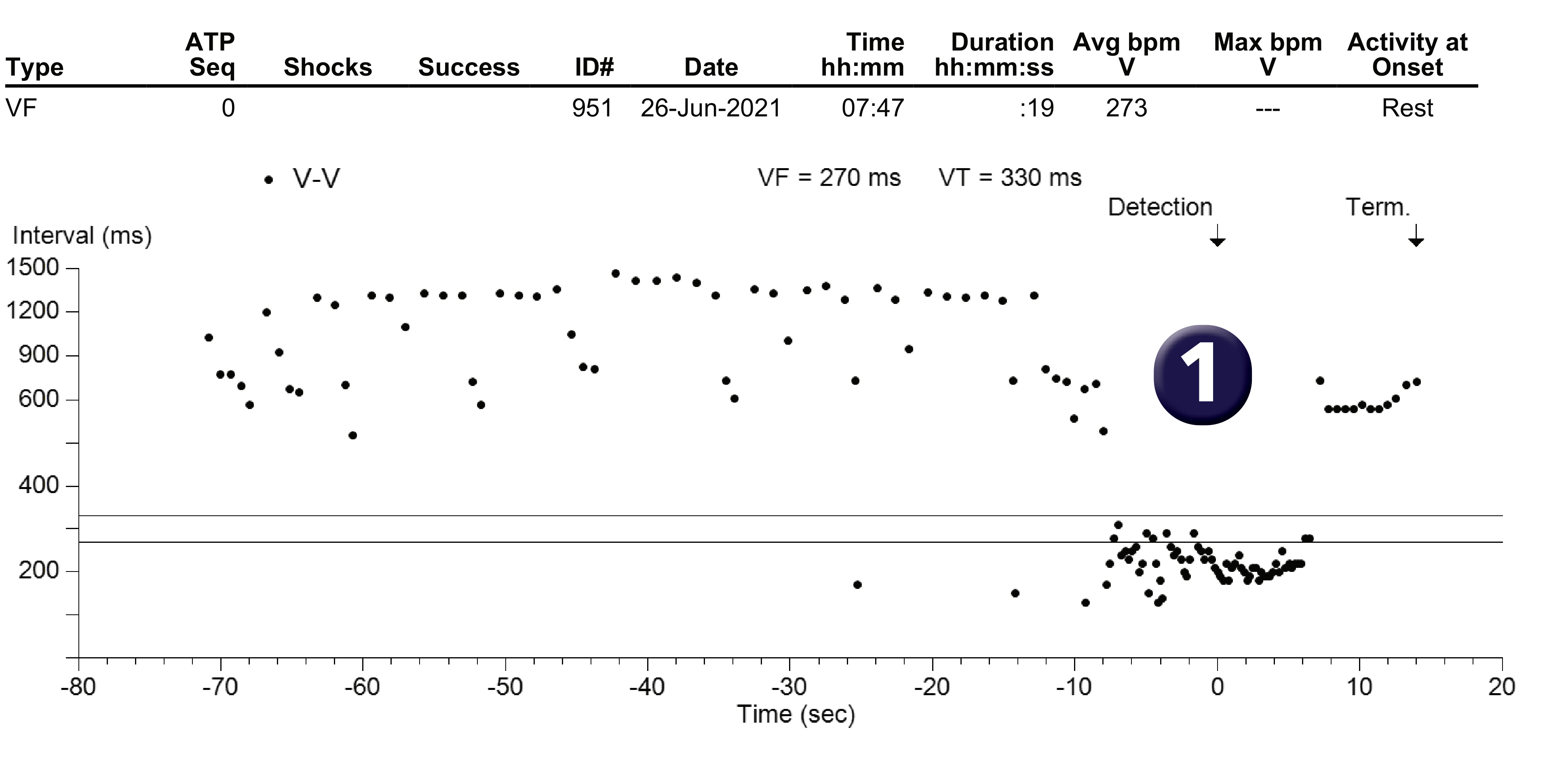
Rate / interval plot
EGM


- What diagnosis is suggested by the interval plot? The plot shows a sudden acceleration of the ventricular rate with irregular cycles detected in the VF zone; the initial VF counter is filled (Detection) but no therapy is delivered following probable spontaneous reversion.
- What type of arrhythmia is it? This is probably a very rapid and irregular ventricular arrhythmia; the shock channel shows the polymorphic character with a torsades-like appearance.
- How is the initial detection counter in the VF zone programmed? The initial counter is set to 30/40.
- What does aborted mean? The capacitors start charging when the initial VF counter is filled; during charging, the arrhythmia stops spontaneously and after 4 consecutive slow cycles, the therapy is abandoned; note that the shock channel makes it possible to identify a very long QT interval
Points to remember
- This episode of arrhythmia corresponded to torsade de pointes which lasted around fifteen seconds and terminated spontaneously with an aborted charge at the end of the charging; this tracing illustrates the importance of the confirmation phase during and at the end of charging to avoid delivering a shock when the tachycardia has terminated.
- One of the main objectives of defibrillator programming is to reduce, as far as possible, the number of inappropriate or avoidable therapies; the systematic programming of an initial counter at 30/40 is a step towards this objective; in the VF zone, the initial counter is filled after approximately 7 to 8 seconds; if we add the charging time and confirmation at the end of the charge, the total time in arrhythmia is at least 15-17 seconds before delivering a shock, which allows spontaneous reversion.
- Treating an episode of malignant ventricular arrhythmia with a shock remains the only option for restoring viable haemodynamics; however, latest recommendations advise avoiding treating ventricular arrhythmias prematurely and too aggressively, because they can terminate spontaneously; a shock can save a life but has its own deleterious effects and should be avoided wherever spontaneous reversion is possible or less aggressive therapies may be effective.
- It is therefore advisable: 1) not to systematically program treatment zones that are too low for primary prevention; 2) to lengthen the initial detection counters not only in the VT zone, but also in the VF zone, to avoid treating episodes of arrhythmia that would have reverted spontaneously (appropriate but avoidable therapies); 3) to favour first-line treatment with anti-tachycardia pacing, even for very rapid tachycardias (limit of 230-250 beats/minute).
Practice out loud
Just describe the tracing. What do you think is going on? Describing the numbers can help.
00:00
0%
—
From Medtronic ICD — clinical cases by P. Bordachar, A. Thiyagarajah, L. Fontagne, M. Strik, S. Ploux. Published by Cardiocases. Every numbered marker on a recording is explained in the list beneath it; tap a marker on the trace or an entry in the list.
Order hardcopyon Amazon