- 2 programming options are available for ATP Quick Convert in VF zones: ATP delivered for tachycardias of less than 250 beats/minute or for tachycardias of less than 300 beats/minute.
- in guideline recommendations, the lower limit of the VF zone is 250 beats/minute; programming ATP Quick Convert up to 300 beats/minute could be considered
- the ventricular rate is calculated as the average of the 4 ventricular cycles preceding the V-Detect marker; in this example, ATP is delivered while the ventricular rate is very fast due to the presence of undersensing; this ATP is ineffective (no effective ventricular capture) and does not terminate the arrhythmia
- the level of evidence for the efficacy of ATP for tachycardias above 250 beats/minute is weak; indeed, for this rate range, a majority of ventricular arrhythmias are disorganized and polymorphic and therefore theoretically less likely to be terminated by anti-tachycardia pacing : unpublished data from our center does indicate that there is an interest in performing ATP at these high rates
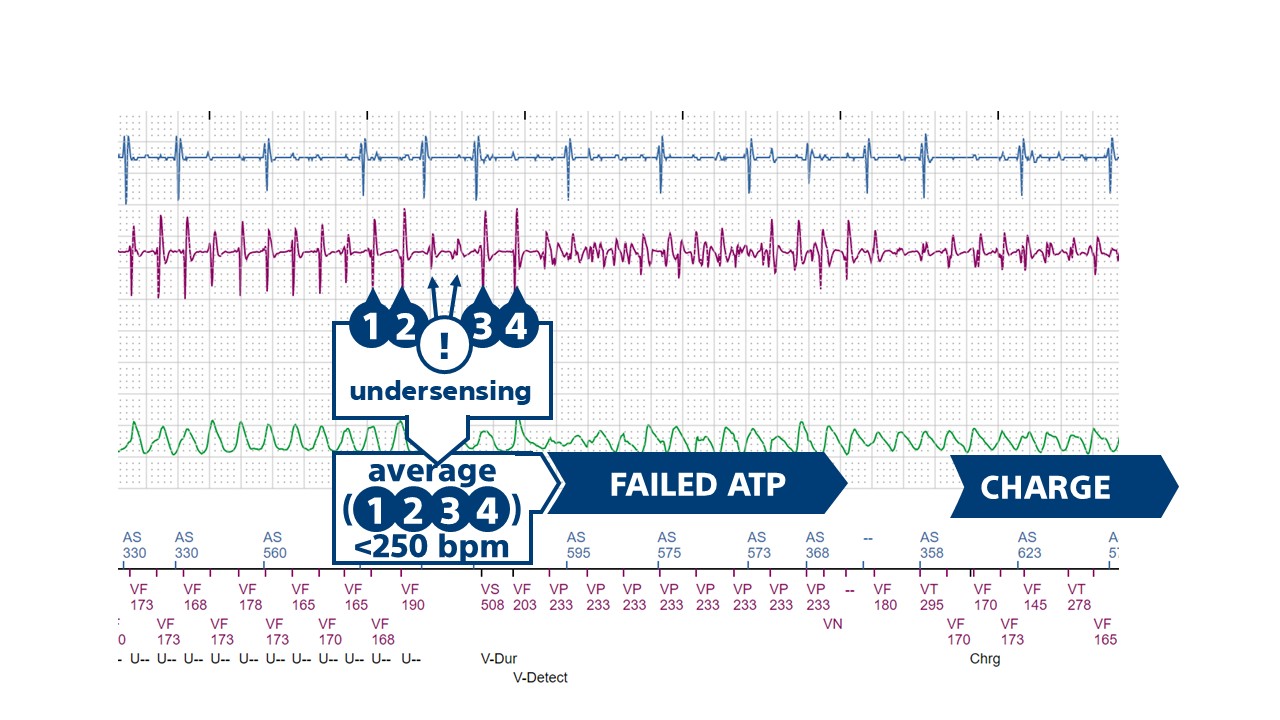
This figure shows the 4 cycles preceding the V-Detect marker and the undersensing which distorts the rate calculation, this is followed by ATP without ventricular capture; the cycle following the ATP is unclassified (–); the ATP is ineffective, after 2 rapid cycles (VF then VT), capacitor charging begins.


