male implanted with a triple-chamber defibrillator; recording of a NSVT trace
EGM layout
intermittent oversensing of atrial activity by the right ventricular lead (clearly visible on the atrial channel); some cycles classified as VS, VT-1, VT or VF
8/10 criterion fulfilled for the VT-1 zone
Take home message
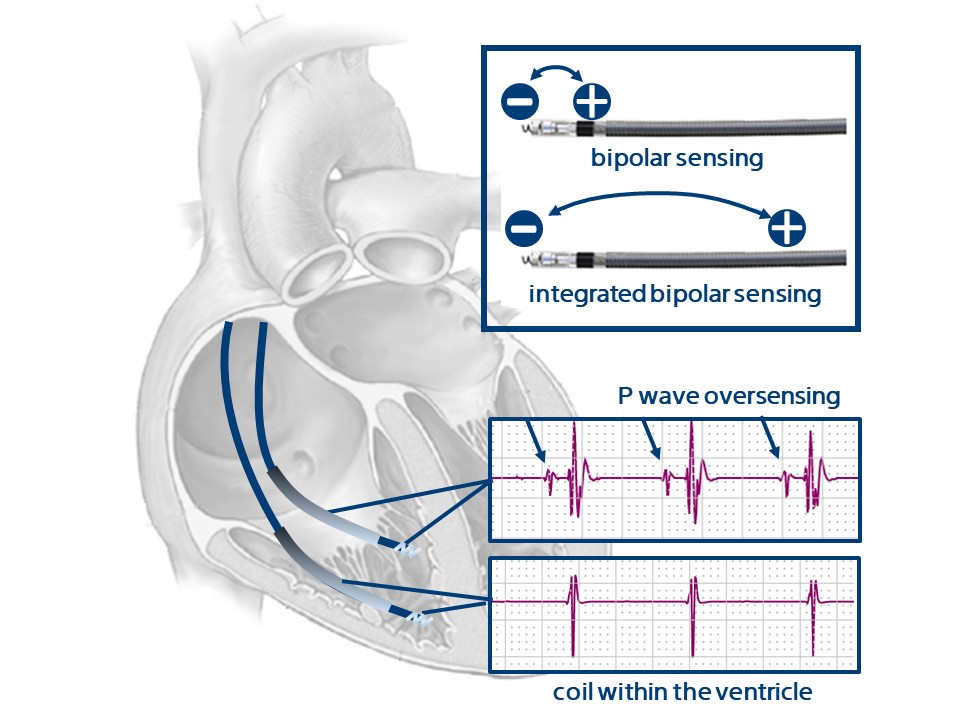
this trace shows sinus tachycardia with intermittent oversensing of atrial activity by the defibrillation lead
oversensing of atrial signals by the ventricular lead tends to occur in 2 situations: 1) displacement of the right ventricular lead at the atrio-ventricular junction (coincides with a decrease in the amplitude of the measured R wave); 2) positioning of an integrated bipolar lead close to the tricuspid annulus, with the distal coil straddling the valve (coincides with a preserved amplitude of the R wave); Boston Scientific devices are potentially more prone to this type of problem insofar as they are frequently connected to an integrated bipolar lead.
Atrial oversensing can also occur under more exceptional circumstances: 1) unintentional placement of a right ventricular lead in the coronary sinus; 2) insulation defect in the atrial portion of the ventricular lead leading to oversensing of atrial activity; 3) interaction between the atrial lead and the right ventricular lead, the atrial lead coming into contact with the ventricular lead and generating a signal at the moment of atrial systole.
several solutions can be implemented to solve the problem and avoid the occurrence of inappropriate therapies or ventricular pauses in pacing-dependent patients with P wave oversensing: 1) reduce the ventricular sensitivity so as to eliminate the supernumerary signal linked to the oversensing of atrial activity; since this programming change is accompanied by an increased risk of under- sensing VF, an induction can then be undertaken to check that the induced VF is correctly sensed with this new sensitivity value; 2) in a significant number of cases, oversensing of atrial activity requires the defibrillation lead to be repositioned (new defibrillation lead for a DF4 system or addition of a pace/sense lead for a DF1 system).
Schematic explaining integrated bipolar sensing and showing how a right ventricular coil can straddle the tricuspid valve and lead to P wave oversensing.