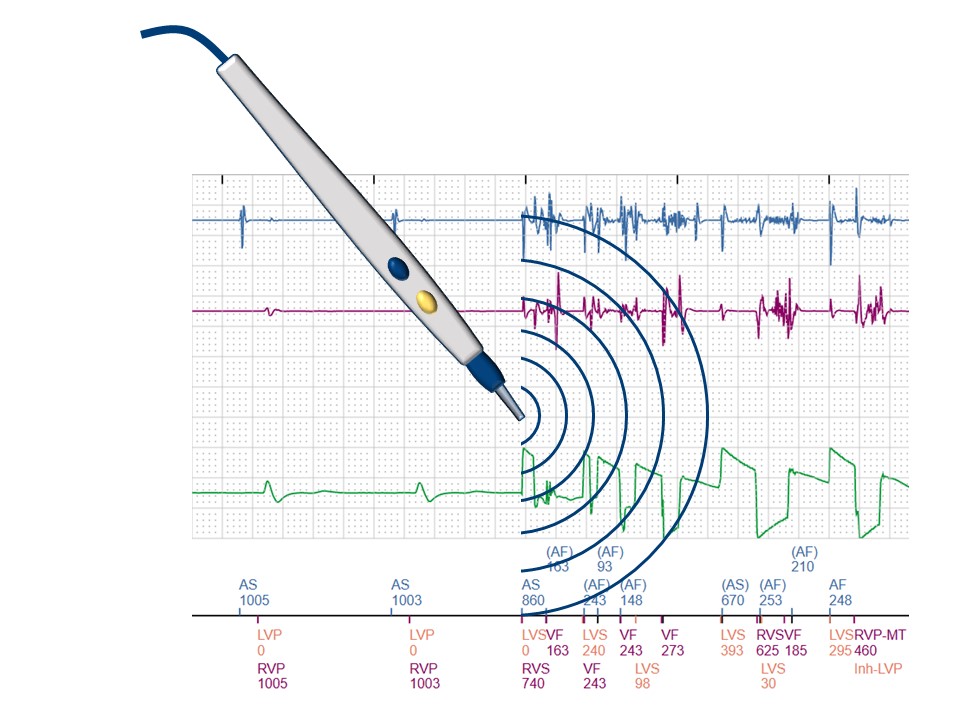
male with ischaemic cardiomyopathy, implanted with a triple chamber defibrillator; box change procedure with implantation of a Resonate defibrillator; electrogram trace recorded during the procedure.
Summary
detection of an episode in the VF zone
no therapy delivered (device not programmed for monitoring + treatment)
EGM layout
atrial sensing and biventricular pacing
simultaneous sensing on all 3 channels (atrial, ventricular, shock) of fast, disorganized signals of variable amplitude and morphology (classified as AF, VF)
end of oversensing
new onset oversensing of identical signals
Take home message
the programmed Tachy Mode controls the availability of detection and treatment functions with 3 programmable options: 1) off: deactivates arrhythmia detection and delivery of therapies; 2) monitoring only: deactivates therapies but allows detection and recording of arrhythmia episodes; 3) monitoring + treatment: activates detection and recording functions as well as the various programmed therapies.
in this patient, the Tachy Mode was programmed to monitoring only during the device change procedure, which explains the detection and recording of this episode but the absence of therapy delivered; once the device was connected and positioned in the pocket, electrocautery was used for hemostasis
as a general rule, the diagnosis of electromagnetic interference is based on exposure to a source at the time of the recorded episode and oversensed signals with a characteristic pattern; oversensing of electromagnetic interference is more common with an integrated bipolar lead than with «true» bipolar sensing, as the sensing antenna is larger
the tracing is characteristic for oversensing of a signal emitted by an electrocautery unit: simultaneous sensing on the 3 channels (atrial, ventricular, shock) of rapid, disorganized signals of variable amplitude and morphology; the diagnosis is obvious insofar as the episode was recorded during the device change procedure
when changing the device, it is customary to program the Tachy Mode to off to avoid inappropriate therapies and recording tracings which unnecessarily overload the device’s memories
in dependent patients, a specific mode can be programmed for asynchronous pacing (AOO, VOO or DOO) to avoid inhibition during electrocautery
in a patient implanted with a defibrillator and undergoing non-cardiac surgery, the surgeon should be advised to use electrocautery in bipolar mode, to limit its use to very short periods and to place the scalpel plates at a distance from the defibrillator unit; to completely eliminate the risk of unwanted interference, a first option is to deprogram detection and therapies; a second option is to place a magnet over the defibrillator to inhibit all therapy; the effect of the magnet is reversible, and the therapies and episode memory are operational again once the magnet is removed; during the procedure, scope monitoring must be maintained, as the patient is no longer protected by his defibrillator
This figure shows the characteristic trace of an oversensing of electrocautery, with disorganized signals appearing simultaneously on the 3 channels.