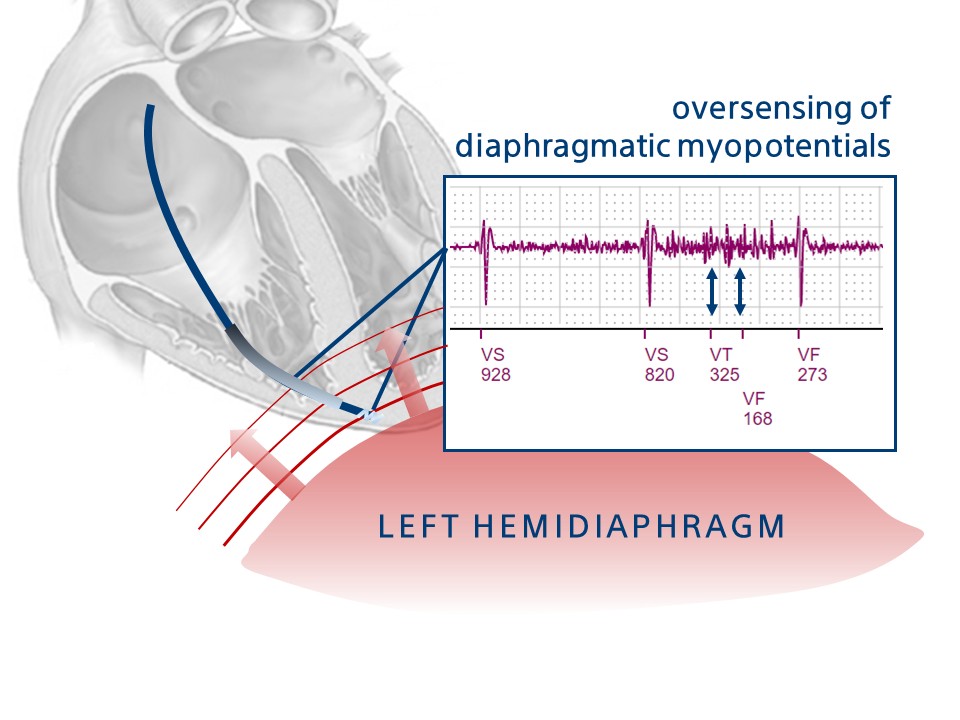
male implanted with an Incepta single-chamber defibrillator
Summary
detection of a non-sustained VT episode
EGM layout
the ventricular sensing channel intermittently senses non-physiological signals of relatively low amplitude (increasing then decreasing amplitude)
EGM trace recorded after 3 consecutive cycles classified as VF
Take home message
using a high auto-adaptive sensitivity optimizes the sensing of very low voltage signals during VF but increases the risk of oversensing diaphragmatic myopotentials at the end of diastole when the sensitivity is at its maximum
oversensing of diaphragmatic myopotentials is rare but has been observed to a greater extent in patients implanted with an integrated bipolar lead positioned at the apex of the right ventricle; an integrated bipolar lead may promote occurrence of this phenomenon because the detection antenna is wider; permanent ventricular pacing is associated with an increased risk of oversensing of these myopotentials because, after pacing, the period of maximum sensitivity is prolonged, particularly when the heart rate is slow
diaphragmatic myopotentials correspond to low amplitude, high frequency signals, most often detected exclusively on the sensing channel (absent on the shock channel); the 2 main characteristics of this type of signal are that their amplitude varies during the respiratory cycle and that they can be reproduced by specific maneuvers (deep inspiration, Valsalva, forced cough); oversensing initially occurs at the end of diastole when sensitivity is at a maximum; detection of the true R wave (large amplitude) modifies the sensitivity level and at least temporarily interrupts oversensing of these small signals which explains why prolonged oversensing only occurs in pacing dependent patients (absence of spontaneous R wave, sensitivity level permanently at a maximum).
This figure shows the characteristic appearance of oversensing of diaphragmatic myopotentials: rapid signals of increasing and decreasing amplitude, detected on the sensing channel and absent on the shock channel.