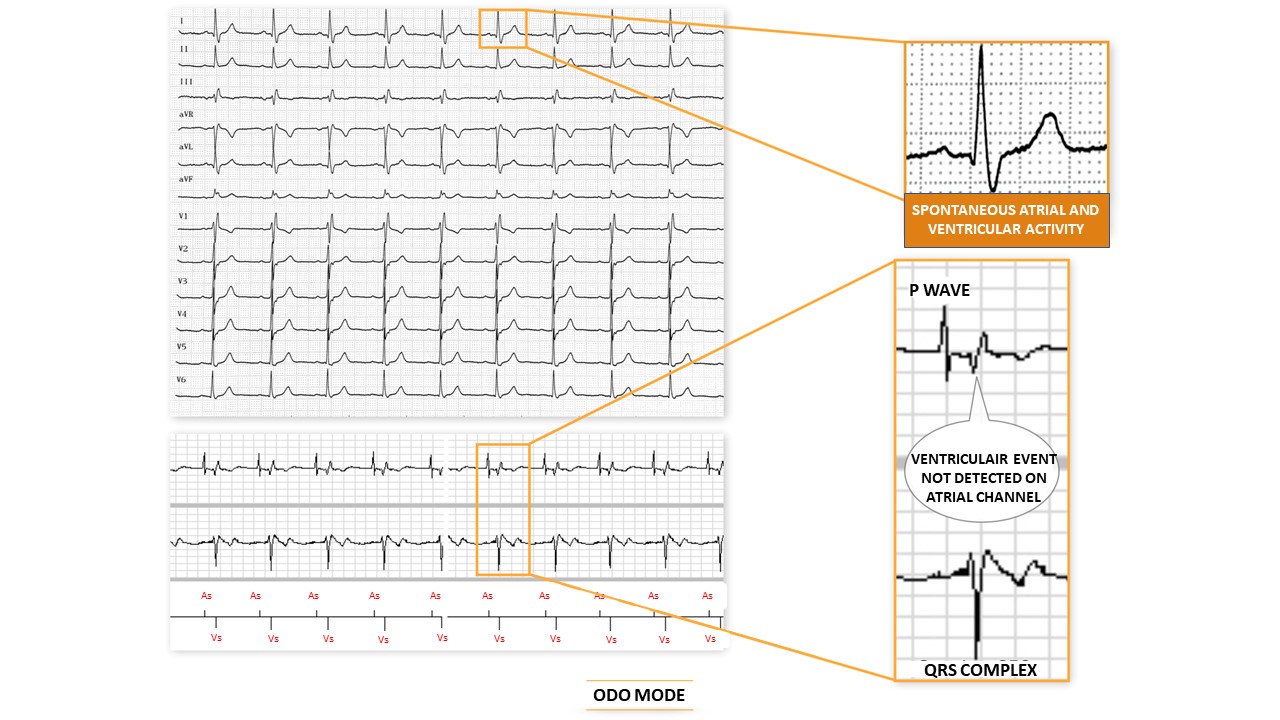
69-year-old man, implanted with a MicroPort™ Reply DR dual-chamber pacemaker for sinus dysfunction; both leads are well positioned with normal pacing impedances, proper sensing and satisfactory pacing thresholds; the day after implantation, pacemaker control; programming of different pacing modes and recording of the tracings;
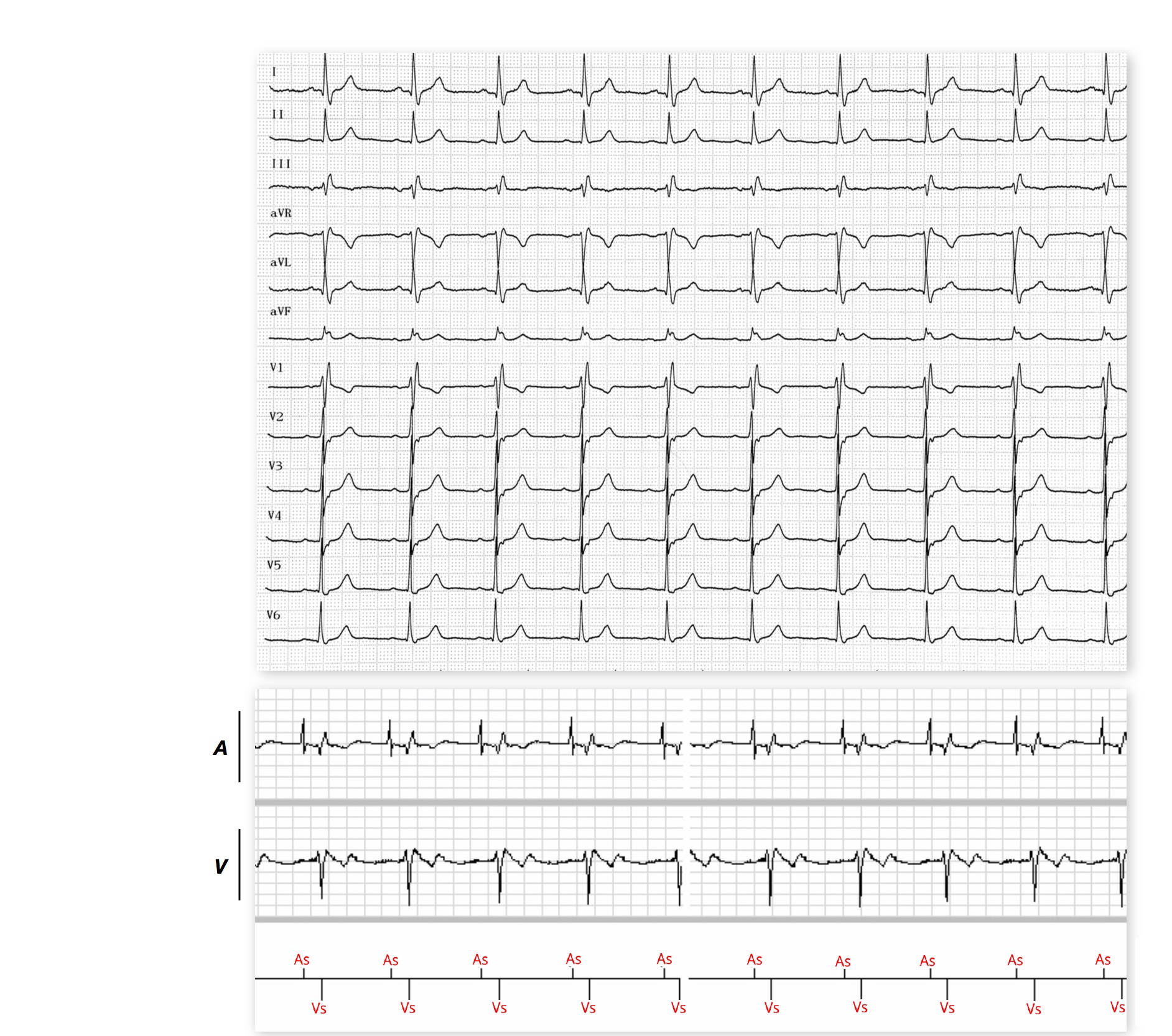
ODO mode: sinus rhythm at 60 beats/minute; normal and fixed PR interval (< 200 ms); intrinsic ventricular activity with right bundle branch block pattern (QRS 140 ms, rSR’ pattern in V1 with delayed intrinsicoid deflection, wide and slurred S wave in V6); the As marker corresponds to the sensing of intrinsic atrial activity, the Vs marker to the sensing of intrinsic ventricular activity; on the atrial channel, the imprint of intrinsic ventricular activity can be observed in conjunction with R wave sensing in the ventricular channel; this signal is not sensed in the atrial channel;
Depending on the number of leads and the implanted device model, different pacing modes are programmable. The operation as well as the advantages and disadvantages specific to each pacing mode must be understood by the physician providing the ( follow-up) in order to optimize the programming relative to the specificities of the implanted patients. A combined approach between the North American Society and the British Society of Pacing and Electrophysiology (NASPE and BPEG) has allowed defining an international classification code (NBG) for the different pacing modes. The various pacing modes are qualified by a 4-letter code enabling to understand their basic operation. The first letter defines the pacing site(s): ventricle (V), atrium (A), both (D), single-chamber (S) or none (O). The second letter defines the sensing site(s): same letters. The third letter indicates the operating mode: inhibited (I), triggered (T), both (D), none of the previous (O). The fourth letter indicates the rate response (R) or its absence (O).
On this first tracing, the pacemaker was programmed in ODO mode. The specificity of this “pacing” mode is that sensing in both chambers is effective whereas pacing (atrial or ventricular) is deactivated. This mode is therefore to be avoided in pacemaker-dependent patients. This pacing mode enables an analysis of the intrinsic rhythm of the patient with concomitant visualization of the electrocardiogram and event markers. This is a sensitivity test mode. The ODO mode can be programmed temporarily for non-dependent patients with an MRI-compatible pacemaker who are scheduled to undergo an MRI. The ODO mode of these compatible MRI pacemakers prevents the possible reversion of a conventional ODO mode to a VVI mode. Obviously, one must not forget to re-monitor and reprogram the pacemaker after the MRI exam (depending on the manufacturer
Specificities; DOO mode: no sensing capability, asynchronous pacing; ODO mode: no pacing; DDT mode: triggered mode, sensing triggers pacing; VDD mode: no atrial pacing; DDI mode: no ventricular pacing following atrial sensing; DDD mode: ventricular synchronization on atrial sensing and ventricular pacing; modes specific to each manufacturer to avoid unnecessary ventricular pacing.