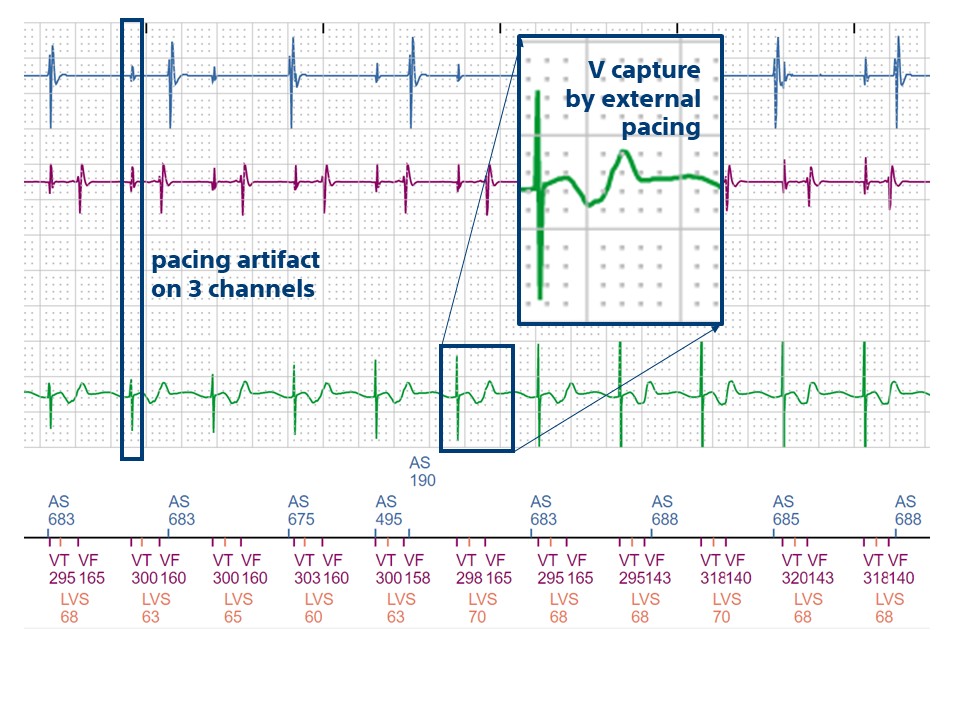
hmale implanted with a Resonate triple-chamber defibrillator; trace recorded during a TAVI implantation procedure. The surgery may be called a transcatheter aortic valve replacement (TAVR) or transcatheter aortic valve implantation (TAVI).
Summary
detection of an episode in the VT zone
sequence of bursts then ramps; 41 Joule shock but deflected impact
EGM layout
atrial sensing and biventricular pacing
sensing of a sharp signal on the 3 channels (atrial, ventricular and shock); this signal corresponds to the ventricular pacing artefact (ventricular capture visible on the shock channel); double counting on the ventricular sensing channel (pacing artefact + subsequent ventricular depolarization).
alternating VT and VF cycles; the 8/10 criterion is fulfilled for the VT zone but not for the VF zone.
end of duration for VT zone and first ATP sequence delivered
after the ATP sequences, the next therapy is a shock; capacitors begin to charge
pacing interrupted and cessation of oversensing
charge diverted (criterion 2/3 rapid cycles at end of charge not confirmed)
Take home message
aortic stenosis is the most common valvular disease encountered in Western countries, with an estimated prevalence of around 5% among people aged over 75; with an ageing of the population, the prevalence is likely to increase further
since the first percutaneous aortic valve implantation 2002, the indications for TAVI (transcatheter aortic valve implantation) have broadened considerably, resulting in an increase in the number of procedures performed worldwide.
during the TAVI implantation procedure, rapid ventricular pacing is usually delivered using a temporary lead positioned in the right ventricle to induce severe, but transient hypotension in order to reduce the risk of embolization of the prosthesis
during a TAVI implantation procedure, the implantable defibrillator must be temporarily deprogrammed in order to avoid the occurrence of inappropriate therapies (sensing of pacing artefact, rapid ventricular rhythm, etc.).
this type of epiode will typically trigger an optional Lattitude alert «Non physiological right ventricular signal detected» through. because of atleast 4 fast ventricular cycles (<=160ms) before the V-Detect marker.
This figure shows the pacing artefact on all 3 channels and ventricular capture on the shock channel during external pacing