- dual tachycardias and AF with aberrant conduction are probably the most difficult tachycardias to discriminate for a dual-chamber defibrillator; in fact, the V>A criterion does not allow a decision to be made, since in both cases the atrial rhythm is faster than the ventricular rhythm; in both cases, there is also no correlation between the vectors during tachycardia and the reference vector.
- when morphology analysis is combined with stability and the search for AF, stability determines the diagnosis when the vectors are not correlated and the atrial rate > A Fib rate threshold: if the rhythm is stable, the device diagnoses dual tachycardia and delivers therapies; if the rhythm is unstable, it diagnoses AF with aberrant conduction and inhibits therapies (as in this example)
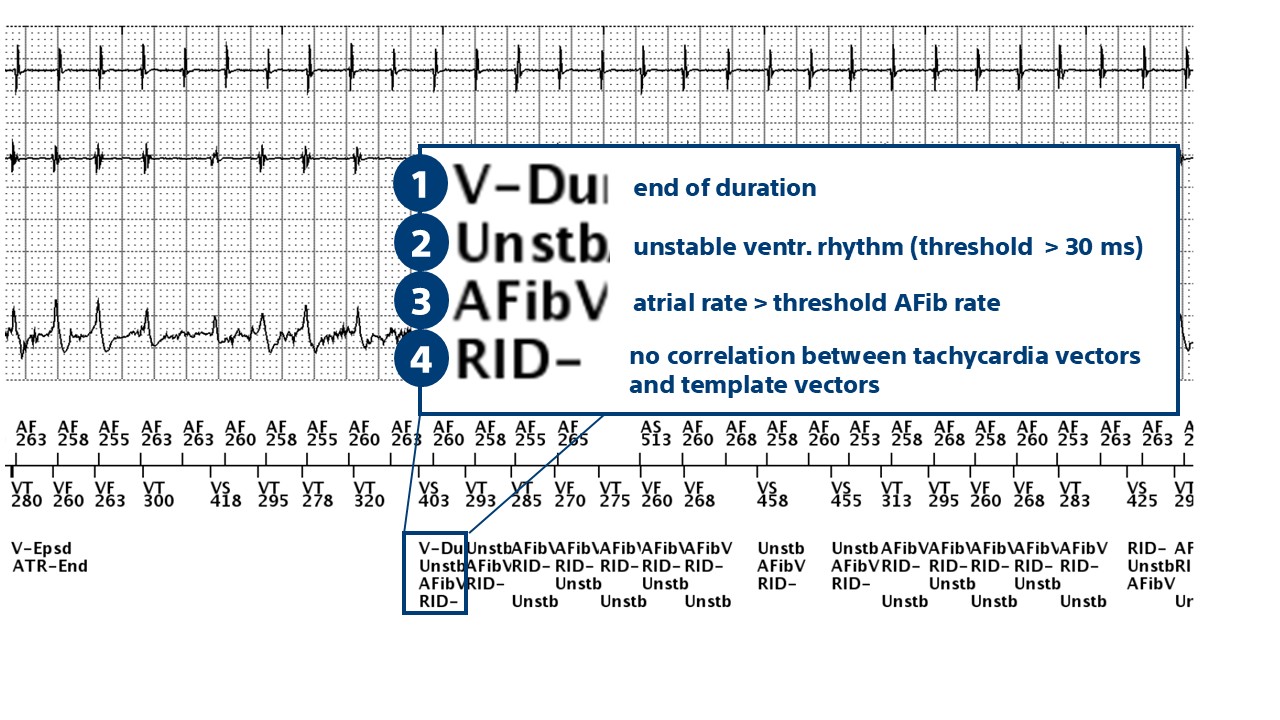
This tracing shows a characteristic appearance of atrial tachycardia with aberrant conduction: atrial activity is rapid and regular (cycles correctly classified as AF); the ventricular channel shows an irregular rhythm with a variable appearance of QRS complexes on the shock channel (narrow QRS on long cycles, wide QRS on rapid cycles); the device diagnoses AF with aberrant conduction (V>A: False, RID-, AF, unstable rhythm) and inhibits therapies.