male with ischemic cardiomyopathy; implanted with a Resonate triple-chamber defibrillator; paroxysmal AF
Summary
episode classified in the VF zone
41 Joule shock with a charge time of 11 seconds
64 Ohm shock impedance
EGM layout
AF and bi-ventricular pacing
spontaneous, very rapid, polymorphic ventricular arrhythmia detected in the VF zone
V-Epsd marker (criterion 8/10 fulfilled) for the VF zone; initial detection time for the VF zone begins
end of duration (V-Detect)
start of capacitor charging
end of charge; this charge lasted approximately 11 seconds, with the magnitude of the shock delivered corresponding to the maximum output of the device
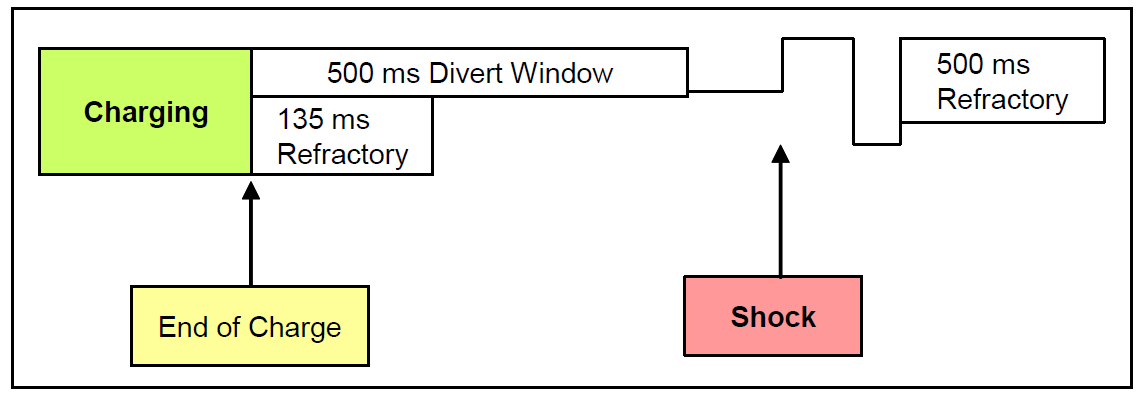
a refractory period of 135 ms begins at the end of the charge; the first cycle following this refractory period is not counted (–)
the following 2 cycles are fast (VF) but the charge diversion window has not elapsed (500 ms after the end of the charge); the shock cannot be delivered during this window and the device waits for the next cycle (the third) to deliver a synchronized shock.
shock terminates ventricular and atrial arrhythmias
the first atrial cycle and the first ventricular cycle following the post-shock refractory period (500 ms) are not counted
Take home message
at the end of capacitor charging, the diversion window begins, which lasts 500 ms; this 500 ms delay provides a minimum reaction time to activate the divert command on the programmer (opportunity for the doctor to cancel the shock from the programmer)
the first 135 milliseconds of this diversion window corresponds to a refractory period when no atrial or ventricular sensing is possible; the ventricular cycle following this refractory period is not counted (–); operation then differs according to programming (Shock not reconfirmed On or Off)
if the Shock not reconfirmed function is set to On, the shock is systematically delivered synchronized to the first sensed R-wave following the 500 ms delay at the end of capacitor charging (whether the arrhythmia is sustained or not); if no R-wave is sensed within 2 seconds of the end of charging, the ventricular shock is administered asynchronously at the end of the 2-second delay
if the Shock not reconfirmed function is set to Off, following the uncounted cycle, the device measures the next 3 intervals and compares them with the minimum rate threshold ; if 2 of the 3 intervals have a rate higher than the lowest rate threshold (lowest programmed tachycardia zone: VF zone if only 1 zone programmed, VT zone if 2 zones and VT-1 zone if 3 zones), the shock is delivered synchronized to the second rapid event; if 2 of the 3 intervals have a rate below the lowest rate threshold, the shock is not delivered; if there is no sensed beat, pacing begins at the programmed lower rate after a period of 2 seconds and the charge is diverted.
in this example, it can be seen that the shock is synchronized to the third fast cycle; in fact, even if the 2 cycles that follow are fast (VF), the charge diversion window has not elapsed when the second fast cycle occurs (less than 500 ms after the end of charging); the shock cannot be delivered during this diversion window; the device therefore waits for the next cycle (the third) to deliver a synchronized shock.
following a shock, there is a non-programmable refractory period of 500 ms
This figure shows the divert window at the end of the charge (500 ms with an initial refractory period of 135 ms) and the 500 ms refractory period following the shock.