- in a Boston Scientific defibrillator, 1, 2 or 3 detection zones can be programmed; the rate thresholds of adjacent zones must differ by at least 20 beats/minute ; in a double- or triple-chamber defibrillator, the rate threshold of the VT zones must be at least 5 beats/minute higher than the maximal tracking rate (MT) and the sensor indicated rate (FMC); in a single-chamber defibrillator, the rate threshold of the VT zones must be at least 15 beats/minute higher than the lower rate limit (Fmin).
- if several detection zones are programmed, each zone has its own detection window; a cycle in a faster zone (VF for VT, for example) increments its zone counter (VF) as well as that of the slower zone (VT and VT-1); when the 8 fast cycles/10 criterion is met for one of the zones, the initial detection criterion is met
- different durations can be programmed for each detection zone; the duration of each zone ends independently of the others; the duration of the faster zones must be shorter than (or equal to) those of the slower zones; if criterion 8/10 is met for the VT zone first and then for the VF zone, the 2 durations continue in parallel; if the VT zone duration ends while the VF zone duration is in progress (criterion 6/10 met in the VF zone), no therapy is delivered before the end of the VF zone duration; if criterion 6/10 is no longer met for the VF zone, as in this example, the VT zone therapies are delivered.
- if the device diagnoses a VT episode and delivers an ATP sequence, and if criterion 8/10 is then verified for the VF zone (acceleration of arrhythmia), the redetection time (1 second in VF zone) of the VF zone and not the initial time (often programmed at a longer interval) is applied so as to not delay the onset of therapies
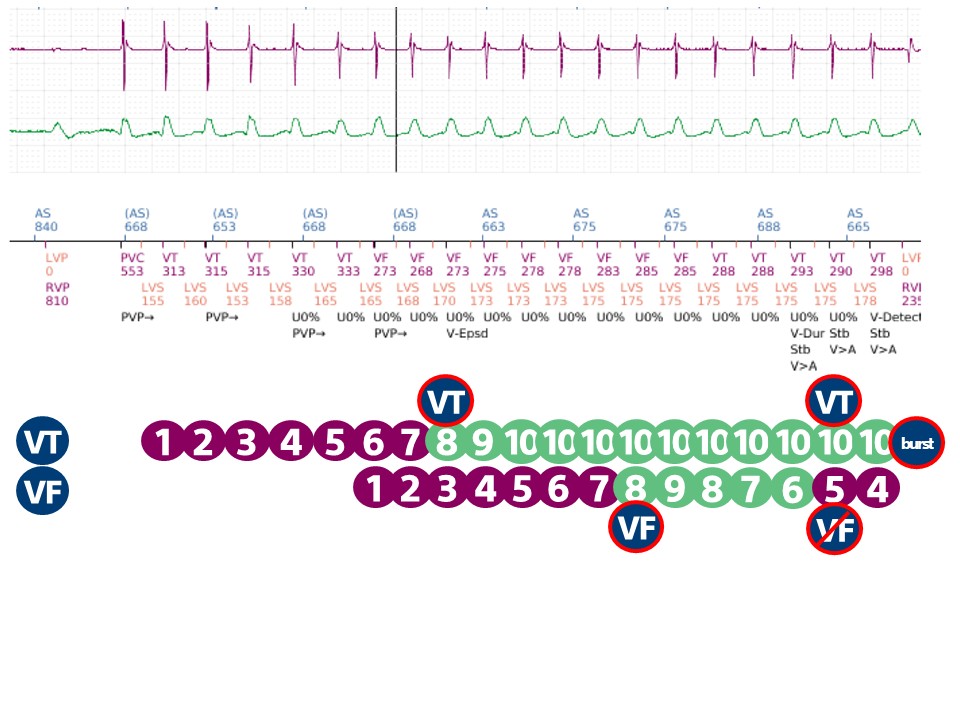
This figure shows that the 8/10 criterion for the VT zone is initially met, then this criterion is also met for the VF zone; at the end of the VT zone duration, the VF zone duration is still active and VT zone therapies are not delivered; the 6/10 criterion for the VF zone is then no longer fulfilled and the burst (first programmed VT zone