


ATP burst in the VF zone - Autogen ICD

Patient

  • 72-year-old male with a dilated cardiomyopathy; implanted with an Autogen dual-chamber defibrillator


Summary

  • episode classified in the VF zone
  • ATP in the VF zone
  • 2 shocks of 41 Joules


EGM layout

  1. sinus rhythm
  2. regular, monomorphic VT detected in the VF zone
  3. initial detection satisfied for the VF zone (8 cycles out of 10 in FV zone); start of initial VF zone duration (1 second)
  4. detection of a VF episode (V-Detect); ventricular rate measured over the 4 cycles preceding the V-Detect marker is below 250 beats/minute (229 bpm)
  5. ATP Quick Convert: burst of 8 stimuli at a fixed rate (identical coupling between the last sensed cycle and the first paced cycle, then between the different paced cycles).
  6. the first atrial and ventricular cycles following ATP are not counted (–)
  7. the device analyzes the effectiveness of the ATP sequence: the first 2 cycles are considered slow (VS); the 2 cycles/3 slow criterion is therefore met and capacitor charging is diverted (dvrt)
  8. end of episode (V-EpsdEnd marker)
  9. recurrence of the same VT
  10. ATP Quick Convert (burst of 8 impulses at fixed frequency)
  11. the first atrial and ventricular cycles following ATP are not counted (–)
  12. the device analyzes the effectiveness of the ATP sequence: the first 2 cycles are considered fast (VF-VT); the 2 cycles / 3 fast criterion is therefore met and capacitor charging begins (Chrg)
  13. end of charge, 500 ms diversion window; shock on the second fast cycle
  14. effective shock and return of sinus of rhythm
  15. recurrence of an identical VT before the end-of-episode criterion (30 seconds after the shock has been delivered)
  16. end of duration; even if the rate is below 250 bpm, the ATP sequence in the VF zone cannot be delivered (only 1 sequence for a single episode, as the current episode has not ended).
  17. capacitor charging
  18. shock and arrhythmia termination


Take home message

  • although it is clear that delivering a shock during an episode of ventricular fibrillation is the only therapy likely to restore a viable rhythm for the patient, optimal programming must ensure that the number of shocks delivered (inappropriate or appropriate but avoidable) by the device is minimized as much as possible
  • a shock is painful when delivered to a conscious patient, and significantly increases energy consumption; the succession of several shocks to the same patient is therefore associated with a risk of premature battery depletion and a marked deterioration in quality of life (numerous cases of depression or anxiety induced by a series of shocks have been described)
  • an endocardial shock is accompanied by microscopic myocardial lesions, an increase in cardiac humoral markers (troponin, CPK, myoglobin) and macroscopic lesions that are more significant with higher energy delivery (momentary drop in left ventricular ejection fraction and cardiac output, particularly in patients with already impaired contractility)
  • a significant correlation has been found between mortality and the number of shocks delivered (notion of paradoxical shock effect); in the Sudden Cardiac Death in Heart Failure Trial (SCD-HeFT) and MADIT II studies and in a meta-analysis of 4 large studies, patients who received one or more appropriate or inappropriate shocks had significantly increased mortality; the main cause of death after shocks was a worsening heart failure; in contrast the meta-analysis found that delivering one or more sequences of anti-tachycardia pacing did not alter prognosis
  • whether shocks are really an independent predictor of mortality, or simply a marker of the severity of the patient’s clinical condition, remains controversial; however, it is now recommended (class I) that anti-tachycardia pacing should be used as a first-line attempt at termination, up to relatively high heart rates (230 beats/minute); electric shocks are only proposed as a second-line treatment after failure of anti-tachycardia pacing, unless anti-tachycardia pacing has proved ineffective or deleterious (acceleration of arrhythmia); in fact, delivering an anti-tachycardia pacing sequence in a VF zone is often effective, painless, reduces battery consumption, improves quality of life and does not alter prognosis
  • the PainFree II study demonstrated the effectiveness of anti-tachycardia pacing on tachycardias between 188 and 250 beats/minute, reducing the number of shocks delivered (71% relative risk reduction) without significantly increasing the risk of syncope or sudden death; the Prepare and Relevant studies confirmed these results
  • it is recommended to program a burst rather than a ramp (class I) to optimize the success rate (ratio between termination and acceleration)


Once the burst has been delivered, the device analyzes the rhythm: if the arrhythmia persists, charging of the capacitors begins; if the arrhythmia has stopped, charging does not begin.

The device uses the following criteria to assess burst efficacy:
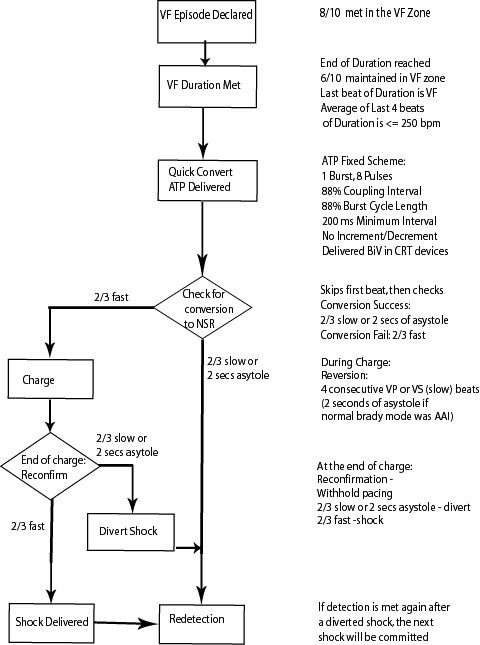
  • the first cycle following the burst is not counted; if a 2-second asystole (no ventricular sensed event) is observed, shock treatment is diverted (not the charge) and the device switches to re-detection
  • if 2 out of 3 intervals after the burst are faster than the lowest rate threshold (lower limit of the lowest programmed detection zone) , the arrhythmia is considered persistent and charging begins
  • if 2 out of 3 intervals are slow, shock treatment is diverted (not the charge) and the device switches to redetection


This figure shows how the Quick Convert algorithm works (anti-tachycardia pacing in the VF zone).

X