62-year-old male implanted with a Momentum CRT defibrillator
Summary
episode classified in the VT zone
1 burst
EGM layout
spontaneous atrial rhythm and biventricular pacing
regular, monomorphic ventricular tachycardia (atrioventricular dissociation) diagnosed in the VT zone
V-Epsd after 8 out of 10 cycles in VT or VT-1 zone
start of initial VT zone duration (12 seconds)
diagnosis of sustained VT (V-Detect) at end of duration (V>A)
burst of 10 complexes at fixed cycle length; biventricular pacing
effective burst and arrhythmia termination
Take home message
a priority when programming an implantable defibrillator is to reduce the number of shocks delivered as much as possible without compromising patient safety; the ideal scenario is to interrupt the tachycardia with the least aggressive and least painful therapy possible; anti-tachycardia pacing is therefore the preferred first-line therapy for organized reentrant tachycardias since it is less painful and reduces battery consumption compared to shocks.
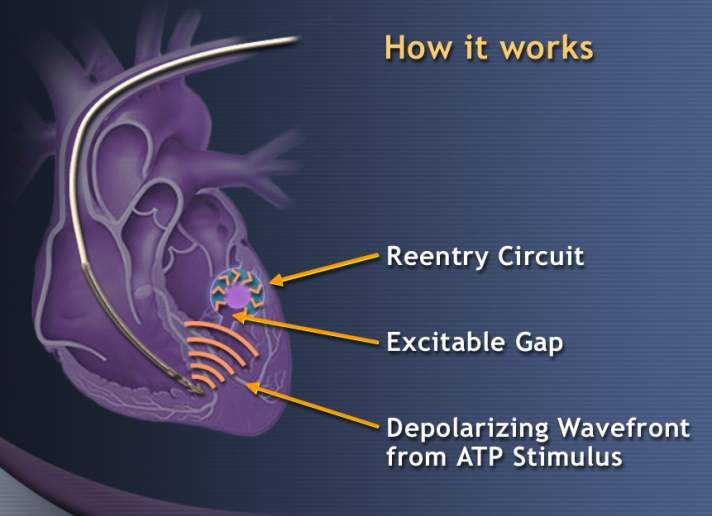
the basic principle of anti-tachycardia pacing is based on the existence of an excitation window in a reentrant circuit during which rapid pacing can generate a new activation front that collides with the tachycardia circuit and interrupts it; the ventricle must therefore be paced at a higher rate than the tachycardia
the efficacy of this type of therapy has been demonstrated for a wide range of ventricular tachycardia rates up to 240 beats/minute; anti-tachycardia pacing terminates around 90% of ventricular tachycardias with rates below 200 beats/minute, with a moderate risk of acceleration on the order of 1 to 5%.
these observations have repositioned the implantable «defibrillator» as a first-line treatment for arrhythmias through rapid pacing, with the possibility of defibrillation as a back-up only.
one or more ATP sequences can be programmed empirically, without the need for prior electrophysiological testing of efficacy
this patient presented with numerous episodes of VT effectively treated by anti-tachycardia pacing; rapid and effective treatment by pacing enabled the patient to remain asymptomatic with a preserved quality of life while preserving the battery’s longevity
This figure shows how antitachycardia pacing works. Scan the QR code to see a Youtube video made by Dr. Joshua Cooper clearly explaining how ATP works with animations.