Aborted charge
Patient
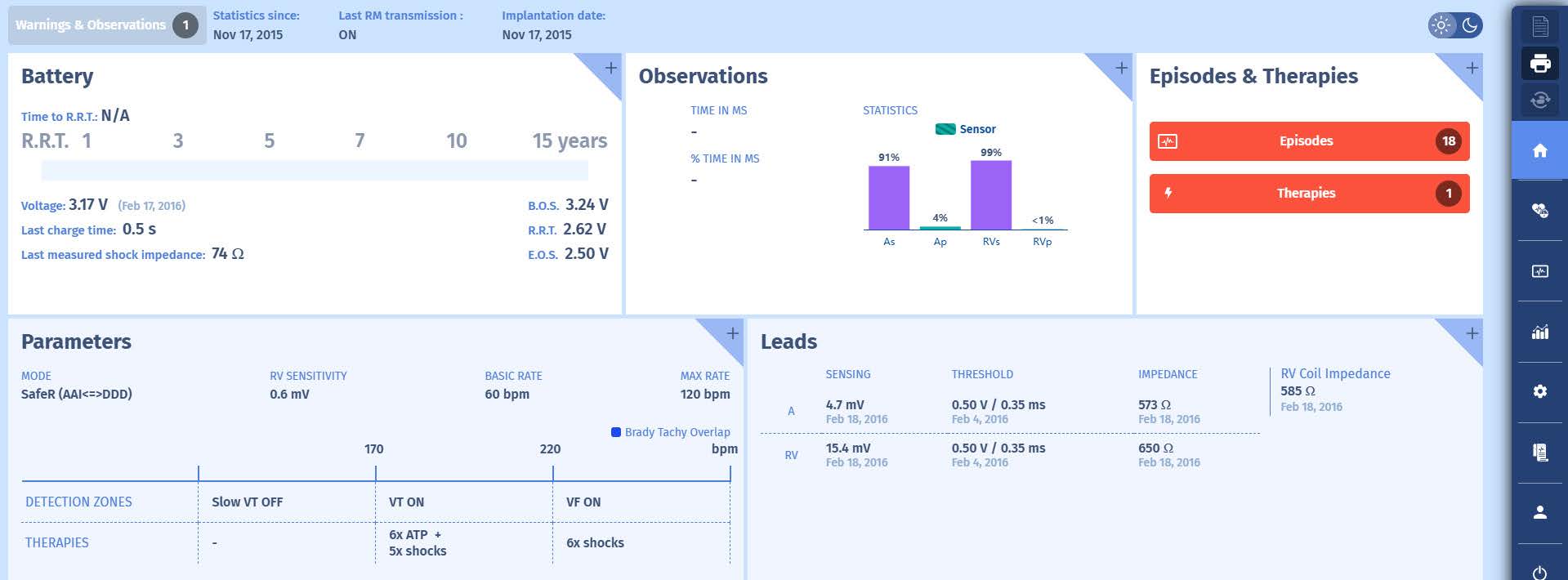
70-year old patient with ischemic cardiomyopathy implanted with a dual chamber ICD comes into office for a device check-up.
EGM
 Rate interval plot
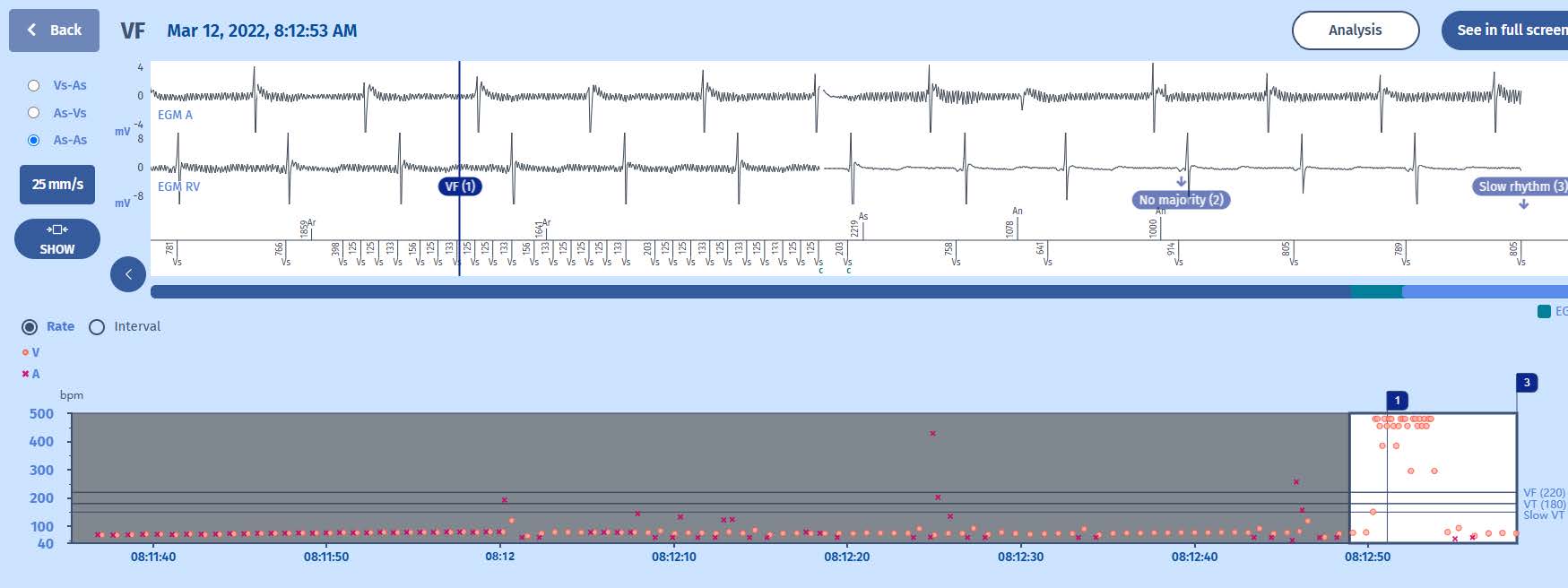
In the beginning there is slow atrial and ventricular rhythm with some isolated fast events.Suddenly there is an extremely fast rhythm with ventricular cycles so high in the VF zone that
they are close to the blanking period. We see a sudden-ON and sudden-OFF phenomenon. Theseaspects are typical for interference from an external source, probably the electrical grid (50 Hz
noise).
EGM
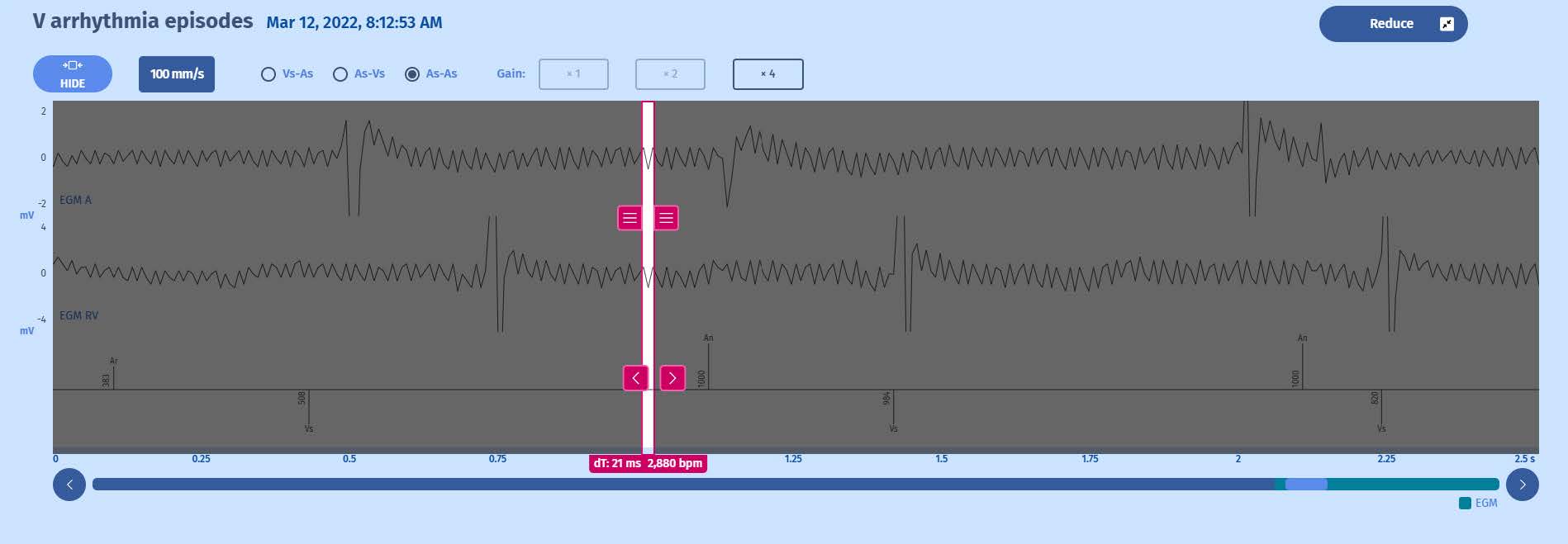
When we look closely to the EGM, we see a very fast organized signal within a certain bandwidth (no clipping) on both the atrial and the ventricular channel. When we zoom (100 mm/sec), we can see that the “cycle length” of this signal is around 20 ms, making it a 50 Hz signal, typical for theelectrical grid in Europe.
Comments
The electrical grid is associated with a 50 Hz signal (in Europe, in the USA it is 40 Hz) which may be oversensed by ICDs when the patient is in contact. This may occur when the patient is in
skin contact with the powergrid. Often because of insufficient isolated electrical appliances or through wet surfaces which are somehow connected to the electricity. While there are filters
in place which attempt to avoid oversensing of these extremely fast signals, there is still a risk of inappropriate therapy. Since these signals may have significant amplitude and are always
extremely fast, altering the sensitivity or the zones is often of little use. The only solution is to interrogate the patient on what activities were performed during the oversensing episode, in
an attempt to identify the source. This activity (for example cleaning a poorly isolated caravan) should then be avoided in the future. Remote monitoring is perfect for this, as these episodes
may be transmitted as an alert, and the remote monitoring staff may interrogate the patient soon after the episode, increasing the possibility that the patient remembers the activity. While
oversensing of 50 Hz may be associated with an inappropriate shock (not so much ATP because too fast), the patient will most often stop the activity at once, eliminating the risk of suffering
from multiple shocks.
Take home message
It is important to recognize these typical patterns of 50 Hz, in order to quickly identify andexclude the source, as these episodes have a high risk of inappropriate shock (very fast and ample signals).