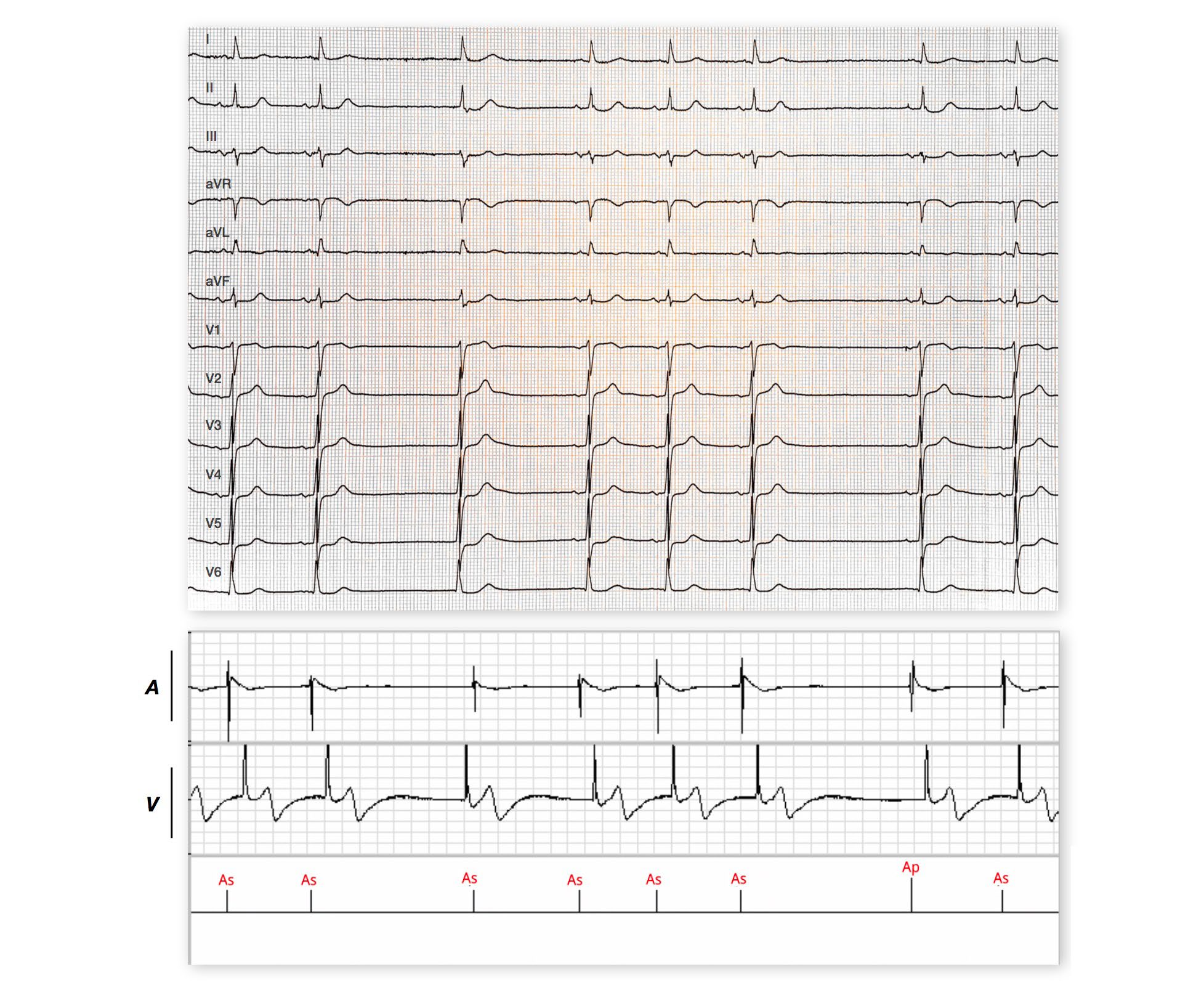
62-year-old man implanted with a Kora 100 DR MicroPort™ dual-chamber pacemaker for sinus dysfunction; both leads are well positioned with normal pacing impedances, proper sensing and satisfactory pacing thresholds;
Tracing Analysis
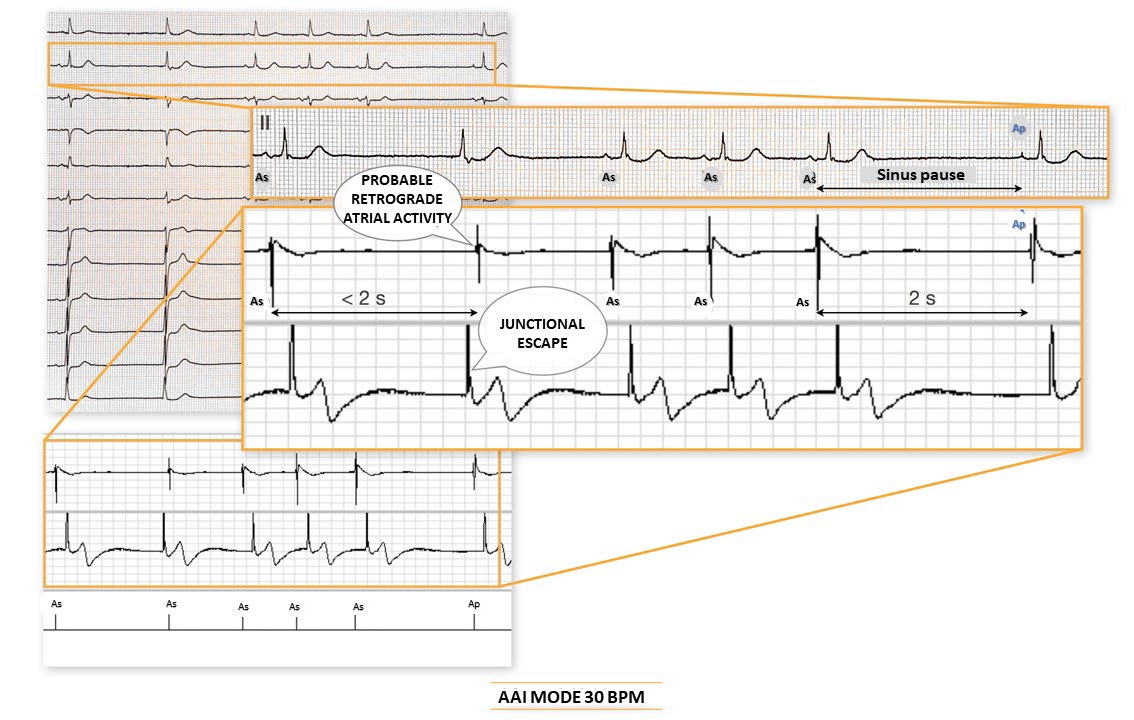
AAI mode 30 beats/minute: initially, sinus activity (P) is faster than the minimum rate; first sinus pause with junctional escape; second pause with atrial pacing (Ap) after 2 seconds which corresponds to the minimum rate;
Comments
A single-chamber pacemaker operates in AAI mode when only one lead is positioned in the atrium; AAI mode can also be programmed in a dual-chamber pacemaker. These tracings allow to highlight the main characteristics of this pacing mode: • sensing and pacing of the atrium, inhibition on an intrinsic atrial event; the preferred indication is therefore pure sinus dysfunction without ventricular conduction disorder. An AAI pacemaker allows 1) to limit the number of implanted leads, 2) to ensure a physiological rate both at rest and during exercise after programming the rate response function and 3) to avoid any unnecessary ventricular pacing. • absence of ventricular sensing or pacing. Single-chamber AAI pacemakers or AAI mode programming on a dual-chamber pacemaker are formally contraindicated in patients with permanent or paroxysmal atrioventricular conduction disorder. Similarly, it is preferable not to use the AAI mode in instances of long PR interval, intraventricular conductive disorder, low Luciani-Wenckebach point, long HV. This mode should also be avoided in patients with vagal symptoms or carotid sinus syndrome. When the pacemaker operates in AAI mode, it may be necessary to program operation; indeed, the amplitude of the atrial complexes is most often weaker period may be programmed longer to prevent ventricular oversensing by the a decrease in the pacing rate, because each sensed R wave recycles the escape possible to lower the sensitivity of the pacemaker and/or to prolong 3344
A recent study reported unfavorable results for the implantation of a single-chamber AAI pacemaker compared to the implantation of a dual-chamber pacemaker in patients with sinus dysfunction. Indeed, the rate of re-intervention is greater in patients implanted with an AAI pacemaker with the need to add a ventricular lead secondary to the occurrence of an atrioventricular conduction disorder. Current indications for implantation of a single-chamber pacemaker AAI are therefore relatively limited. a higher sensitivity (lower programmed value) than for VVI than that of the ventricular complexes. Similarly, the refractory atrial lead. The sensing of an R wave by an AAI pacemaker causes interval. In the presence of far-field (sensing of the R wave) it is the refractory period to encompass ventricular activity.