
Chapter 2 · Therapies · Case 4
Anti-tachycardia pacing in the VF zone and conserving energy
Patient and episode
Patient
- Same patient as the previous trace. Male implanted with a triple chamber defibrillator (Viva Quad CRT-D) for ischaemic cardiomyopathy.
The recording
Tap a number on the trace, or an entry in the list below
Rate / interval plot
EGM

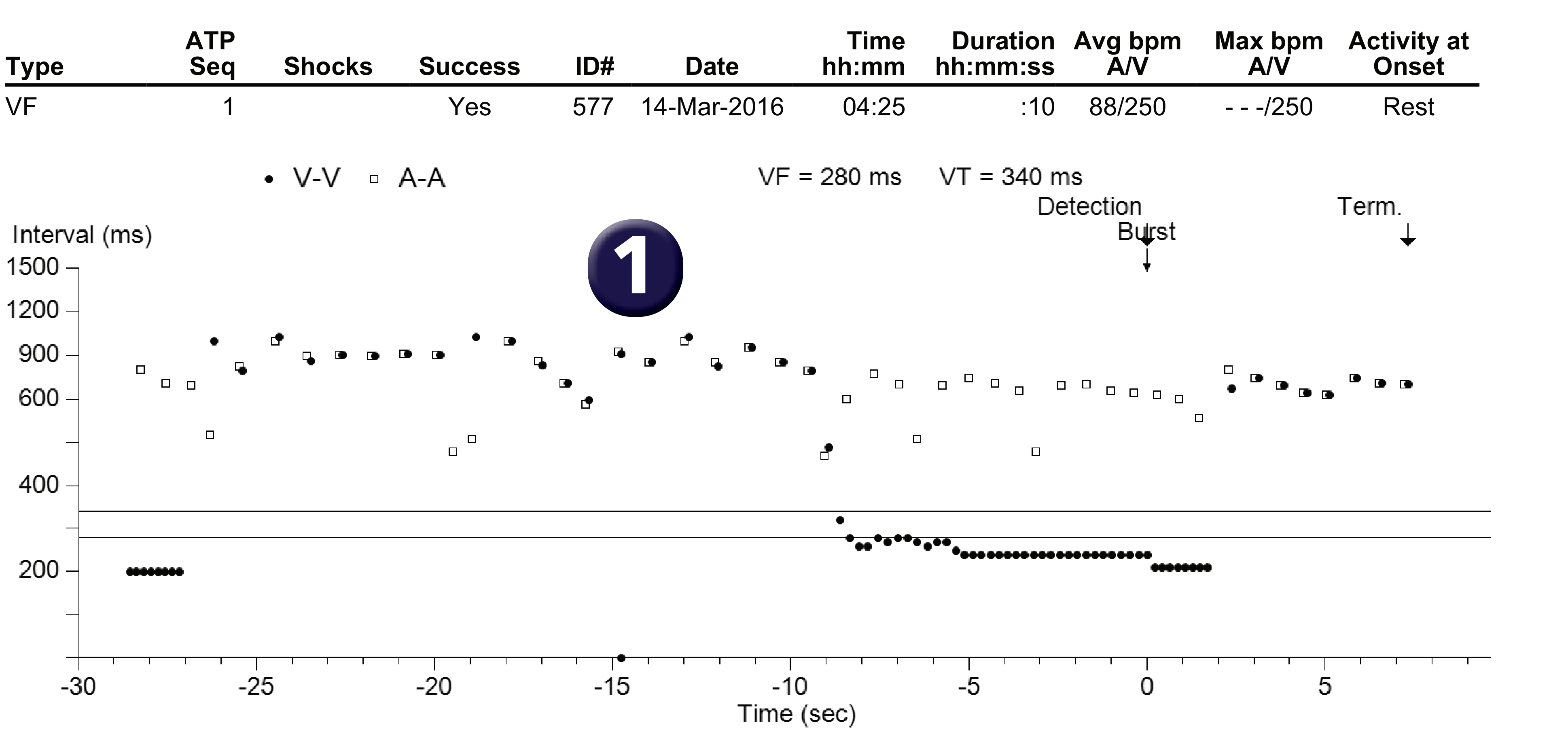
- What diagnosis are you suggesting on this graph? Probable episode of monomorphic VT detected in the VF zone and treated by a burst which appears to be effective.
- What therapy is delivered by the device? The episode is detected in the VF zone; when the initial VF counter is full, a burst before charging is delivered.
- Has the device charged its capacitors? No, this is a burst before charging; when the burst is effective, the device does not charge its capacitors.
Points to remember
- 2 options are available in the VF zone: ATP during charging or ATP before charging.
- ATP during charging enables ventricular tachycardias to be treated painlessly without the risk of delaying shock therapy; once the diagnosis of VF has been established, charging begins and ATP is delivered simultaneously; if VF is reconfirmed after ATP, the shock is delivered ; if the patient has returned to sinus rhythm, the shock is not delivered; this makes it possible to treat the tachycardia painlessly if ATP is effective, without delaying the onset of the shock if the ATP is ineffective; on the other hand, even if ATP is effective, there is virtually no energy saved.
- ATP before charging reduces energy consumption; once VF has been diagnosed, ATP is delivered; if VF is reconfirmed after ATP has occurred, capacitors begin charging; if the arrhythmia is terminated, charging is not initiated; therefore this saves capacitor charging if ATP is effective; on the other hand, if ATP is ineffective, it delays the shock delivery by a few seconds.
- The device only delivers ATP before or during charging if the last 8 ventricular cycles detected are equal to or longer than the programmed value («deliver ATP if the last 8 RR intervals are ≥»); if charge saver is programmed, the device automatically switches from ATP during charging to ATP before charging if the former has been effective over a programmable number of consecutive episodes.
Practice out loud
Just describe the tracing. What do you think is going on? Describing the numbers can help.
00:00
0%
—
From Medtronic ICD — clinical cases by P. Bordachar, A. Thiyagarajah, L. Fontagne, M. Strik, S. Ploux. Published by Cardiocases. Every numbered marker on a recording is explained in the list beneath it; tap a marker on the trace or an entry in the list.
Order hardcopyon Amazon