
Chapter 3 · Oversensing · Case 10
Ventricular cycles too short to be physiological
Patient and episode
Patient
- Male implanted with a triple-chamber defibrillator (Claria MRI Quad CRTD); NSVT episodes recorded in memory.
The recording
Tap a number on the trace, or an entry in the list below
Rate / interval plot
EGM

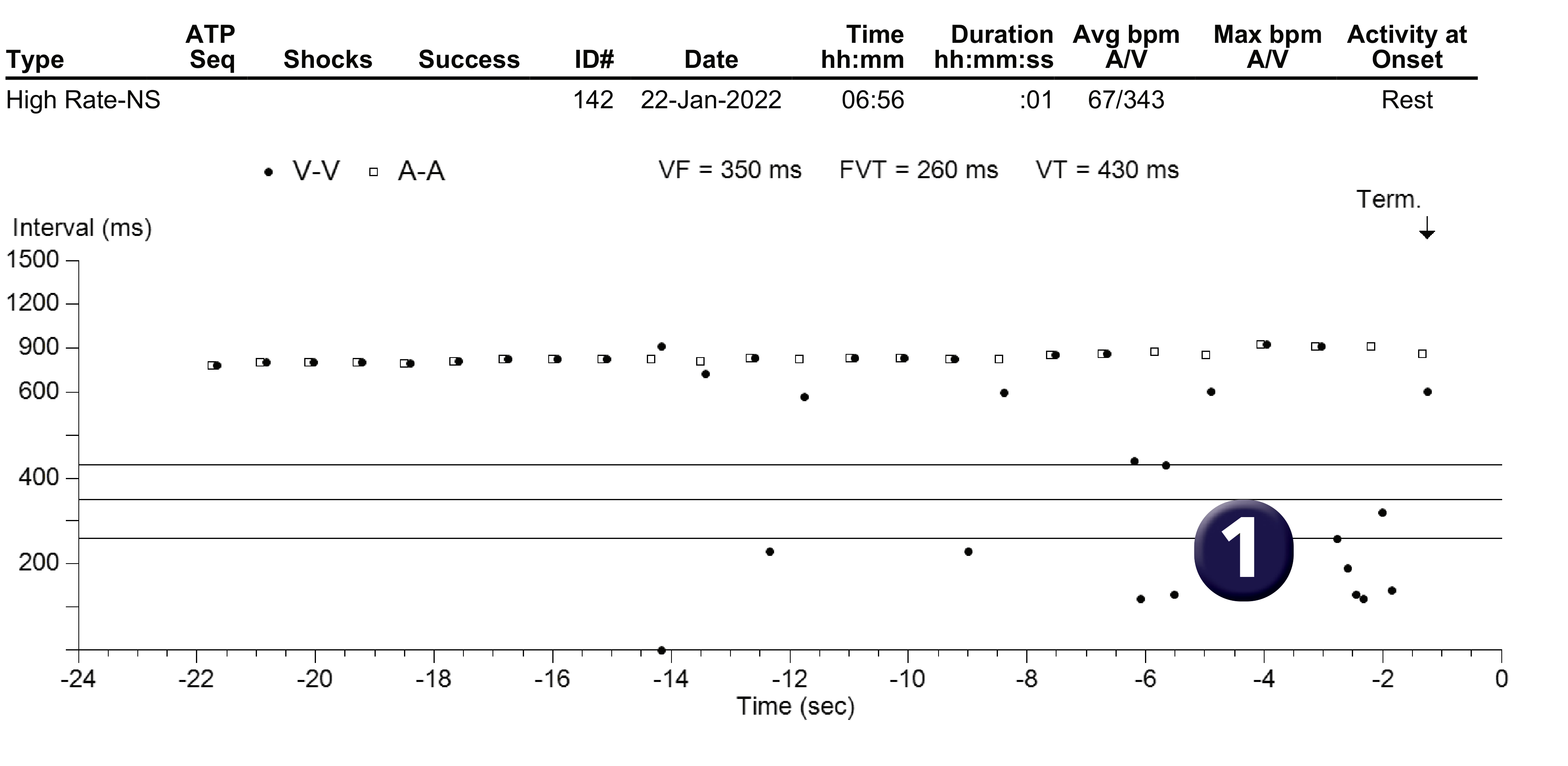
- Is the appearance of the interval plot in favour of an episode of non-sustained ventricular arrhythmia? The plot shows detection of a few rapid cycles followed by detection of a succession of cycles in the VF zone explaining the diagnosis of NSVT; the fact that some cycles are extremely short at the blanking limit of 120 ms and the duration of cycles varies from one cycle to another makes the diagnosis of true ventricular arrhythmia rather unlikely and instead suggests a problem of oversensing.
- How do you analyse these complexes? The EGM shows non-physiological signals on the ventricular channel; the cycle length is clearly non-physiological with an interval corresponding to the limit of the programmed blanking; the signal is of large amplitude, it saturates the amplifiers and is characteristic of a ventricular lead fracture; these signals are called ‘make-break’ potentials.
- How do you analyse this salvo? This appearance is also highly suggestive of lead fracture, with the detection of NSVT with very short cycles and a characteristic EGM appearance.
Points to remember
- The ventricular lead is the weak link in the defibrillation system, with the number of malfunctions varying from model to model.
- Following a lead fracture, the diagnosis must be made as quickly as possible to avoid inappropriate therapies and to ensure that the system remains effective during an episode of ventricular arrhythmia.
- The systematic use of remote monitoring has considerably reduced the time between onset of dysfunction and diagnosis, resulting in a major reduction in adverse outcomes.
- Various manufacturers have proposed different algorithms for early diagnosis and/or inhibition of therapy when the diagnosis of ventricular oversensing due to lead dysfunction is made.
- LIA (Lead Integrity alert) is an algorithm incorporated into all modern MedtronicTM defibrillator platforms, enabling early diagnosis and a rapid alert in the vast majority of lead dysfunction cases.
- The pattern observed in this patient is highly suggestive of recent lead dysfunction with oversensing of very short cycles and false episodes of NSVT with rapid cycles; lead dysfunction can also be associated with impedance variations, although this often occurs later than oversensing of non-physiological signals.
- The LIA algorithm has been developed to generate an alert when lead dysfunction is suspected and to delay the onset of therapy by monitoring bipolar and integrated bipolar impedances, the frequency of episodes of non-sustained VT and the frequency of very short ventricular cycles; lead dysfunction is suspected if at least 2 of the following 3 criteria are met over the last 60 days: 1) the pacing impedance in one of the 2 polarities (bipolar and/or integrated bipolar) is 50% lower or 175% higher than a baseline value corresponding to the median of the previous 13 daily measurements; 2) the ventricular sensing integrity counter (short ventricular intervals ≤ 130ms) has incremented to at least 30 over a period of 3 consecutive days; 3) the device has detected 2 episodes of rapid non-sustained VT with an average RR interval over 5 beats of less than 220ms.
- When lead malfunction is suspected, the device transmits a specific telemedicine alert, an audible alert is emitted every 4 hours until the defibrillator is interrogated and the number of intervals required for detection is automatically extended to 30/40 to delay (but not prevent) the occurrence of inappropriate therapies.
Practice out loud
Just describe the tracing. What do you think is going on? Describing the numbers can help.
00:00
0%
—
From Medtronic ICD — clinical cases by P. Bordachar, A. Thiyagarajah, L. Fontagne, M. Strik, S. Ploux. Published by Cardiocases. Every numbered marker on a recording is explained in the list beneath it; tap a marker on the trace or an entry in the list.
Order hardcopyon Amazon