
Chapter 4 · Keeping up the CRT · Case 10
Sinus tachycardia, Wenckebach and pro-arrhythmia
Patient and episode
Patient
- COGNIS CRT-D in a 61-year-old man with ischaemic cardiomyopathy and left bundle branch block
- Seen after a shock felt during exertion at night
The recording
Tap a number on the trace, or an entry in the list below
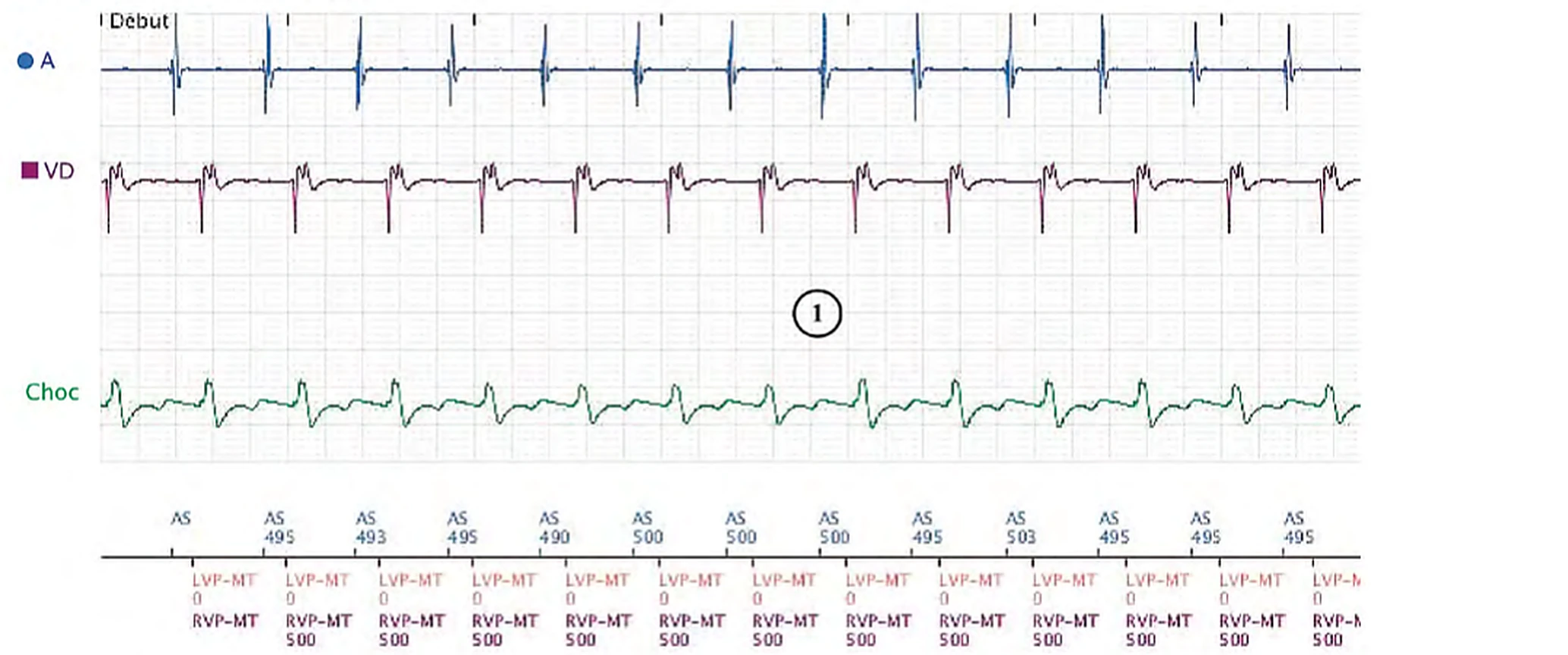
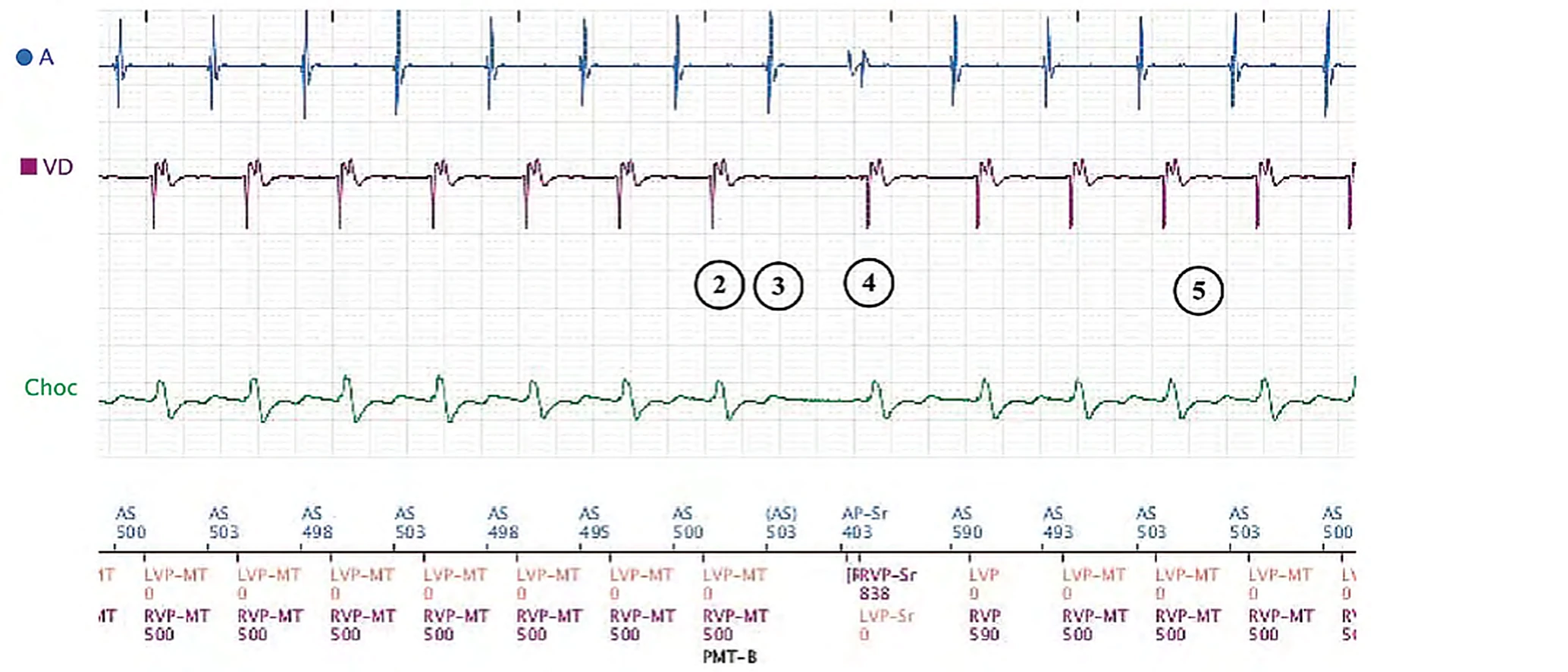

- First stored episode, diagnosed as PMT (A 121, V 120 bpm). Each atrial event is sensed (AS 490 to 503 ms) and both ventricles are paced at the maximum tracking rate: LVP-MT and RVP-MT at 500 ms (120 bpm)
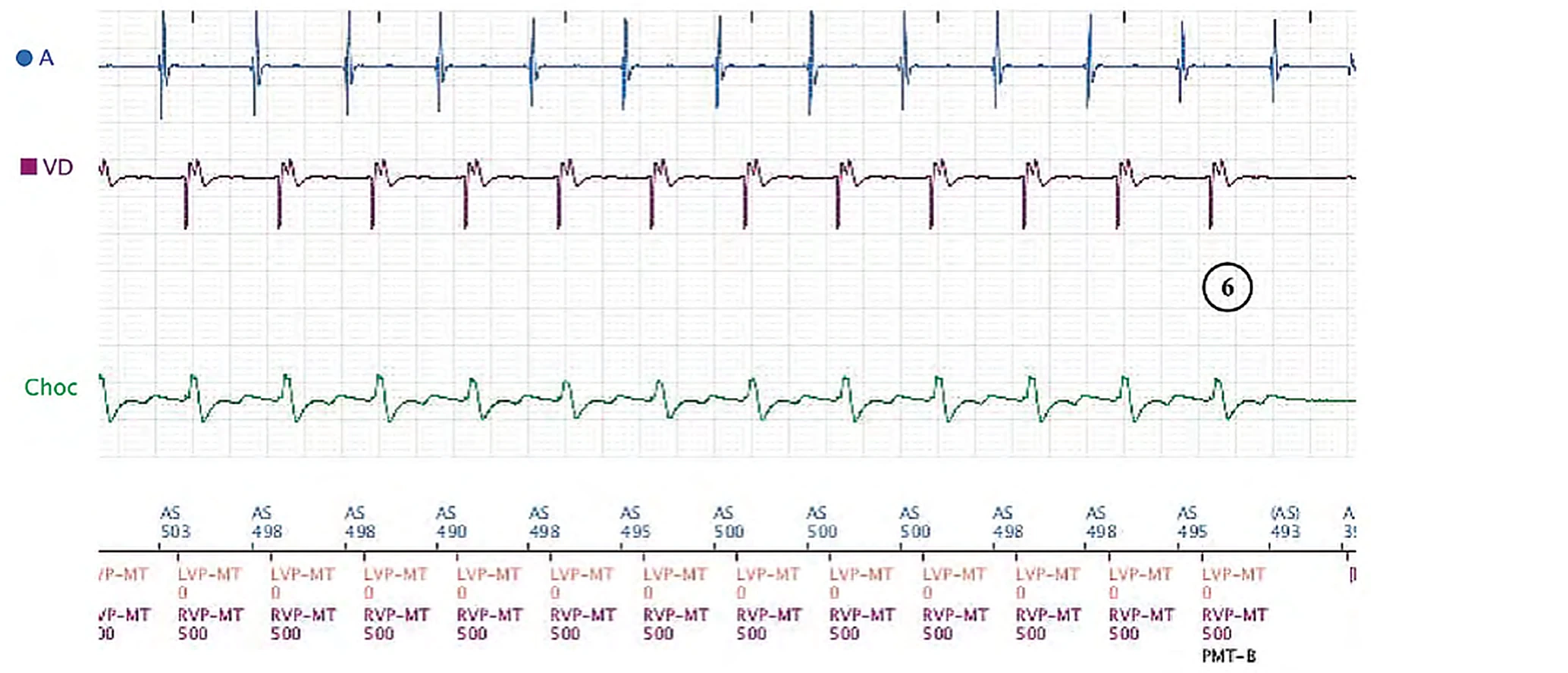
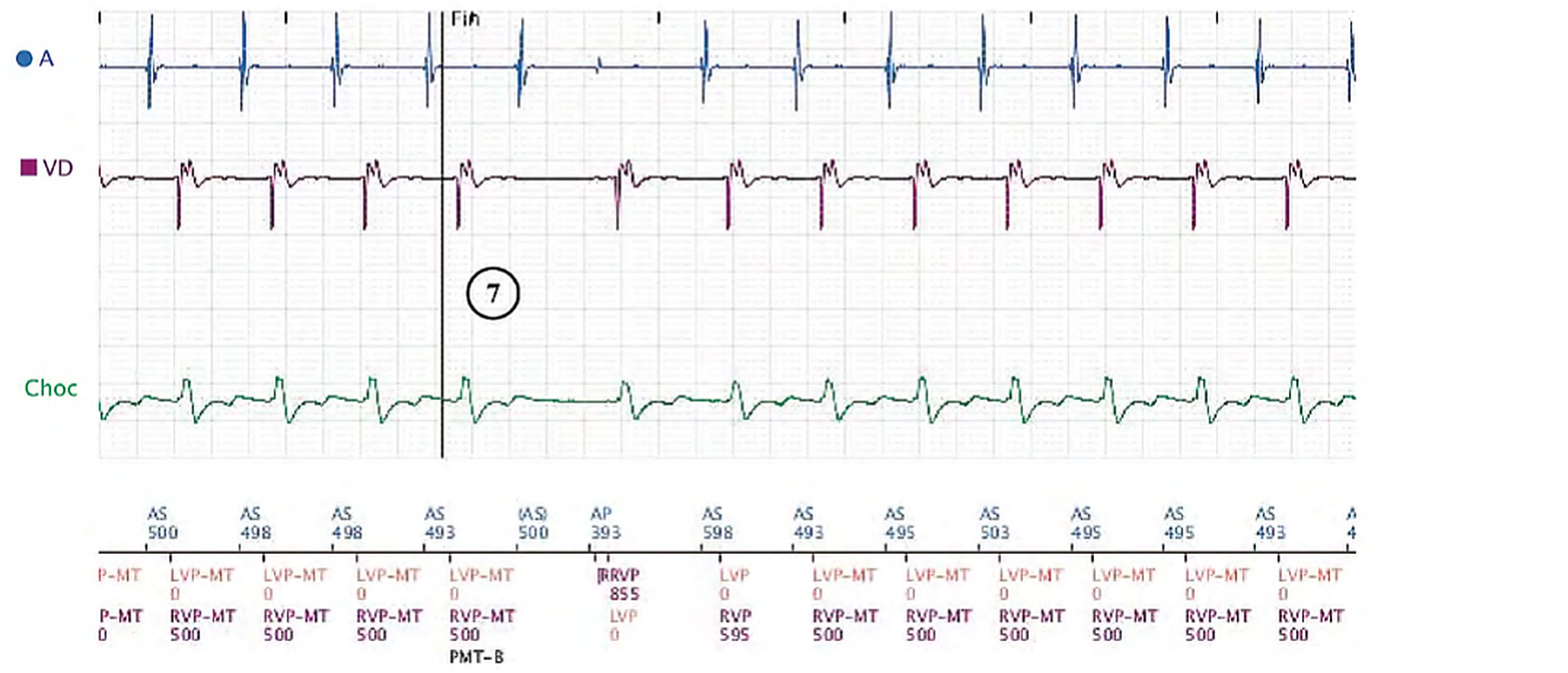
- After 16 consecutive AS – BiV cycles at the maximum rate, with a stable BiV-AS interval, the device diagnoses a PMT (PMT-B)
- The PVARP is extended to 500 ms for one cycle: the next atrial event falls in it ((AS) 503) and starts no AV delay
- Pacing resumes at the sensor rate: AP-Sr 403 ms after the untracked atrial event, then RVP-Sr and LVP-Sr at 838 ms. But this is a conducted beat (its RV EGM differs from the paced beats): BiV pacing is lost on this beat
- The sinus tachycardia goes on and is tracked again (AS 590, RVP and LVP at 590 ms), then BiV pacing at the maximum tracking rate again (500 ms)
- Same sequence 16 VP-MT cycles later: PMT-B, and a new atrial event not tracked ((AS) 493)
- Same sequence again: PMT-B, (AS) 500 not tracked, AP 393, then RVP and LVP at 855 ms on a conducted beat (different RV EGM: BiV pacing lost on that beat), then back to BiV pacing at the MTR. BiV pacing is thus lost on one beat after every run of 16 VP-MT cycles
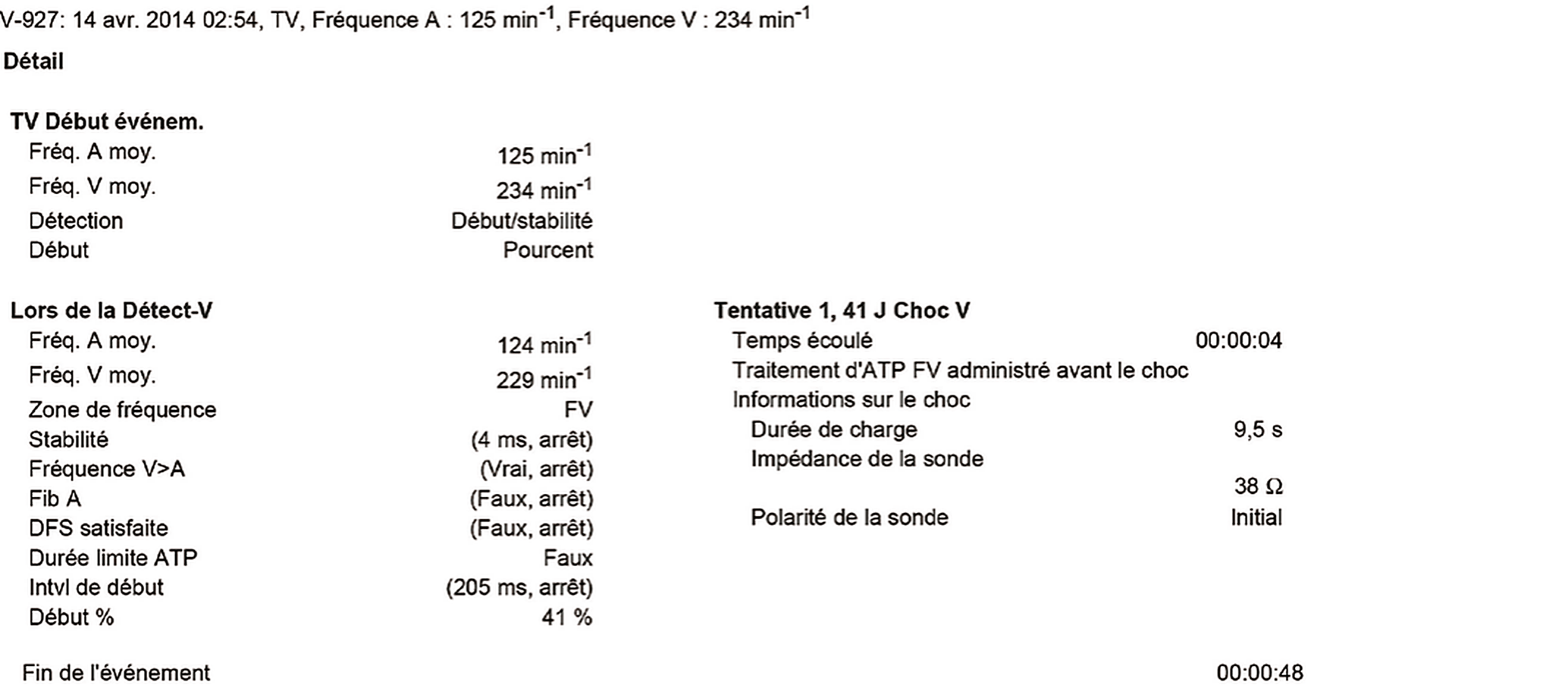
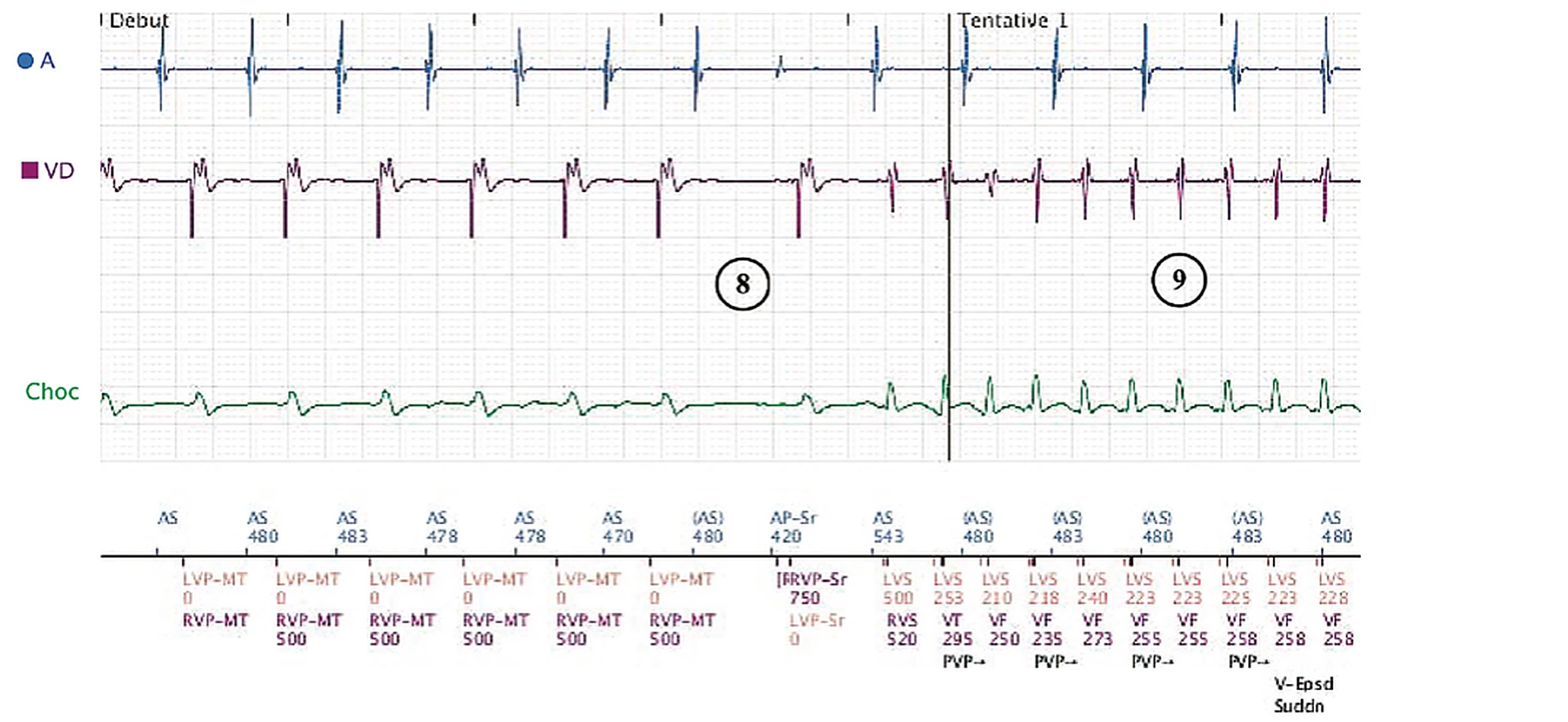
- Second stored episode, 14 minutes later (VT, A 125, V 234 bpm). The sinus rate exceeds the MTR (AS 470 to 483 ms, against 500 ms for the VP-MT): the AV delay lengthens beat after beat, then an atrial event falls in the PVARP ((AS) 480): Wenckebach behaviour
- That atrial event starts no AV delay and no ventricular pace: a long cycle (AP-Sr, then RVP-Sr and LVP-Sr at 750 ms). A fast VT starts just after (cycles of 235 to 295 ms), detected in the VF zone (VF markers, V-Epsd)
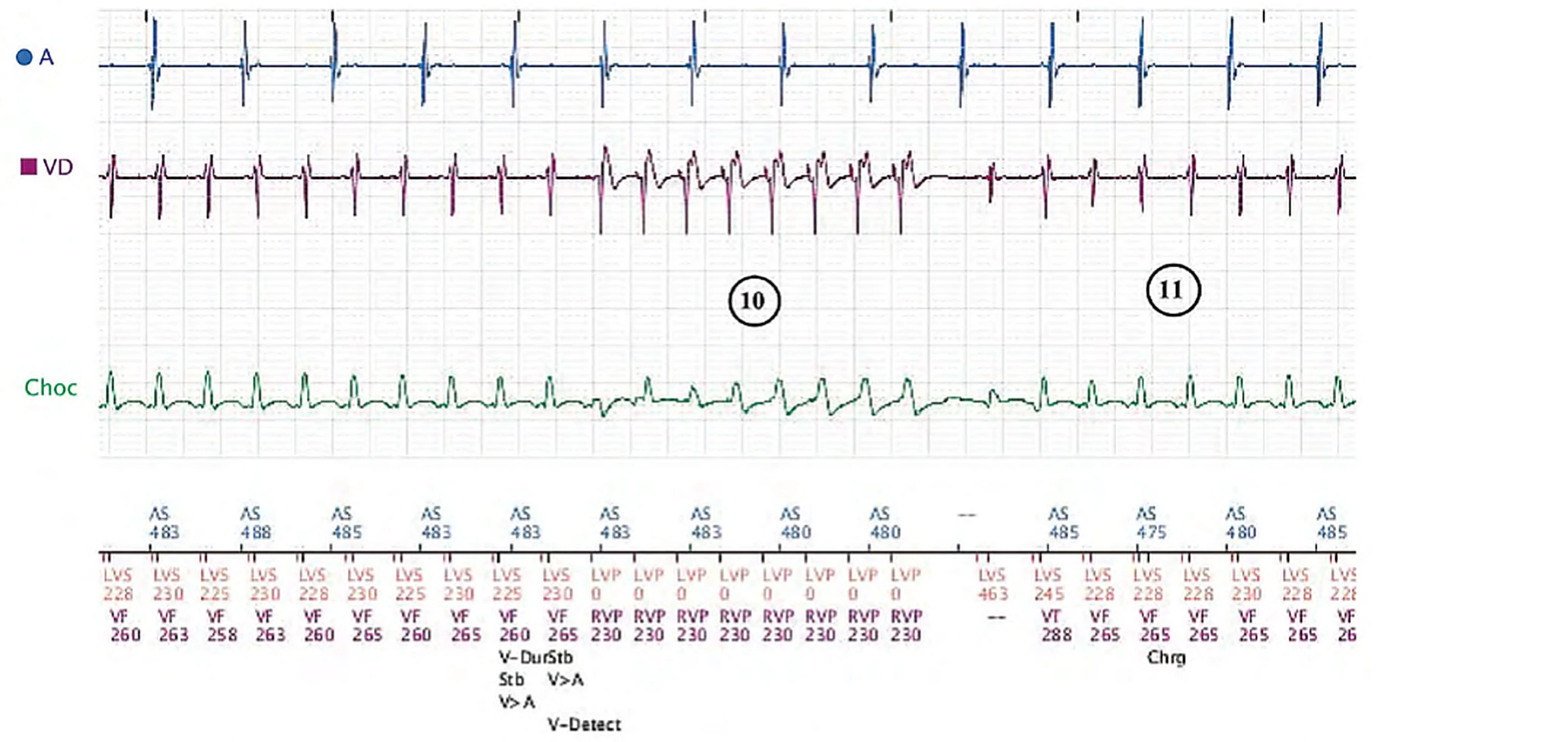
- V-Detect in the VF zone: Quick Convert, ATP before charging in the VF zone, a burst of 8 BiV pulses (RVP, LVP 0) at 230 ms
- The burst fails: the VT goes on (VT 288, then VF 265 ms) and the capacitors charge (Chrg). A shock is delivered at the end of charging (not shown on this tracing) and stops the VT; episode report: 41 J shock, charge 9.5 s, lead impedance 38 Ω
Points to remember
- At the MTR, an exercise sinus tachycardia can be taken for a PMT: each anti-PMT intervention blocks one atrial event, with a long-short cycle and one beat without BiV pacing
- Above the MTR, the device can no longer track every atrial event of a pacing-dependent patient: the AV delay lengthens until an atrial event is blocked (Wenckebach behaviour). Most such episodes cause few or no symptoms
- Rarely, the long-short sequence after a blocked atrial event, with exercise catecholamines and an ischaemic cardiomyopathy, sets off a very fast VT, as here. The device memory held 3 ventricular arrhythmia episodes, all in this setting
- What to do here: raise the MTR to avoid Wenckebach behaviour, and probably switch the anti-PMT algorithm off, as there was no retrograde conduction at rest (it may still appear on exertion)
Summary
- Sinus tachycardia at the MTR (120 bpm) taken for a PMT: BiV pacing is lost on one beat after each anti-PMT intervention. Fourteen minutes later the sinus rate exceeds the MTR (Wenckebach behaviour): a fast VT starts after the long cycle that follows a blocked atrial event, and a 41 J shock ends it after failed ATP
Clinical pearl
A too-low MTR is not always harmless: on exertion, each blocked atrial event (Wenckebach, or a sinus tachycardia taken for a PMT) gives a long-short sequence that can, rarely, set off a fast VT, as in this ischaemic heart
Practice out loud
Just describe the tracing. What do you think is going on? Describing the numbers can help.
00:00
0%
—
From Boston Scientific CRT — clinical cases by M. Strik. Published by Cardiocases. Every numbered marker on a recording is explained in the list beneath it; tap a marker on the trace or an entry in the list.