
Chapter 4 · Keeping up the CRT · Case 7
Sinus tachycardia above the MTR, stored as NSVT
Patient and episode
Patient
- A 33-year-old patient with a RESONATE X4 CRT-D implanted 2 years earlier; sinus rhythm, BiV pacing; maximum tracking rate (MTR) 145 bpm: paced V-V at the MTR 413 ms; VT-1 zone from about 150 bpm, with RhythmID
- LATITUDE Event Detail report of an event stored as NSVT (V-32), sent by a remote transmission
The recording
Tap a number on the trace, or an entry in the list below
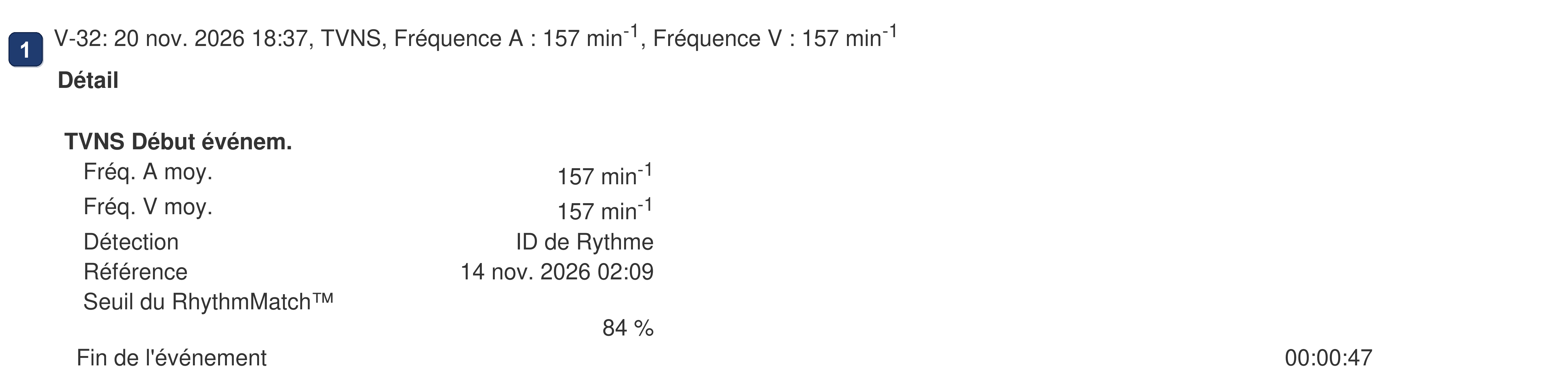
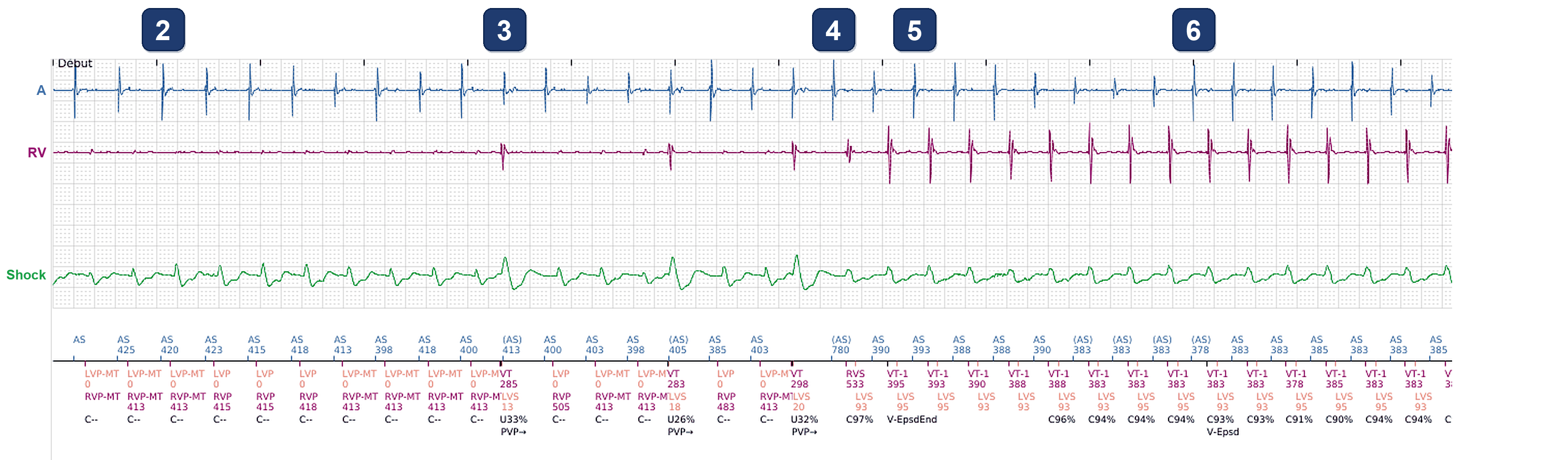


- Event Detail report: event V-32, stored as NSVT, with an average atrial and ventricular rate of 157 bpm (1:1), detected by RhythmID (RhythmMatch threshold 84%), 47 s long
- Onset (channels: atrial, RV and shock EGM; no LV EGM in this episode). Sinus tachycardia, AS 398-425 ms (141-151 bpm), at or just above the MTR: each atrial event is tracked and both ventricles are paced, at the MTR interval (LVP-MT/RVP-MT 413) or just after it: BiV pacing holds
- A PVC (VT 285, morphology uncorrelated with the template: U33%). The device extends PVARP after it (PVP→), but the next atrial event comes late enough to be tracked (AS 400 → LVP/RVP): CRT holds. A second PVC a few beats later does the same
- A third PVC (VT 298, U32%): the atrial event that comes with it falls in the post-ventricular atrial blanking (no marker), and the next one in the extended PVARP ((AS) 780): it is not tracked. It conducts: RVS 533, then LVS 93 ms later, the RV first and the LV late, as in LBBB. BiV pacing is lost
- Now the atrial events come every 383-393 ms (153-157 bpm), sooner than the MTR interval: the device may not pace before 413 ms after the last ventricular beat, so the conducted beat always comes first (VT-1 388-395, LVS 93-95), and some atrial events fall in PVARP ((AS) 383). Nothing pulls the rhythm back to pacing
- The conducted beats are in the VT-1 zone (VT-1 markers) and an episode starts (V-Epsd). Their morphology matches the template (C89-97%, above the 84% threshold): RhythmID calls them SVT and no therapy is given. The device stores the episode as NSVT
- Later in the episode the sinus rate slows to the MTR and then below it (AS 403-423 ms, 149-142 bpm) but the beats are still conducted (RVS 405-423, LVS 93 ms later): after a conducted beat the next pace would still come too early, and the patient’s own conduction keeps winning
- An atrial event falls in PVARP ((AS) 415) after a PVARP extension (PVP→) and conducts, then the next atrial event is tracked: the RV is paced at the MTR (RVP-MT 413) but the LV pace is withheld (Inh-LVP), too close to the last LV sense (LV protection period): one RV-only beat
- From then on each atrial event is tracked and both ventricles are paced again (LVP/RVP 415-448), at a sinus rate now below the MTR (AS 430-448 ms, 134-140 bpm). BiV pacing is back until the end of the episode
Points to remember
- Above the MTR, a CRT device may not pace sooner than the MTR interval after the last ventricular beat. With good AV conduction, the conducted beat comes first and BiV pacing is lost, with no pause and no alert
- Once lost, CRT does not come back as soon as the sinus rate falls back to the MTR: a conducted beat comes later after the atrial event than a paced one, so the next pace is still due too early. Here the sinus rate had to fall a few bpm below the MTR, and a PVARP extension had to break the chain, before pacing resumed
- A PVC is a common trigger: the PVARP extension after it (PVP→) leaves one atrial event untracked, and at a sinus rate above the MTR that is enough to hand the ventricles to the patient’s own conduction
- This loss of CRT was seen only because the sinus rate also reached the VT-1 zone: RhythmID (morphology match above 84%) withheld therapy and stored an NSVT. Read stored NSVT and PMT episodes in CRT patients: they show what happens to CRT at their highest sinus rates
- In a young patient with sinus rates above 150 bpm, an MTR of 145 bpm is too low: raise the MTR (with the VT zones moved above it), and consider rate control (beta-blocker); an exercise test or Holter shows the sinus rates that matter
Summary
- A young patient’s sinus tachycardia goes just above an MTR of 145 bpm. A PVC lets one atrial event go untracked, the conducted beats take over and BiV pacing is lost for most of a 47-s episode, which the ICD stores as NSVT (RhythmID: SVT, no therapy). CRT comes back only once the sinus rate is clearly below the MTR
Clinical pearl
Loss of CRT during sinus tachycardia is an underappreciated problem in young and active patients. Many CRT candidates have preserved AV conduction and lose their CRT as soon as they cross the MTR. It is hard to know: the % of CRT stays high and there are no episodes (unless, as here, the sinus rate also reaches a VT zone)
Practice out loud
Just describe the tracing. What do you think is going on? Describing the numbers can help.
00:00
0%
—
From Boston Scientific CRT — clinical cases by M. Strik. Published by Cardiocases. Every numbered marker on a recording is explained in the list beneath it; tap a marker on the trace or an entry in the list.