
Chapter 4 · Keeping up the CRT · Case 8
Exercise, anti-PMT algorithm and long PR
Patient and episode
Patient
- INCEPTA CRT-D in an active 71-year-old woman with dilated cardiomyopathy and an intraventricular conduction delay
- Numerous PMT episodes diagnosed by the device in its memory
The recording
Tap a number on the trace, or an entry in the list below
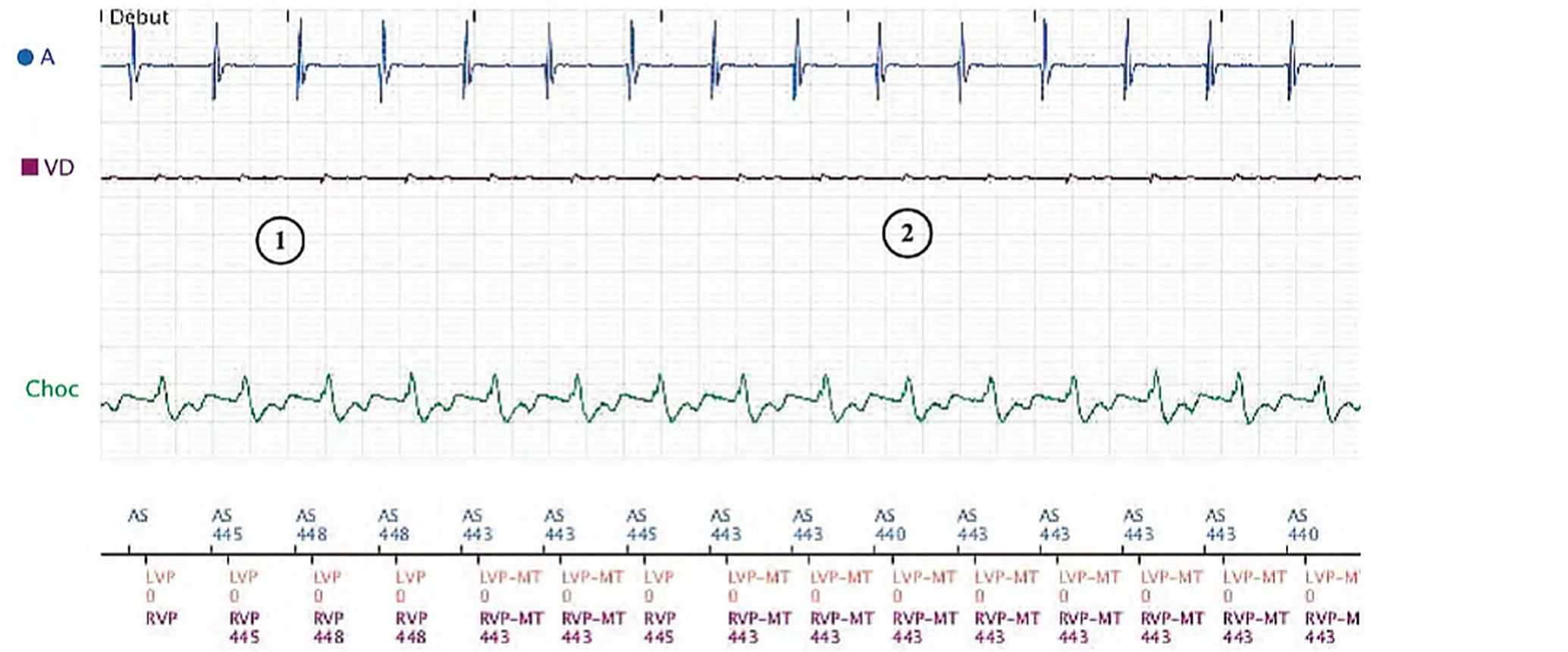
- Stored “PMT” episode (A and V 136 bpm). AS, then RVP and LVP together (LVP 0) after a short AV delay (adaptive AV delay): each atrial event is tracked, BiV pacing at 445 to 448 ms
- AS, then RVP-MT and LVP-MT at 443 ms: the sinus rate has reached the maximum tracking rate, and the ventricular paces are held to the MTR interval (443 ms, about 135 bpm)
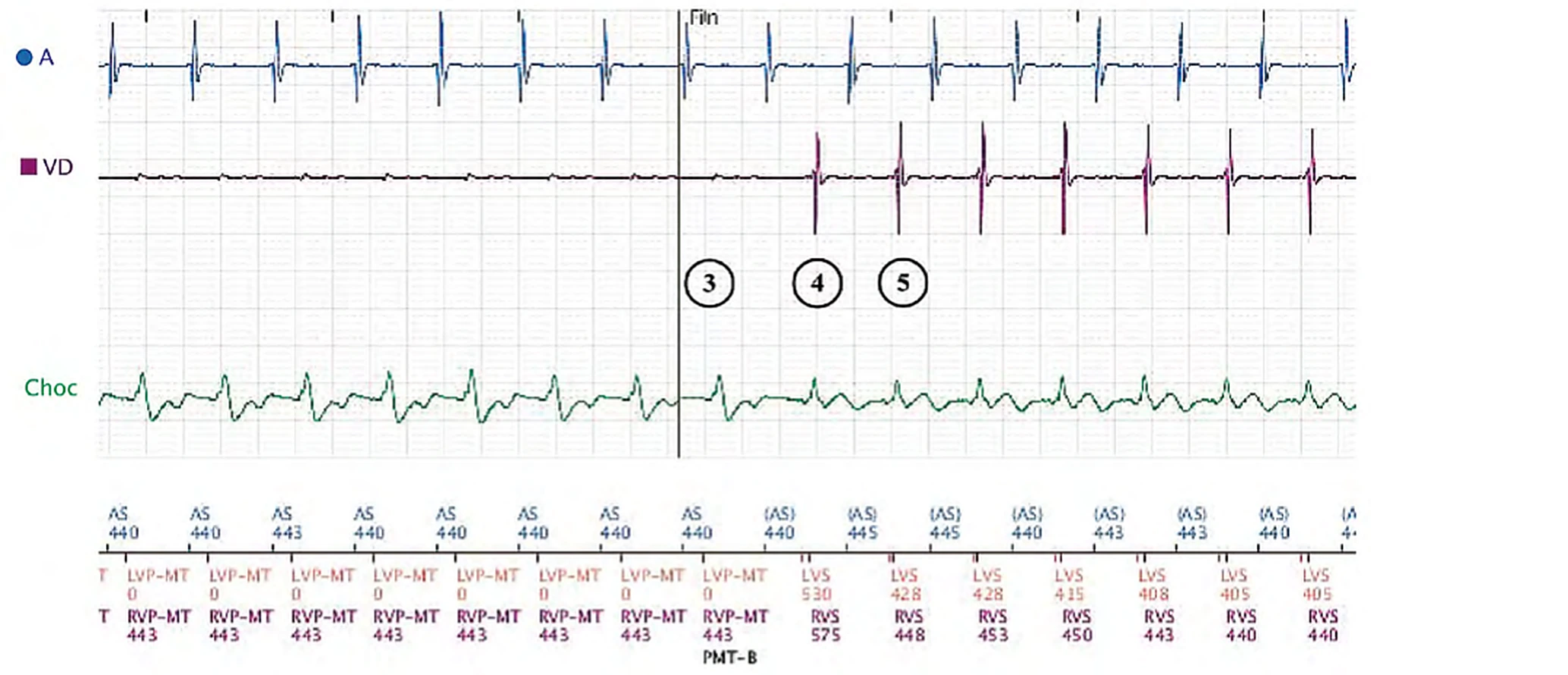
- PMT-B: after 16 consecutive AS – VP-MT cycles, the device diagnoses a PMT
- The PVARP is extended to 500 ms for one cycle: the next atrial event falls in it ((AS) 440), starts no AV delay and is not followed by a ventricular pace. Spontaneous conduction: LVS 530, then RVS 575 ms after the last paced beat
- The sinus tachycardia goes on. The device takes this spontaneous ventricular beat for a PVC (it follows no tracked atrial event) and extends the PVARP again: the next atrial event also falls in the PVARP ((AS) 445) and is conducted, with a long PR
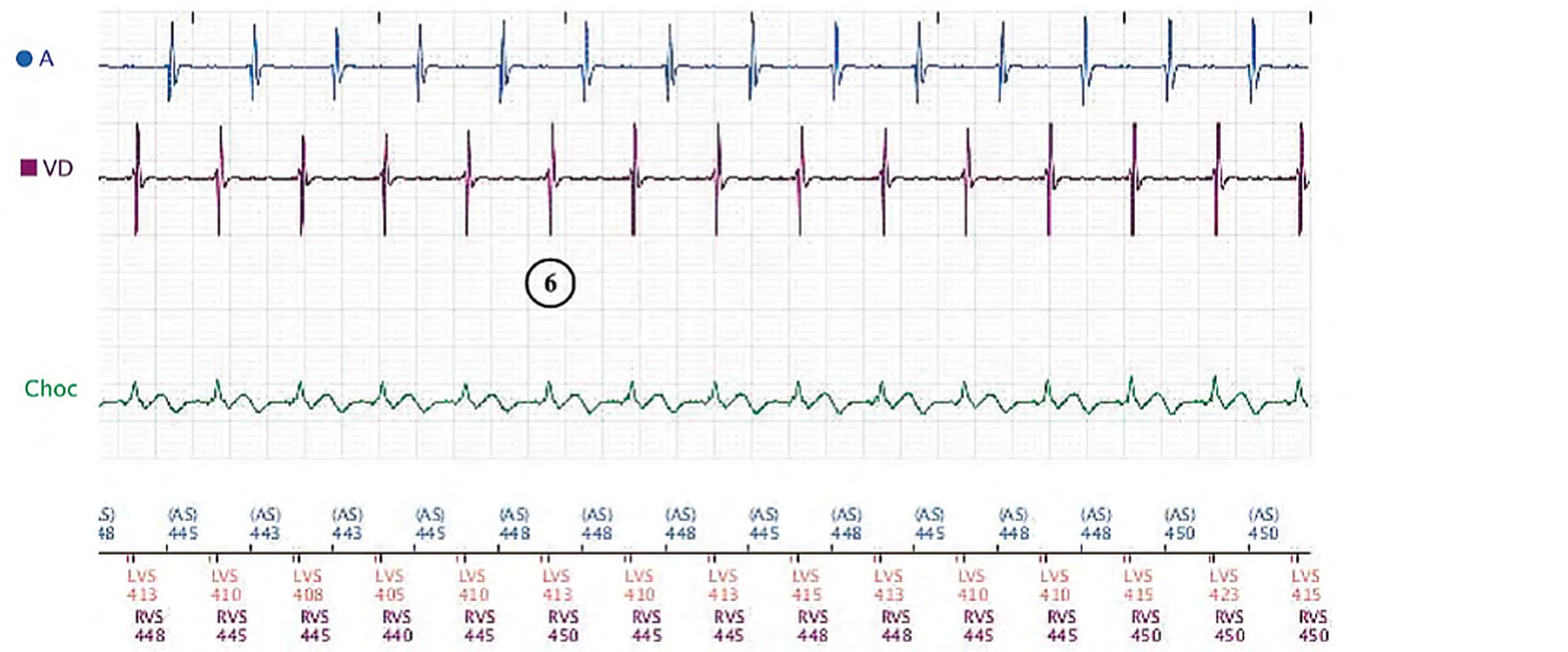
- Sustained loss of CRT, the same sequence on every beat: (AS) – LVS – RVS. With this long PR, the delay from the previous ventricular depolarisation to the atrial event is short (< 200 ms): every atrial event falls in the PVARP and is not tracked, even when the sinus rate falls below the MTR ((AS) 443 to 450 ms)
Points to remember
- Boston devices store the episodes they label PMT with their EGM: read them to confirm or reject the diagnosis. In this active patient the stored “PMT” is sinus tachycardia on exertion
- The device calls it a PMT after 16 ventricular paces in a row at the MTR, each followed by an atrial event at a stable interval, then lengthens PVARP to 500 ms for one beat. Nothing checks that it is a real PMT, so sinus tachycardia exactly at the MTR can be taken for one
- Usually such a false PMT costs one untracked atrial event every 16 beats, with few symptoms. Here BiV pacing stays lost, because of the long PR and a PVARP too long for the rate: each atrial event falls in the PVARP, even when the rate drops below the MTR
- What can help: a dynamic PVARP, fairly short at peak exercise (the PMT risk is low, though not nil, in this patient without retrograde conduction at the visit), and Tracking Preference, designed for this very problem (a run of conducted beats with the atrial events in PVARP)
Summary
- Exercise sinus tachycardia at the MTR taken for a PMT. After the PVARP extension the next atrial event conducts, and with the long PR every following atrial event falls in the PVARP: CRT stays lost, even below the MTR
Clinical pearl
With a long PR, a single anti-PMT intervention on exertion can switch CRT off for many beats: each following atrial event falls in the PVARP. Consider a dynamic PVARP, short at high rates, and Tracking Preference
Practice out loud
Just describe the tracing. What do you think is going on? Describing the numbers can help.
00:00
0%
—
From Boston Scientific CRT — clinical cases by M. Strik. Published by Cardiocases. Every numbered marker on a recording is explained in the list beneath it; tap a marker on the trace or an entry in the list.