
Chapter 2 · Therapies · Case 6
Anti-tachycardia pacing in the VT zone
Patient and episode
Patient
- Male implanted with a single chamber defibrillator (Visia XT VR) for ischaemic cardiomyopathy.
The recording
Tap a number on the trace, or an entry in the list below
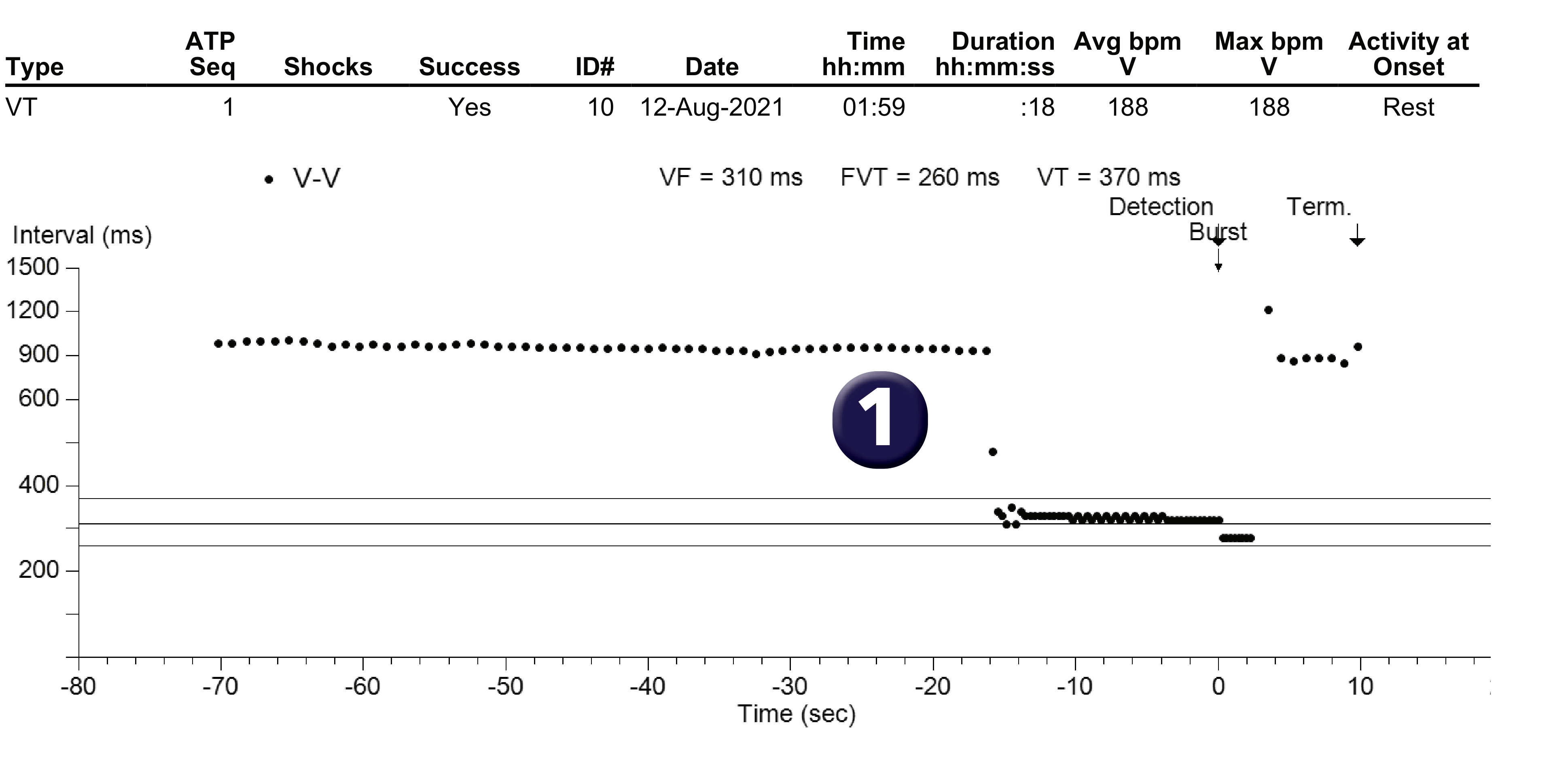
Rate / interval plot
EGM

- What diagnosis is suggested by the interval plot? The plot shows a probable arrhythmic episode with sudden acceleration into the VT zone; a burst is delivered with probable termination of the arrhythmia; the plot on this single-chamber defibrillator does not allow us to differentiate with certainty between ventricular tachycardia and supra-ventricular tachycardia.
- What is your final diagnosis? This is a regular, monomorphic tachycardia with QRS complexes that appear wide on the shock channel; the burst is effective with termination of the arrhythmia; the morphology of QRS complexes post-termination is different from the morphology during tachycardia; therefore the diagnosis of ventricular tachycardia is very likely.
Points to remember
- A priority during programming is to reduce the number of shocks delivered without compromising patient safety; ideally, this is achieved by interrupting the tachycardia with the least aggressive and least painful therapy possible; for organised tachycardias, ATP is preferred over a shock as first-line therapy since it is less painful and limits battery consumption; moreover, potentially deleterious effects of device based shocks have been clearly demonstrated.
- The principle underlying ATP is the existence of an excitable gap in a reentrant circuit such that rapid pacing can generate a new activation front that collides with the tachycardia circuit and interrupts it; the ventricle must therefore be paced at a higher rate than that of the tachycardia.
- The efficacy of this type of therapy has been demonstrated for a wide range of ventricular tachycardia with rates of up to 240 beats/minute; one or more ATP sequences can terminate up to 90% of ventricular tachycardias of less than 200 beats/minute, with a moderate risk of acceleration of approximately 1 to 5%.
- These observations have redefined the role of the implantable cardiac defibrillator as a device that offers ATP as a first line treatment, and possible defibrillation as a back-up.
- One or more ATP sequences can be programmed empirically without the need to test efficacy with an electrophysiology study.
Practice out loud
Just describe the tracing. What do you think is going on? Describing the numbers can help.
00:00
0%
—
From Medtronic ICD — clinical cases by P. Bordachar, A. Thiyagarajah, L. Fontagne, M. Strik, S. Ploux. Published by Cardiocases. Every numbered marker on a recording is explained in the list beneath it; tap a marker on the trace or an entry in the list.
Order hardcopyon Amazon