
Chapter 2 · Therapies · Case 9
Accceleration after anti-tachycardia pacing
Patient and episode
Patient
- Male implanted with a dual chamber defibrillator (Evera XT DR) for ischaemic cardiomyopathy.
The recording
Tap a number on the trace, or an entry in the list below
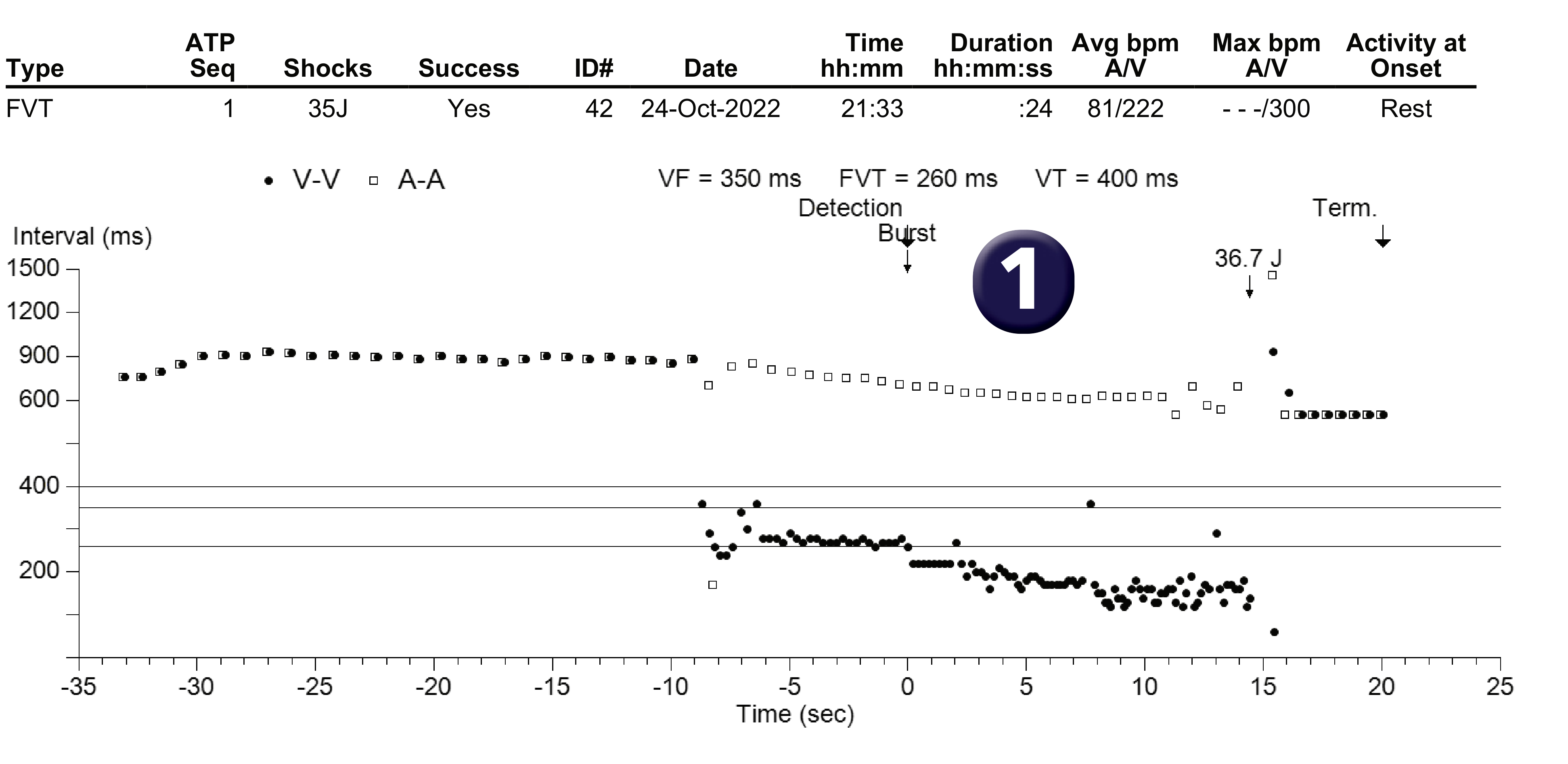
Rate / interval plot
EGM


- What diagnosis are you suggesting on this graph? The plot shows a probable arrhythmic episode with sudden acceleration into the FVT zone (atrioventricular dissociation); the first burst accelerates the arrhythmia which becomes irregular and is detected in the VF zone; a maximum output shock facilitates reversion.
- What is your final diagnosis? This is initially an episode of regular, monomorphic ventricular tachycardia; the first burst degrades the arrhythmia into ventricular fibrillation with extremely short cycles; a shock (first therapy in the VF zone) terminates the arrhythmia.
Points to remember
- This tracing also shows an example of acceleration following an ATP sequence and serves to emphasise the often polymorphic and very rapid nature of induced arrhythmias.
- ATP can 1) accelerate a tachycardia resulting in a morphology identical to the previous one, 2) accelerate a tachycardia resulting in a different morphology or 3) cause an organised tachycardia to degenerate into VF.
Practice out loud
Just describe the tracing. What do you think is going on? Describing the numbers can help.
00:00
0%
—
From Medtronic ICD — clinical cases by P. Bordachar, A. Thiyagarajah, L. Fontagne, M. Strik, S. Ploux. Published by Cardiocases. Every numbered marker on a recording is explained in the list beneath it; tap a marker on the trace or an entry in the list.
Order hardcopyon Amazon