
Chapter 3 · Oversensing · Case 13
Use of an algorithm to avoid inappropriate therapies
Patient and episode
Patient
- Patient with dilated cardiomyopathy implanted with a single-chamber defibrillator (Protecta XT VR).
The recording
Tap a number on the trace, or an entry in the list below
Rate / interval plot
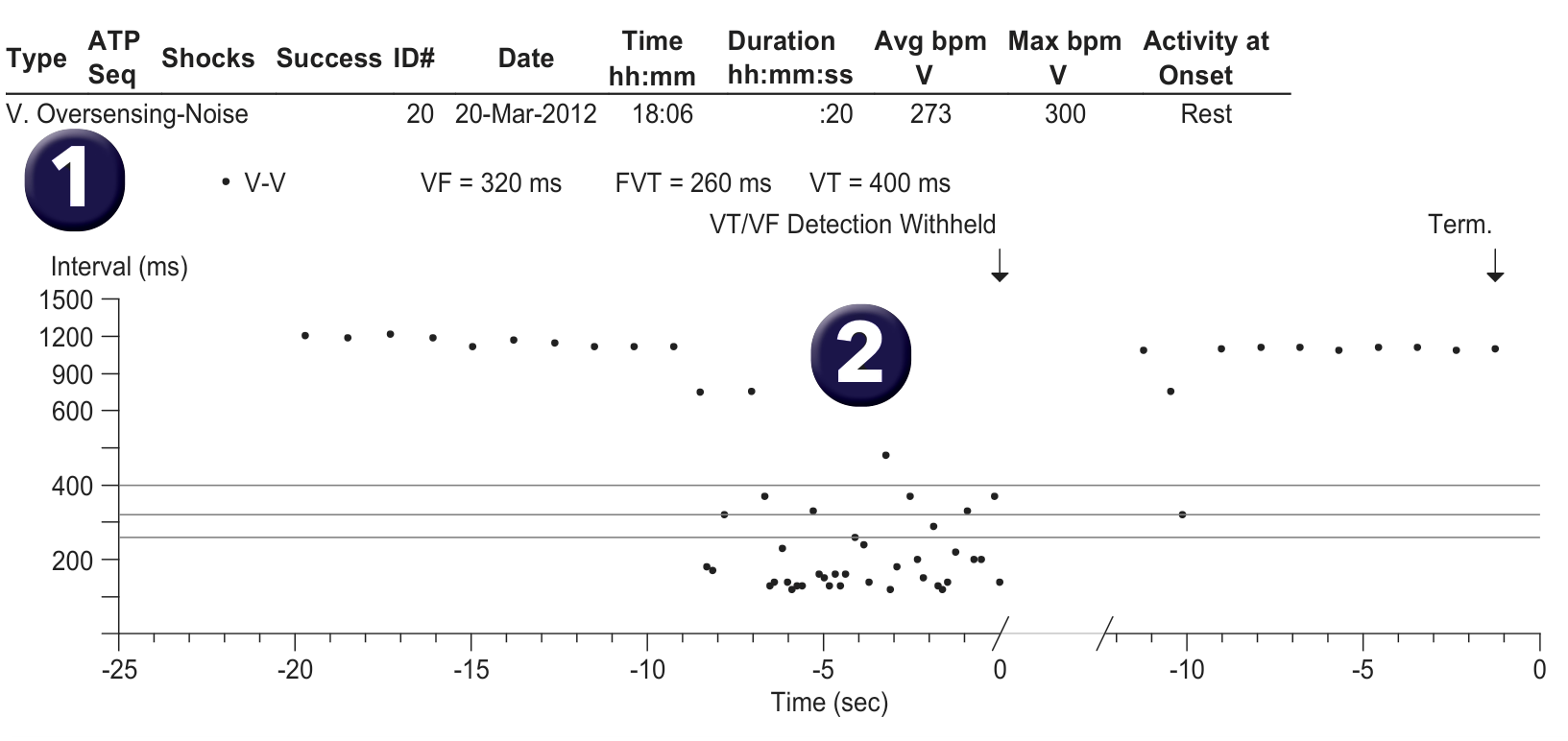
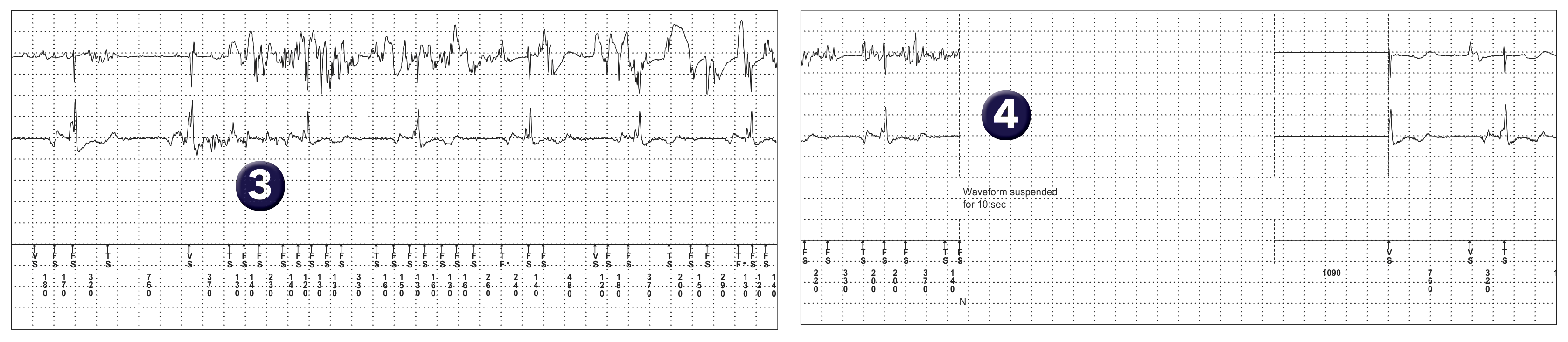
EGM
- What is the diagnosis made by the system? The system classified this episode as oversensing of noise.
- What diagnosis is suggested by the interval plot? The plot shows a characteristic cloud of points with significant cycle-to-cycle variability and very short ventricular cycles at the limit of the programmed blanking value, suggesting the diagnosis of oversensing.
- What is your diagnosis? The EGM reveals chaotic cycles in the bipolar channel with marked variation in amplitude and frequency, no relationship to the QRS complexes, with some signals saturating the amplifiers and some cycles bordering on the programmed blanking; there is much less or no oversensing on the shock channel.
- What is the explanation for the inhibition of therapies? The VF counter is full but no therapy is delivered, the device having diagnosed oversensing due to lead malfunction after implementation of the noise algorithm (N for noise).
Points to remember
- The lack of long-term reliability of defibrillation leads is one of the main limitations of implantable devices and one of the most difficult challenges for the manufacturers involved.
- MedtronicTM devices are equipped with 2 complementary algorithms specifically dedicated to the diagnosis of lead dysfunction and the prevention of inappropriate shocks: the LIA and the RV Lead noise discrimination algorithm.
- The principle of this second algorithm is to analyse the EGM tracings, identify an oversensing episode (a non-physiological episode that does not correspond to true arrhythmia) and inhibit therapies.
- The identification of electrograms characteristic of lead fracture is based on a comparison of the amplitude (peak to peak) of the signals recorded in the shock channel (far-field) and the signals recorded in the sensing channel (near-field); conceptually, this is based on the fact that during oversensing, signals may be present on the bipolar channel but absent on the shock channel, unlike a true arrhythmia episode where fast signals are detected simultaneously on both channels.
- The amplitude of 12 consecutive signals is analysed over a sliding window using a counter; when the number of intervals required to detect VT or VF has been completed, if 3 of the 12 sequences (amplitude comparison at far-field and near-field channel level) are classified as «noise», detection is interrupted, therapies are not delivered and a «noise on RV lead» alert is triggered (an audible alert is emitted by the device every 4 hours until the defibrillator is interrogated; a telemedicine alert is also transmitted if this specific alert has been programmed).
- This algorithm can be set to OFF, ON or ON + Timeout; in the latter case, a time limit is programmed; if noise oversensing continues beyond this time (15 seconds to 2 minutes), therapies are delivered despite the diagnosis made by the device.
- In practice, LIA enables a much earlier diagnosis of lead dysfunction than this second algorithm; in fact, the LIA issues an alert in the presence of short cycles and episodes of non-sustained VT, whereas the noise algorithm only intervenes if the initial counter is filled (30/40) and therefore only during a sustained episode of oversensing. This second algorithm is therefore only useful if, despite the LIA alerts, no action has been taken, or if the very first episode of oversensing is sustained long enough to fill the initial counters (a relatively rare occurrence).
- Therefore LIA most often enables an early diagnosis; it delays therapies but does not inhibit them and generates an alert, whereas the noise algorithm often results in a later diagnosis but inhibits therapies.
Practice out loud
Just describe the tracing. What do you think is going on? Describing the numbers can help.
00:00
0%
—
From Medtronic ICD — clinical cases by P. Bordachar, A. Thiyagarajah, L. Fontagne, M. Strik, S. Ploux. Published by Cardiocases. Every numbered marker on a recording is explained in the list beneath it; tap a marker on the trace or an entry in the list.
Order hardcopyon Amazon