
Chapter 4 · Discrimination · Case 9
Using single-chamber discriminators in a dual-chamber defibrillator
Patient and episode
Patient
- Male implanted with a dual-chamber defibrillator (EnTrust) for ischaemic cardiomyopathy.
The recording
Tap a number on the trace, or an entry in the list below
EGM
From the interrogation
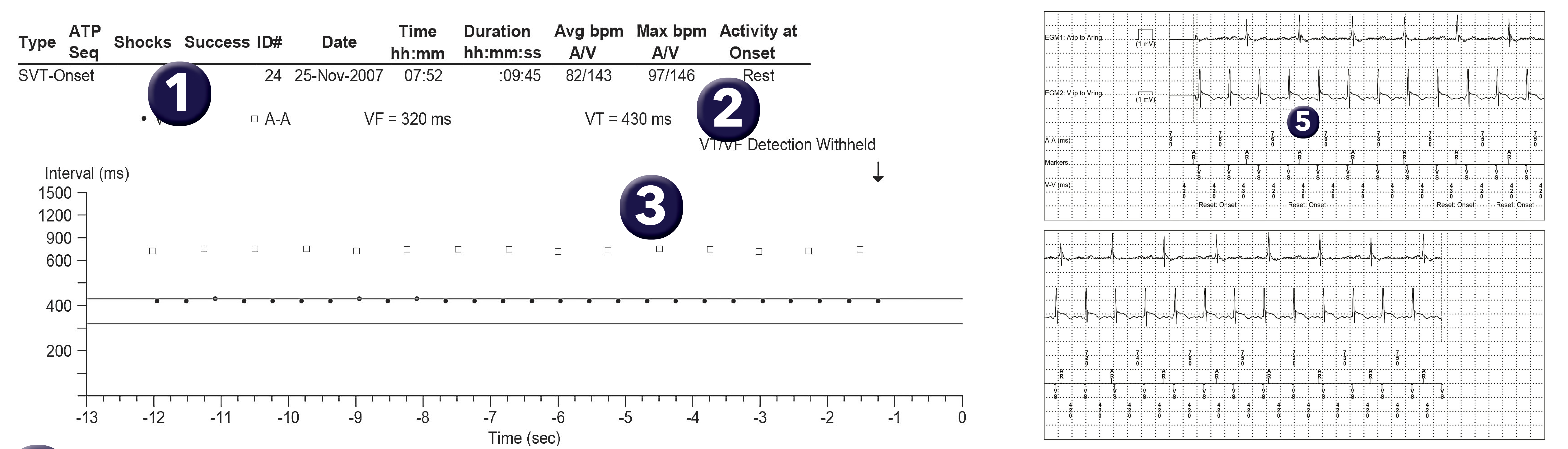
- What was the diagnosis made by the defibrillator for this episode? This episode was classified as SVT-Onset by the system.
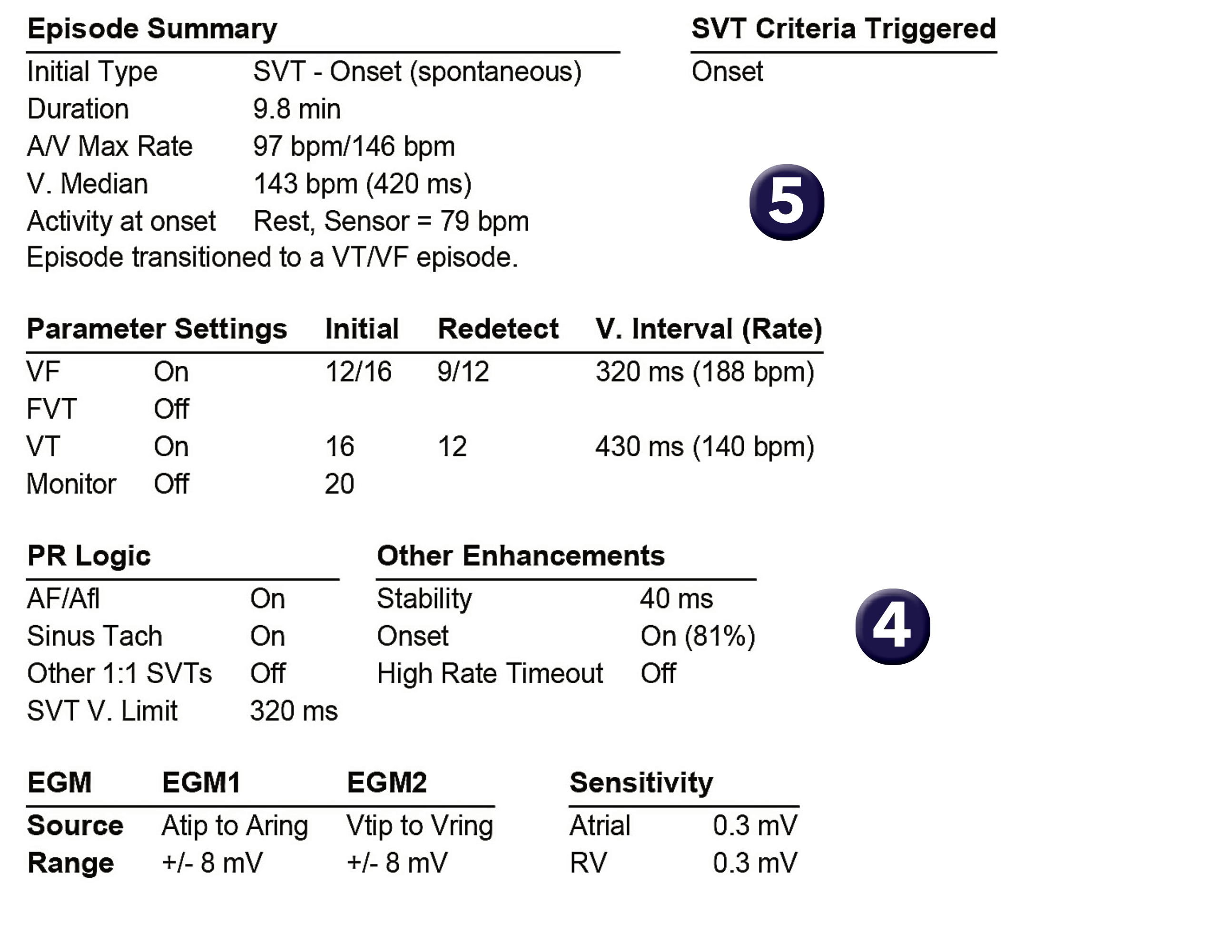
- How many detection zones are programmed? Two detection zones have been programmed with a VT zone of 430 to 320 ms.
- What diagnosis does the interval plot suggest? The graph shows atrioventricular dissociation (ventricular rhythm faster than atrial rhythm); the ventricular rhythm oscillates around the lower limit of the VT zone.
- How many discrimination parameters are programmed? All the discrimination parameters (stability, hard start, PR Logic) available on this legacy platform are set to ‘On’.
- What is your diagnosis? The diagnosis of VT is obvious, as the ventricular rhythm is faster than the atrial rhythm; the Reset. Onset marker reflects the fact that the sudden onset criterion has not been fulfilled; the cycles are therefore classified as VS even when they correspond to the VT zone.
Points to remember
- On a dual-chamber or triple-chamber defibrillator, it is possible to program the 2 single-chamber discrimination parameters (other discriminations: sudden onset and stability) separately or in association with PR Logic; these parameters take precedence over analysis by PR Logic; in other words, if sudden onset is programmed in conjunction with PR Logic, the first discrimination step consists of validating the single-chamber criterion; if, as in this example, the device does not find a sudden onset, it concludes that there is an SVT without further analysis and without consulting PR Logic.
- In this patient, the diagnosis of VT seemed obvious to the cardiologist who analysed the tracing, the atrioventricular dissociation being pathognomonic; an analysis using PR Logic would also have led to the diagnosis of VT, the ventricular rate being faster than the atrial rate.
- This patient presents with a tachycardia oscillating around the lower limit of the VT zone, which explains why the analysis is misleading and why the defibrillator considers that there was no sudden onset; the most likely scenario is that the ventricular rate went from a normal rate (60 beats/minute) to a rapid rate just below the VT zone at the start of the tachycardia (138 to 139 beats/minute) with a slight acceleration of the rate thereafter into the VT zone (140-141 beats/minute).
- This tachycardia therefore had a sudden onset but was not diagnosed by the device; in fact, the criterion is calculated by comparing the first intervals corresponding to the VT zone with the 4 previous cycles; the device is therefore fooled in this example (no jump in rate between the 4 cycles at 139 beats/minute and the 4 cycles at 140 beats/minute).
- The easiest solution in this patient is to turn off this discrimination criterion in favour of PR Logic.
- The third single-chamber discrimination parameter (Wavelet) can be programmed in conjunction with PR Logic; its position in the diagnostic tree differs from that of the other 2 parameters and will be described in more detail when subsequent tracings are analysed.
Practice out loud
Just describe the tracing. What do you think is going on? Describing the numbers can help.
00:00
0%
—
From Medtronic ICD — clinical cases by P. Bordachar, A. Thiyagarajah, L. Fontagne, M. Strik, S. Ploux. Published by Cardiocases. Every numbered marker on a recording is explained in the list beneath it; tap a marker on the trace or an entry in the list.
Order hardcopyon Amazon