
Chapter 4 · Discrimination · Case 14
Double-chamber discrimination and exertion in a young patient
Patient and episode
Patient
- 31-year-old male implanted with a triple-chamber defibrillator (Amplia Quad CRTD) for dilated cardiomyopathy.
The recording
Tap a number on the trace, or an entry in the list below
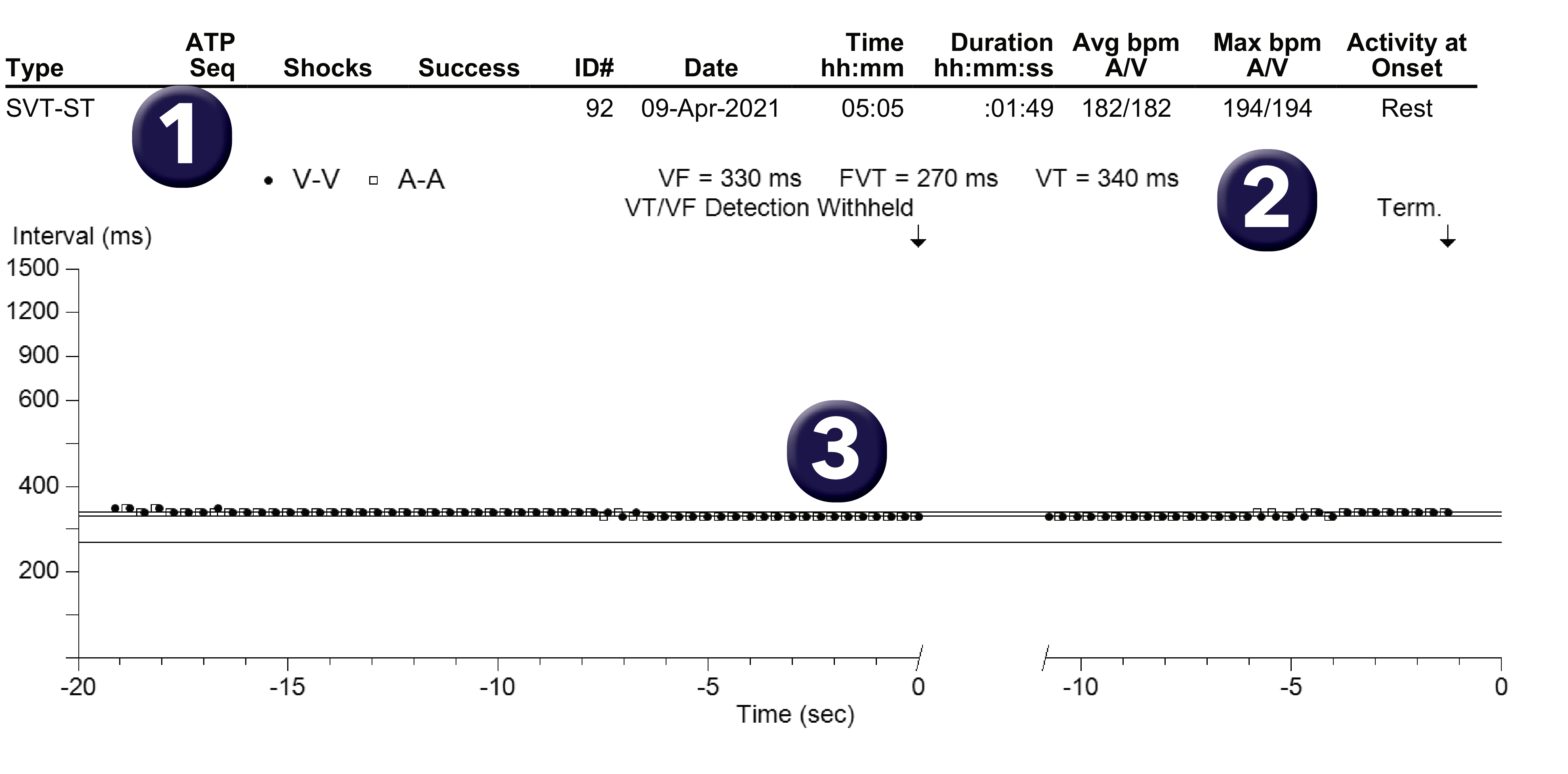
Rate / interval plot
EGM

From the interrogation
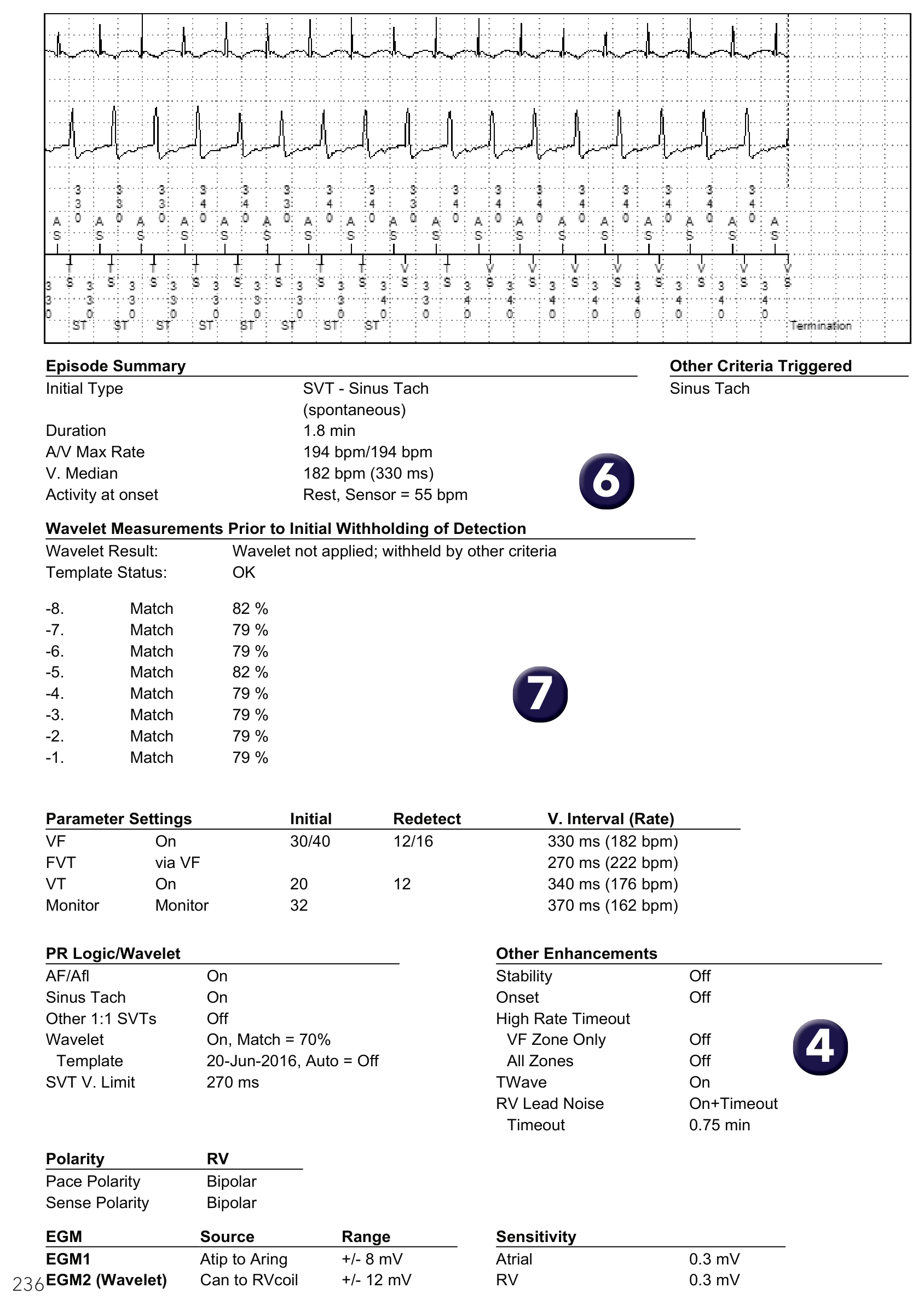
- What was the diagnosis made by the defibrillator for this episode? This episode has been classified SVT- Sinus Tach by the device.
- How many detection zones are programmed? Three detection zones have been programmed with a VT zone of 340 to 330 ms.
- What diagnosis does the interval plot suggest? The graph shows a 1/1 tachycardia with progressive acceleration then deceleration suggestive of sinus tachycardia.
- How many discrimination parameters are programmed? The discrimination parameters (PR Logic and Wavelet) are programmed with a SVT V. Limit of 260 ms; the other SVT 1:1 criterion is set to ‘Off’.
- What is your diagnosis? The diagnosis of sinus tachycardia seems likely, with a succession of AS-VS then AS-TS cycles.
- What is the diagnosis made by the system? As indicated on the trace, the device diagnoses sinus tachycardia (ST).
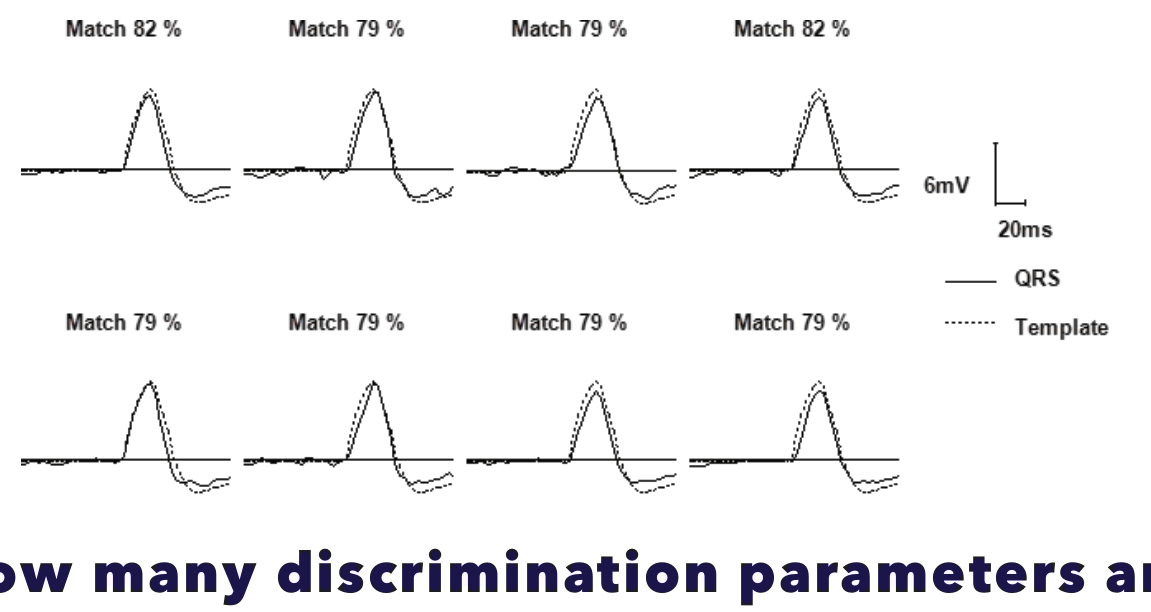
- What are the results of Wavelet? Wavelet supports the diagnosis of SVT, with all the QRS complexes analysed judged to be similar; Wavelet was not used because it was superseded by other criteria (PR Logic).
Points to remember
- This young patient had experienced episodes of symptomatic VT requiring programming of a VT zone starting at 340 ms, increasing the risk of overlap with sinus rates during exercise.
- This episode had the characteristics of a sinus tachycardia (1:1 ratio between the atria and ventricles, progressive acceleration and deceleration), well diagnosed by PR Logic.
- When the Sinus tach option is set to ‘On’, there are various stages involved in diagnosing sinus tachycardia.
- The first step is to demonstrate that there is a 1:1 ratio between the atria and ventricles (check that there is no far-field R wave oversensing).
- The second step is to determine whether the RR intervals are compatible with a sinus tachycardia; for each ventricular interval, the device determines an adaptive range of expected RR intervals (based on an average value of the previous RR intervals); each RR interval is therefore defined as expected (within the range expected for a sinus tachycardia) or unexpected (outside the range expected for a sinus tachycardia).
- The third step is to determine whether PR intervals are compatible with a sinus tachycardia; for each interval, the device determines an adaptive range of expected PR intervals (based on an average value of the previous PR intervals); each PR interval is therefore defined as expected (within the range expected for a sinus tachycardia) or unexpected (outside the range expected for a sinus tachycardia).
- In the fourth step, the device establishes a sinus tachycardia counter based on the analysis of successive RR intervals and PR intervals.
- During a 1/1 tachycardia, if PR Logic concludes sinus tachycardia, Wavelet is not included in discrimination and therefore cannot modify the diagnosis; on the other hand, if PR Logic concludes VT with retrograde conduction, Wavelet is included in the discrimination; if the morphology of the ventricular complexes in tachycardia is considered different from the reference, the device confirms the VT diagnosis; on the other hand, if the morphology is considered similar, the device corrects the diagnosis and concludes supra-ventricular tachycardia.
Practice out loud
Just describe the tracing. What do you think is going on? Describing the numbers can help.
00:00
0%
—
From Medtronic ICD — clinical cases by P. Bordachar, A. Thiyagarajah, L. Fontagne, M. Strik, S. Ploux. Published by Cardiocases. Every numbered marker on a recording is explained in the list beneath it; tap a marker on the trace or an entry in the list.
Order hardcopyon Amazon