
Chapter 4 · Discrimination · Case 20
Double-chamber discrimination and bi-tachycardia
Patient and episode
Patient
- Male implanted with a dual-chamber defibrillator (Evera XT DR) for ischaemic cardiomyopathy.
The recording
Tap a number on the trace, or an entry in the list below
Rate / interval plot
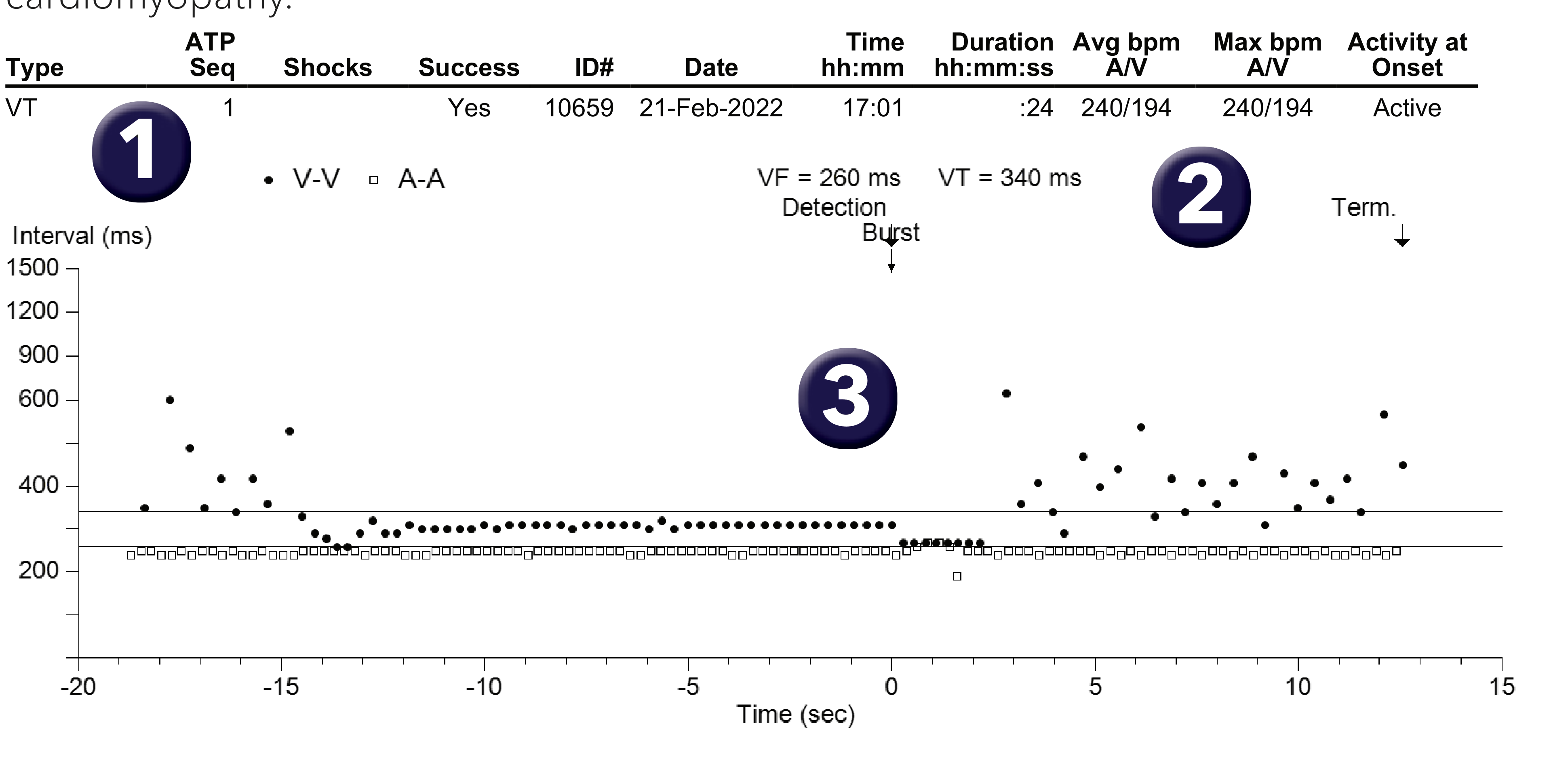
EGM

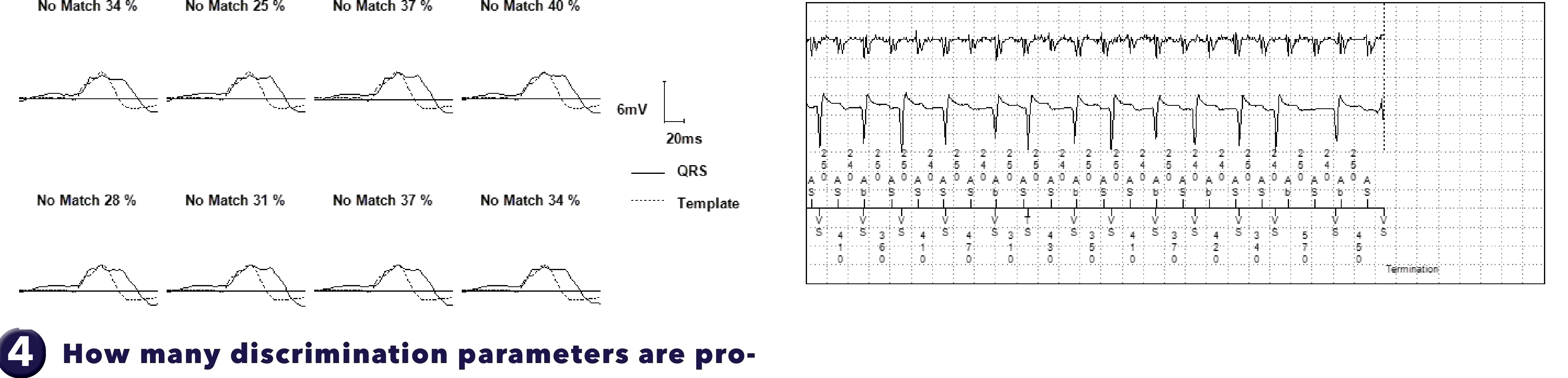
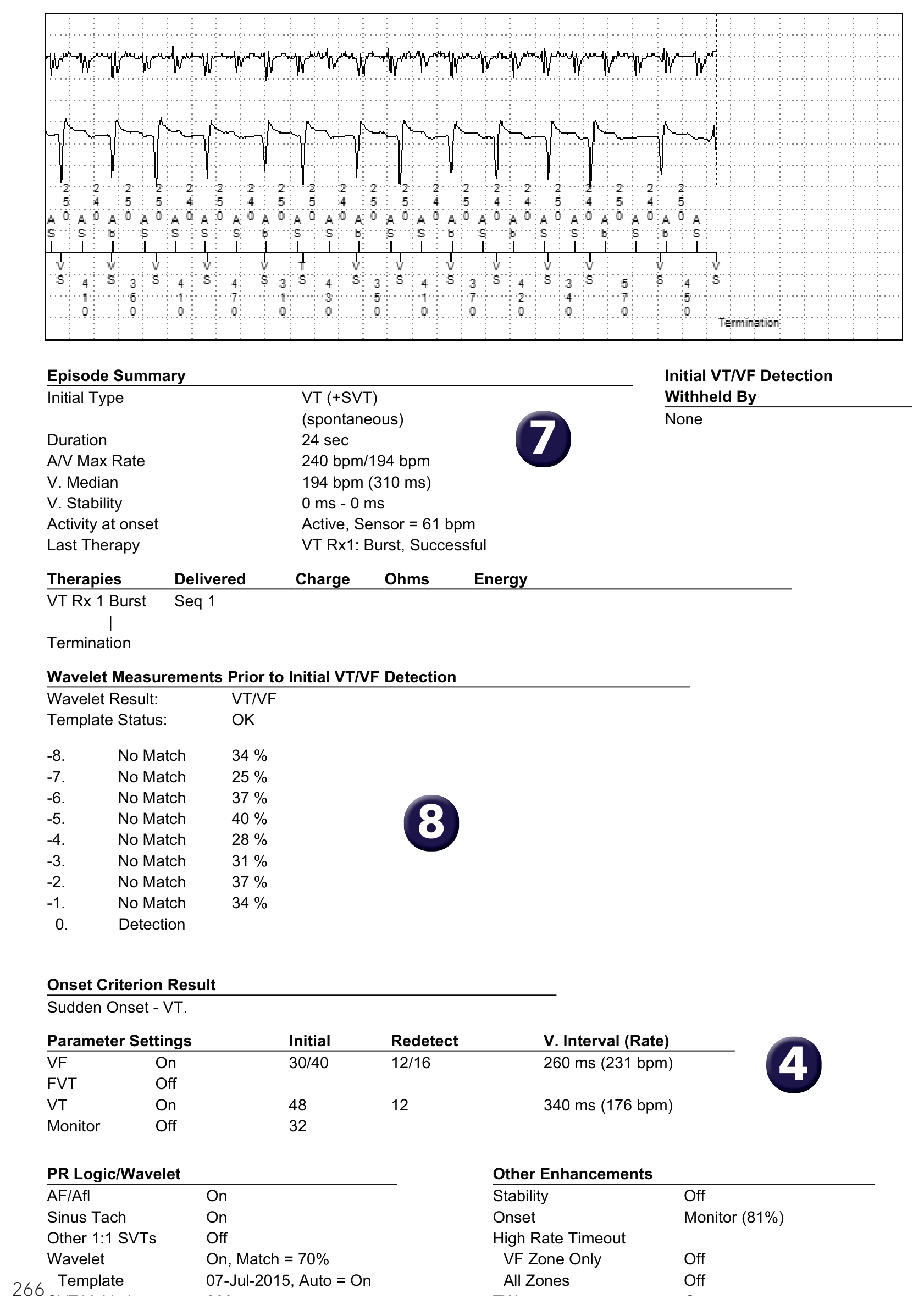
From the interrogation
- What was the diagnosis made by the defibrillator for this episode? This episode was rated VT + SVT by the device.
- How many detection zones are programmed? Two detection zones have been programmed with a VT zone of 340 to 260 ms.
- What diagnosis does the interval plot suggest? The graph shows a regular tachycardia in the atrium, an initially irregular ventricular rhythm (compatible with conducted AF) which accelerates and becomes regular (compatible with VT); a burst re-establishes the initial irregular ventricular rhythm.
- How many discrimination parameters are programmed? The discrimination parameters (PR Logic and Wavelet) are programmed with a SVT V. Limit of 260 ms.
- What is the most likely diagnosis at the start of the trace? The trace is compatible with conducted AF.
- What is the most likely diagnosis for the rest of the trace? The ventricular rhythm accelerates and becomes more regular, with a clear change in the morphology of the ventricular complexes compared with the beginning of the trace.
- What is the diagnosis made by the system? Implementation of PR Logic and Wavelet results in a diagnosis of VT; a burst is delivered with termination of VT.
- What are the results of Wavelet? Wavelet is used because PR Logic has concluded VT; Wavelet leads to the diagnosis of VT because the 8 ventricular complexes are classified as different from the reference template.
Points to remember
- This patient presented with episodes of bi-tachycardia with VT + AF.
- PR Logic diagnoses bi-tachycardia in several steps: 1) the atrial rhythm is faster than the ventricular rhythm; 2) there is no far-field R wave oversensing; 3) the atrial rhythm is compatible with AF (AF counter > 6); 4) the ventricular rhythm is regular (300 ms and 310 ms represent more than 75% of the last 18 ventricular cycles before diagnosis); 2 possible diagnoses: bi-tachycardia and conducted atrial flutter; 5) there is no atrioventricular association leading to the diagnosis of bi-tachycardia and excluding conducted atrial flutter.
- When PR Logic diagnoses bi-tachycardia (VT + SVT), Wavelet is interrogated: in this example, the change in morphology is obvious, the 8 complexes are different from the stored template and Wavelet confirms the diagnosis of VT.
Practice out loud
Just describe the tracing. What do you think is going on? Describing the numbers can help.
00:00
0%
—
From Medtronic ICD — clinical cases by P. Bordachar, A. Thiyagarajah, L. Fontagne, M. Strik, S. Ploux. Published by Cardiocases. Every numbered marker on a recording is explained in the list beneath it; tap a marker on the trace or an entry in the list.
Order hardcopyon Amazon