
Chapter 1 · Counters · Case 2
Detection and treatment of a VT episode
Patient and episode
Patient
- Female with ischaemic cardiomyopathy; implanted with a Momentum triple-chamber defibrillator
Summary
- Episode classified in the VT zone
- Discrimination criterion V>A: True
- Burst of ATP delivered
The recording
Tap a number on the trace, or an entry in the list below
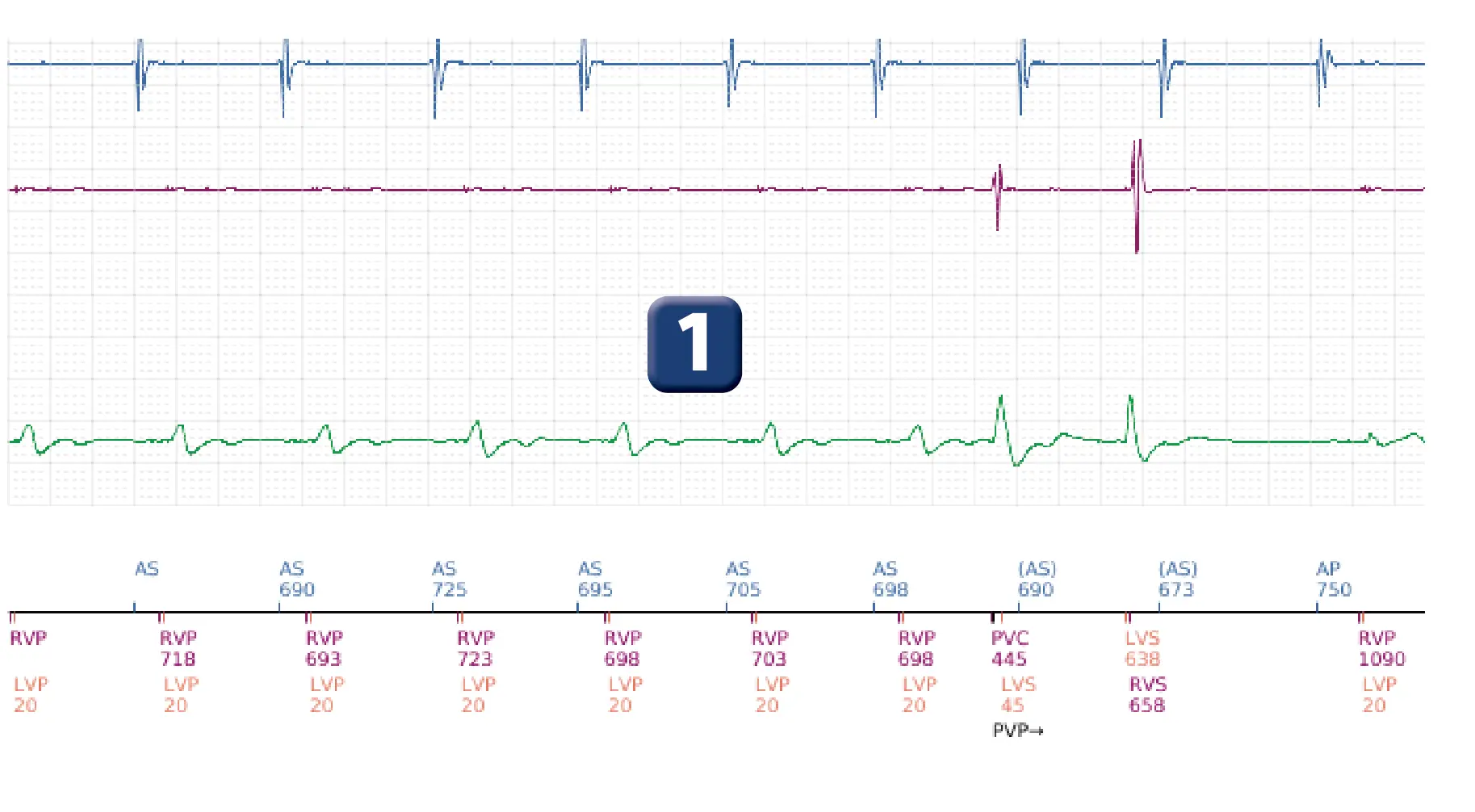
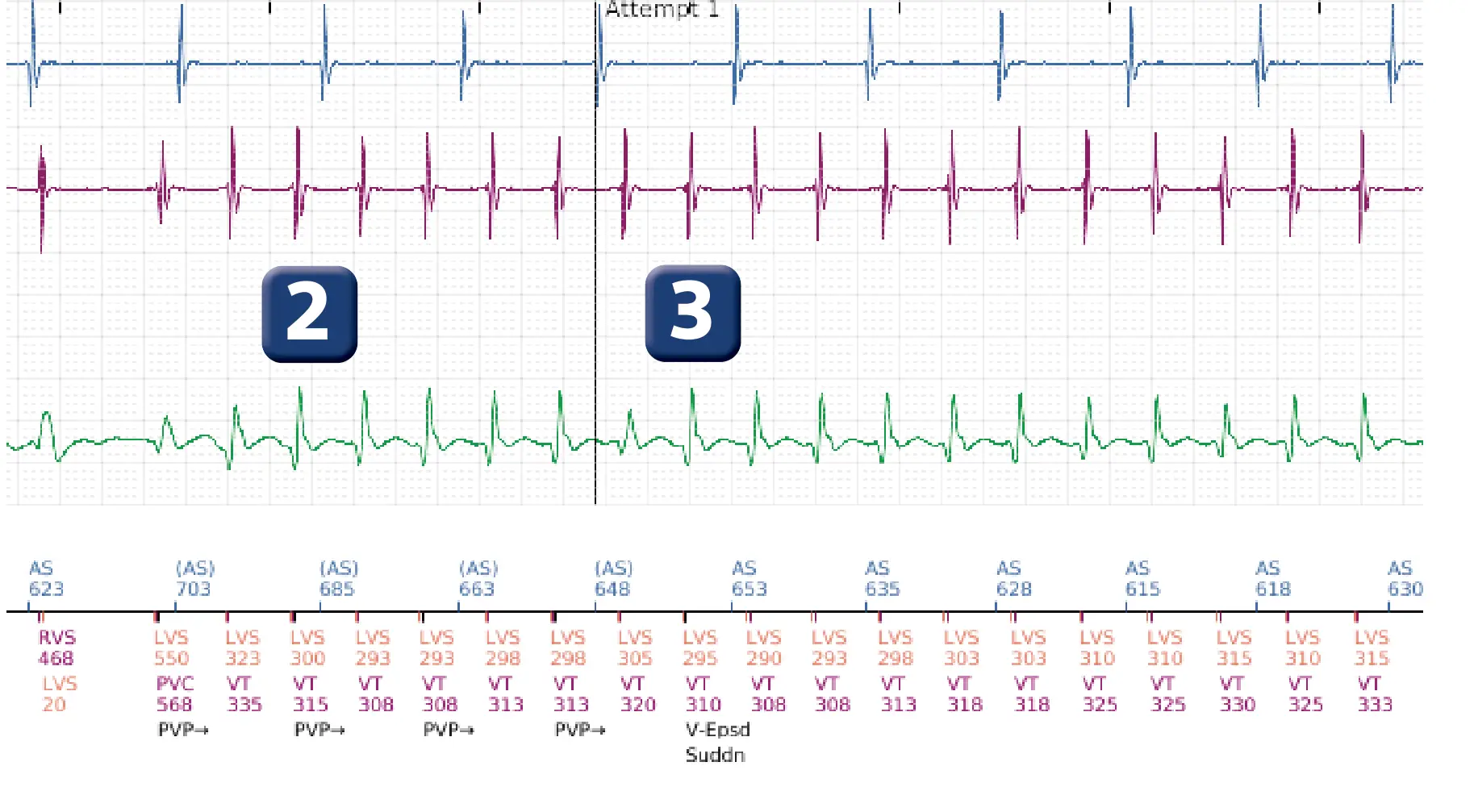
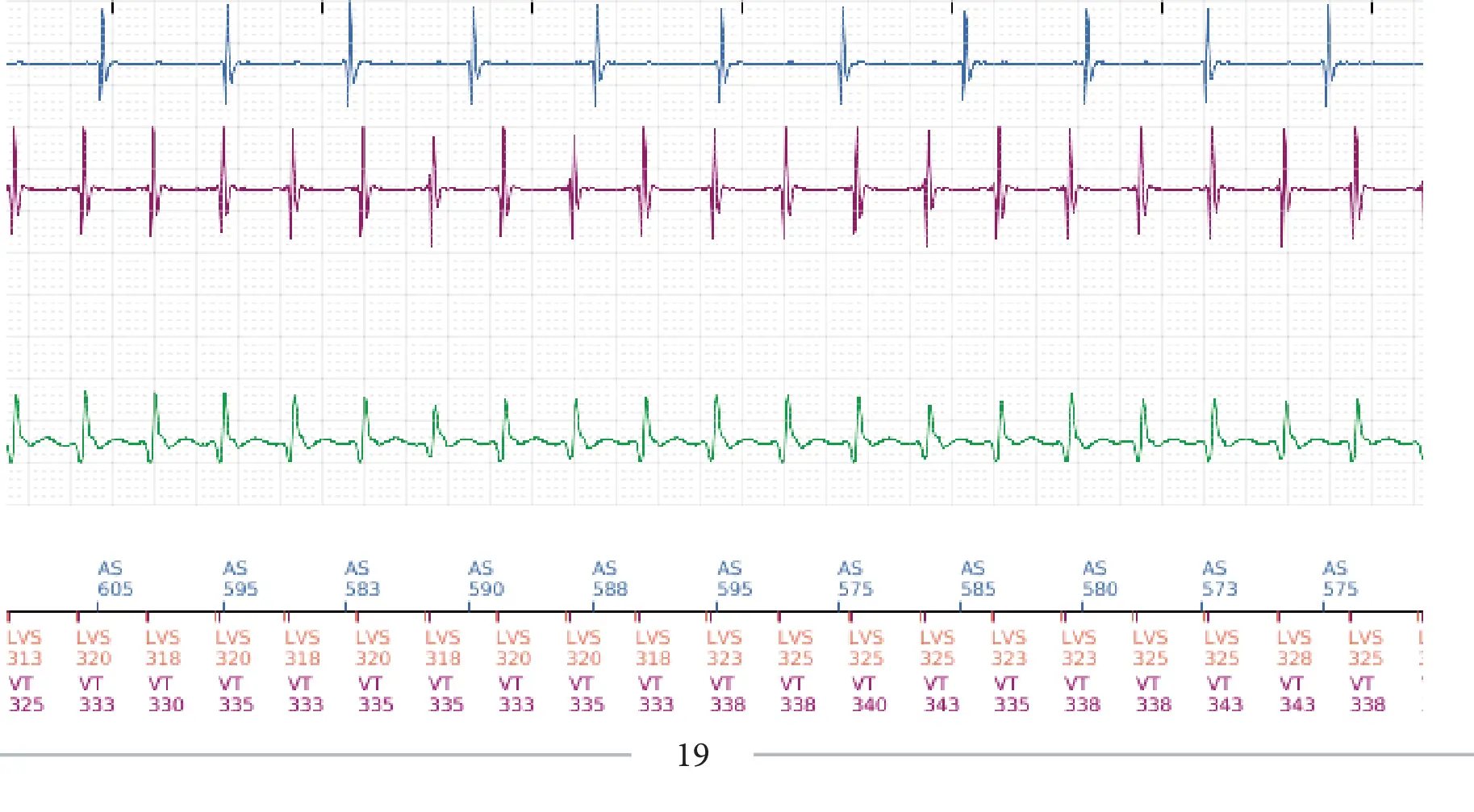
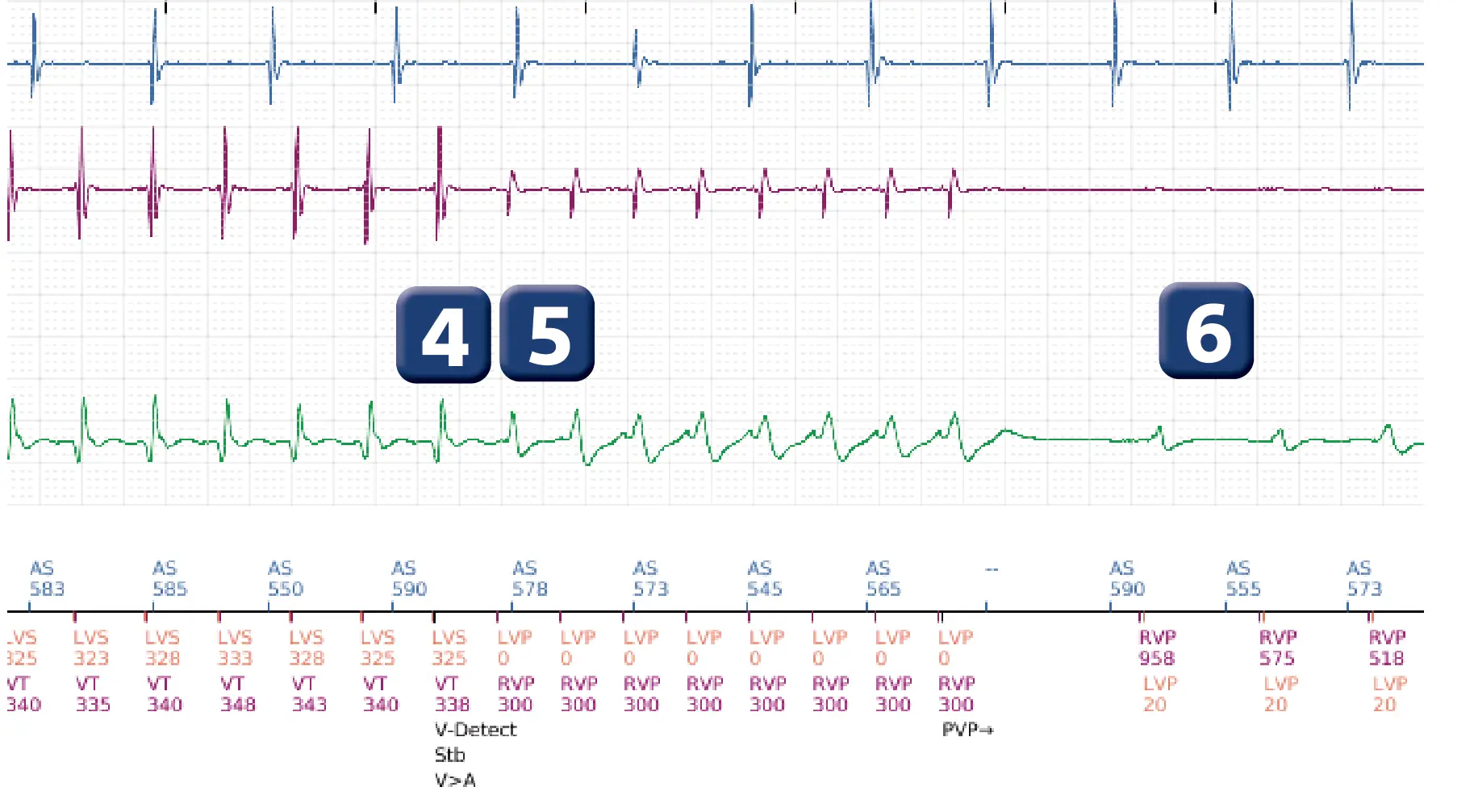
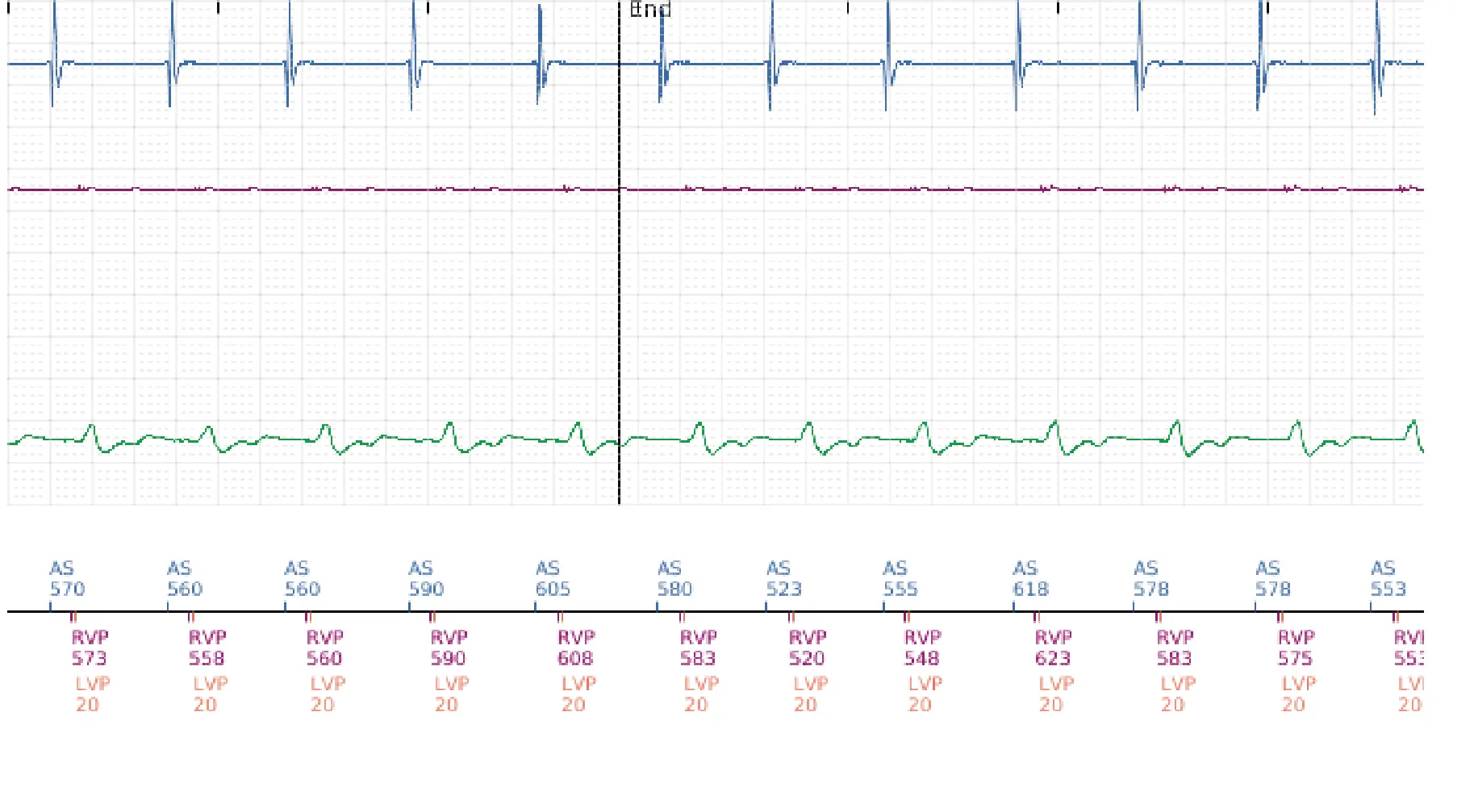
- Spontaneous rhythm in the atrium and bi-ventricular pacing
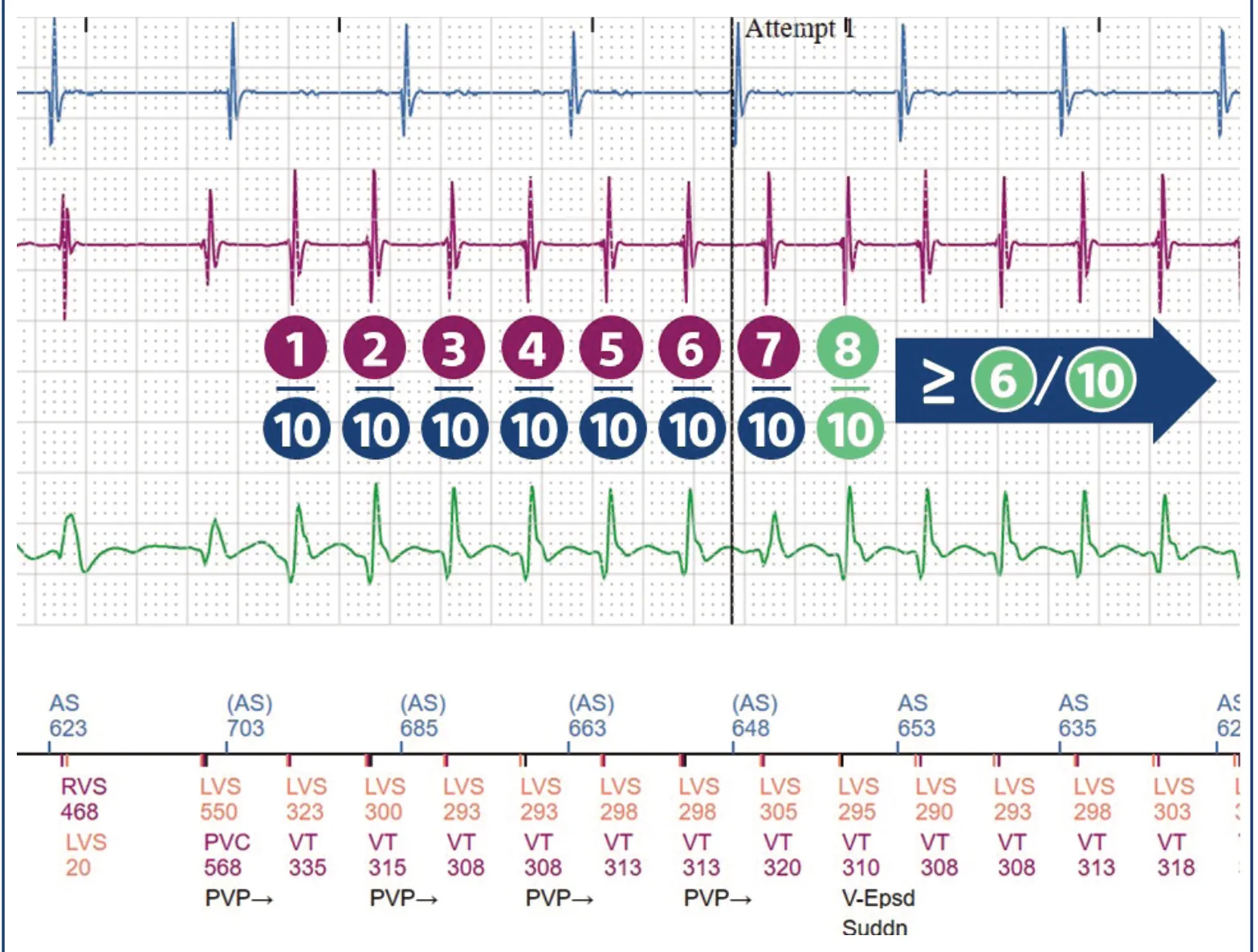
- Onset of ventricular tachycardia (regular, monomorphic with atrioventricular dissociation)
- VT episode (V-Epsd) after 8 cycles in VT zone (criterion 8/10 verified); start of initial VT zone duration (12 seconds)
- Diagnosis of sustained VT (V-Detect) at end of duration; discrimination criterion V>A verified
- Burst of 8 impulses at a fixed rate; biventricular pacing
- Effective burst and arrhythmia termination
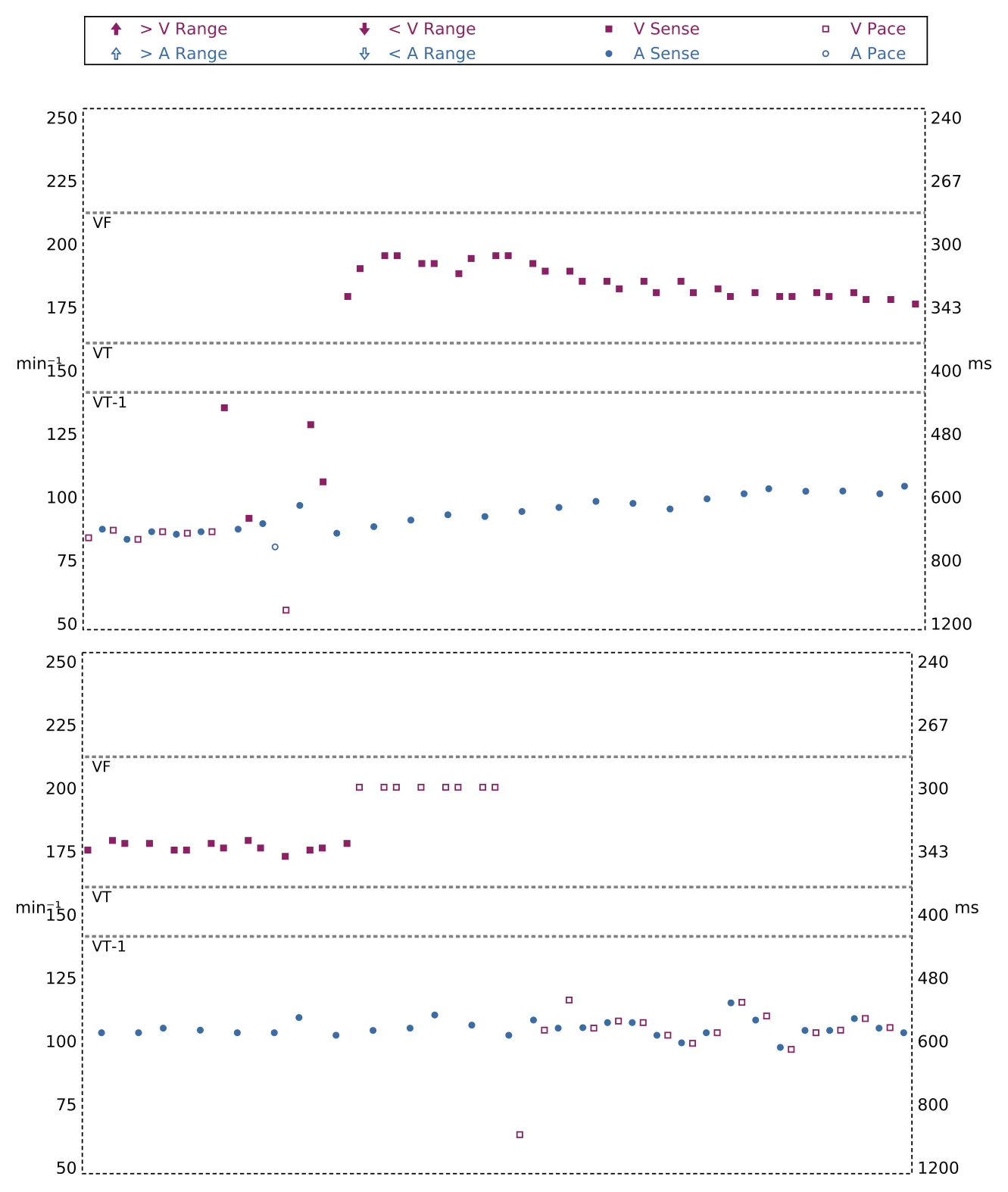
From the interrogation
Points to remember
- These first 2 tracings (termination of a disorganized polymorphic arrhythmia by a shock, and termination of an organized ventricular arrhythmia by anti-tachycardia pacing) illustrate the basics of how the Boston Scientific™ defibrillator detection counters work.
- It is possible to program 1 (VF), 2 (VF + VT) or 3 (VF + VT + VT-1) detection zones; counter operation is identical for all 3 zones; initial detection requires a minimum ratio of 8 rapid cycles out of 10; this ratio then decreases to 6 out of 10 during the duration of detection; during post-charge confirmation, for a shock to be delivered, a ratio of 2 rapid cycles out of 3 is required; during re-detection or post-shock, identical counters apply (8/10 then 6/10); therefore during an episode, the same probabilistic counters (X/Y rapid cycles) are applied in both VT and VF zones.
- The first tracing showed an episode of VF; probabilistic counters seem to be most suitable for this type of arrhythmia; ventricular fibrillation is by definition rapid, disorganized and, chaotic, with ventricular signals of low and/or variable amplitude; all these characteristics increase the risk of undersensing due to low amplitude signals below the sensitivity threshold (nominal value of 0.6 mV); the high beat-to-beat variability of the amplitude may fool the sensing circuit, as the defibrillator uses a sensitivity level that adapts to the amplitude of the preceding signal; the first counter requires a minimum of 80% rapid cycles (criterion 8/10); this 80% ratio between fast and slow cycles has been chosen to achieve an optimum balance between correct detection of ventricular fibrillation (requiring tolerance of a certain number of pseudo long cycles generated by undersensing) and the need to avoid filling counters in the presence of T wave, P wave or R wave oversensing (frequently associated with a ratio of 50% short cycles), or sensing of frequent ventricular extrasystoles; this 80% ratio is not programmable, nor is the number of cycles (8 out of 10); once this first stage of detection has been achieved, the duration in the VF zone begins, with a lower requirement of 60% rapid cycles; the device considers that if the first stage criterion has been met (8/10), the probability of a true arrhythmia is high, and the priority is then to avoid being fooled by possible undersensing (hence a lower number of rapid cycles are required).
- The second tracing shows a regular, monomorphic ventricular tachycardia detected in the VT zone; for this type of arrhythmia, the operation of a probabilistic counter is also effective since sensing is generally correct and 100% of cycles are correctly sensed
Practice out loud
Just describe the tracing. What do you think is going on? Describing the numbers can help.
00:00
0%
—
From Boston Scientific ICD — clinical cases by P. Bordachar, M. Strik, A. Thiyagarajah, S. Ploux. Published by Cardiocases. Every numbered marker on a recording is explained in the list beneath it; tap a marker on the trace or an entry in the list.
Order hardcopyon Amazon