
Chapter 3 · Sensing · Case 5
CRT-D shock: and what about the LV channel?
Patient and episode
Patient
- RESONATE X4 CRT-D, 6 years after implant; tachy mode Monitor + Therapy; sinus rhythm with BiV pacing, the LV paced 20 ms before the RV
- Stored episode V-6, classified VF: A 119 / V 229 bpm at onset, A 110 / V 259 bpm at detection; one 41 J shock; episode length 49 s
The recording
Tap a number on the trace, or an entry in the list below
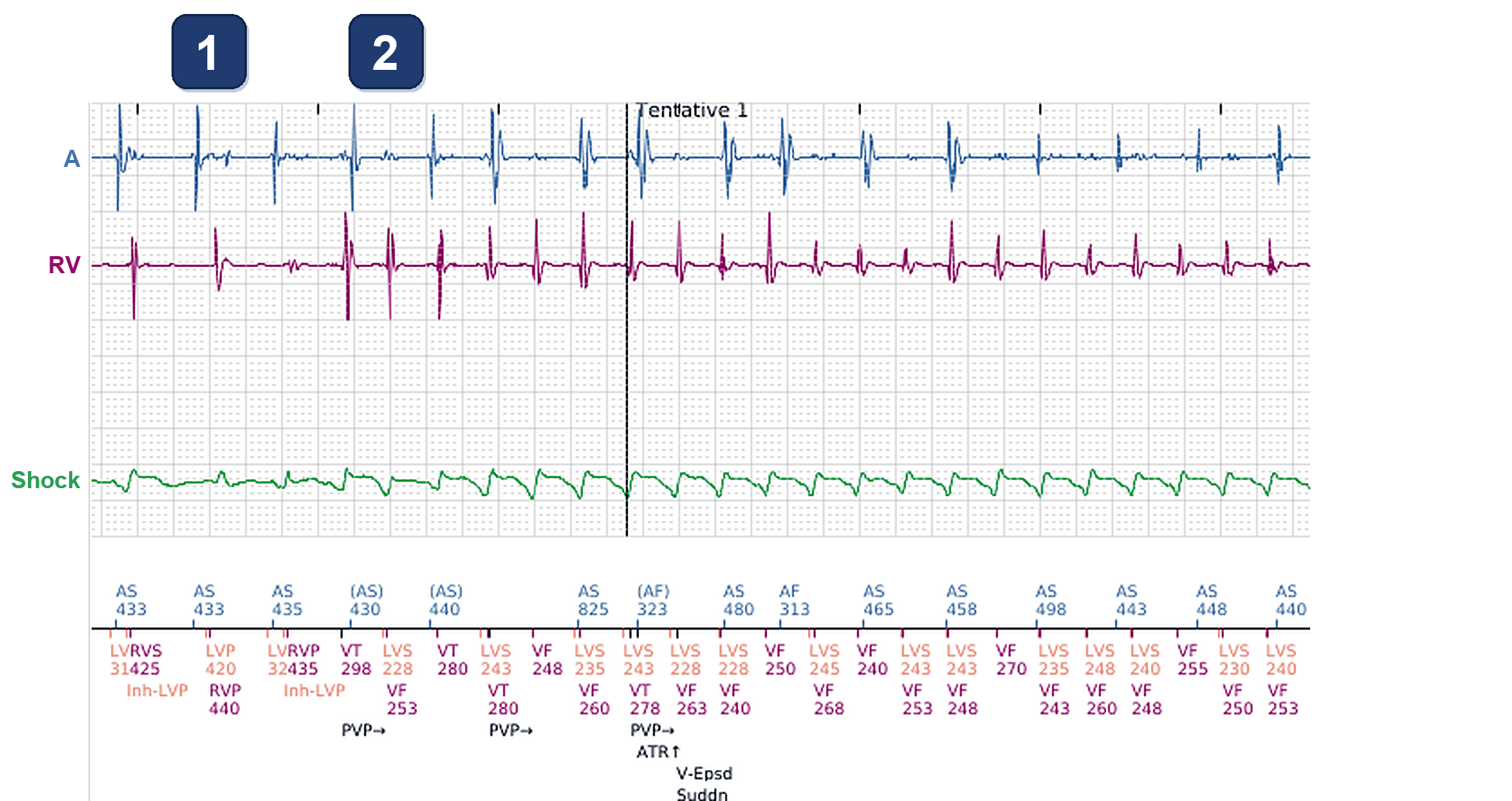
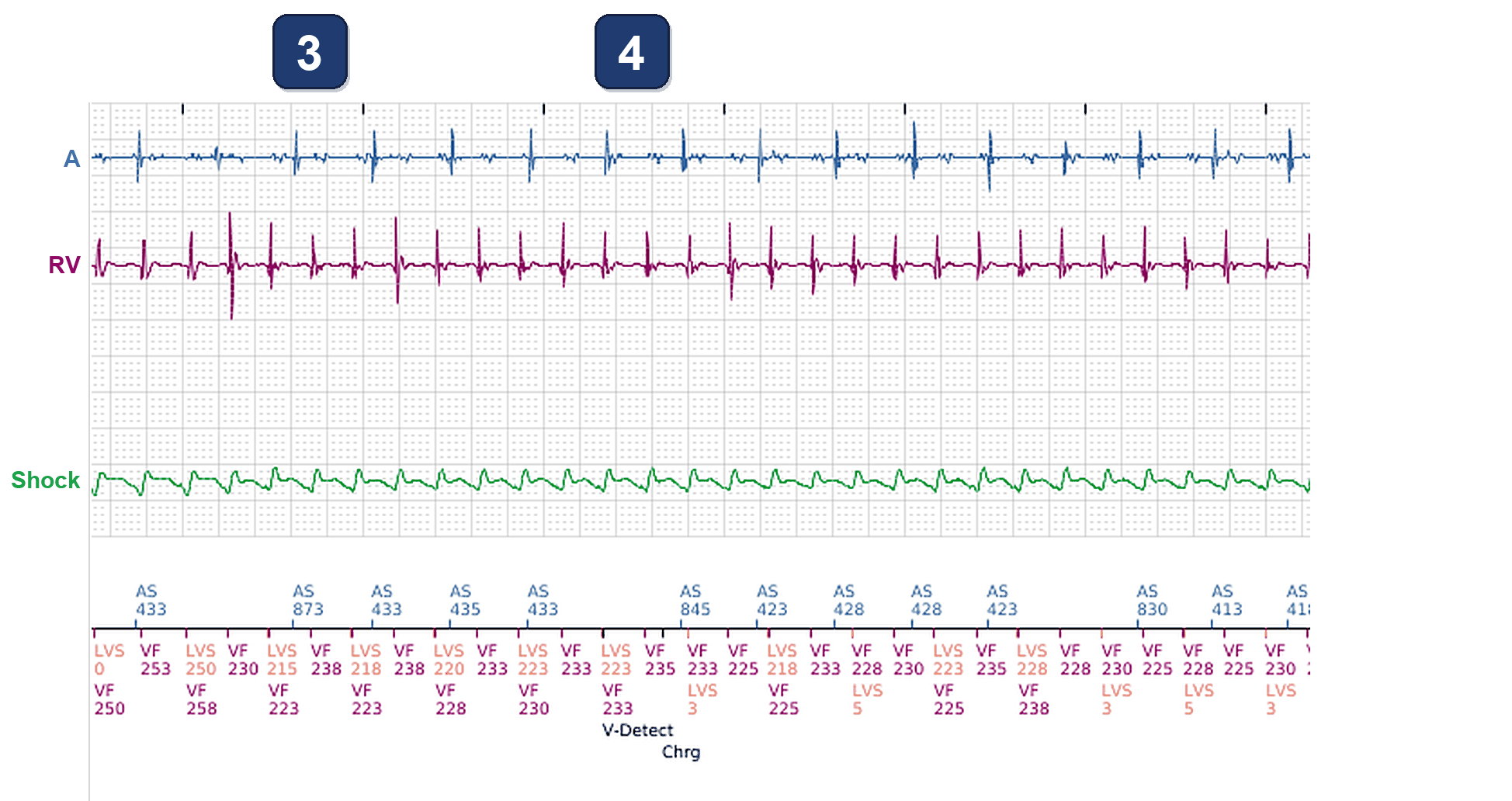
- Atrial, RV and shock EGM channels (this stored episode has no LV EGM, only the LV markers). Sinus rhythm at 433-435 ms (138 bpm): this beat is BiV paced (LVP 420, RVP 440: the LV 20 ms before the RV); on the beats around it the LV is sensed first and its pace is withheld (Inh-LVP: the LV protection period that follows the LV sense)
- A premature beat (VT 298, PVP→), then a sudden, regular tachycardia at 240-280 ms with a new RV EGM and a wider shock EGM, while the atrium keeps its own, slower rate (AS 440-498 ms): V faster than A = VT. Most intervals fall in the VF zone (VF 240-270); V-Epsd, onset marked sudden (Suddn). The LV is still sensed on most beats (LVS): at 250 ms or more, each LV activation falls after the LV refractory period (nominal 250 ms) of the one before
- The VT speeds up to 223-258 ms: now the LV is sensed on only one beat in two (LVS, with every other VF beat). After each LV sense comes the LV refractory period (LVRP, nominal 250 ms): the next LV activation, one VT cycle later, falls inside it and is not sensed. With a 250-ms LVRP the LV channel cannot sense two beats less than 250 ms apart (above 240 bpm): 2:1 LV sensing, a functional undersensing. Every RV beat is still counted (VF)
- V-Detect: detection is met on the RV rate alone (mean 259 bpm, A 110 bpm); the LV channel plays no part in tachycardia detection. The report lists a stable (9 ms), sudden (31%) rhythm with V>A, but marks these criteria “Off” (arrêt); the capacitors charge (Chrg)
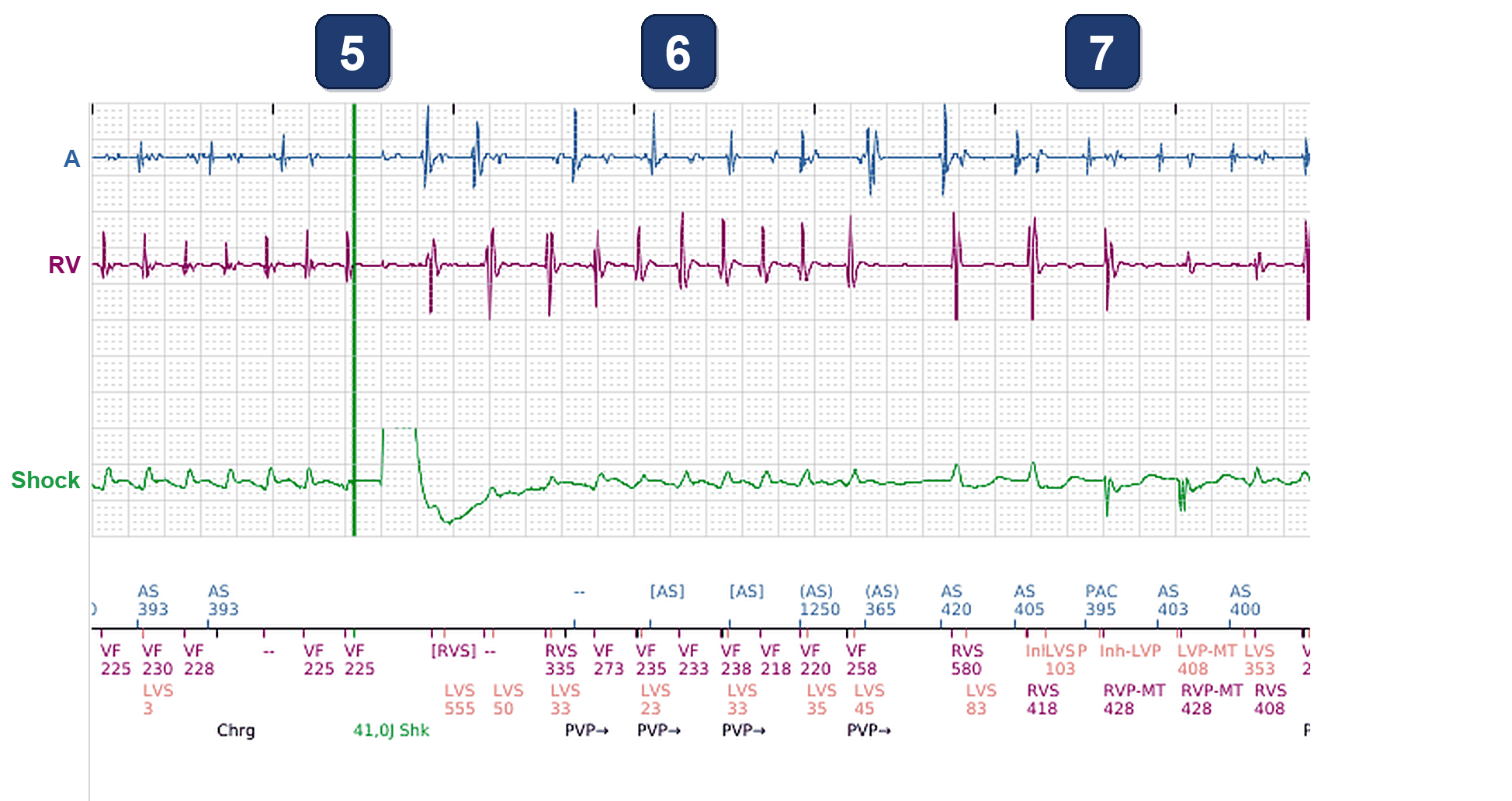
- End of charge (11.3 s) and 41 J shock (41,0J Shk), lead impedance 61 Ω; no ATP was delivered before it
- After the shock, a short run of fast beats (218-273 ms) that stops by itself; on these beats the LV is sensed 23-45 ms after the RV; no second shock
- Sinus rhythm at 400-420 ms (145-150 bpm), faster than the MTR (RVP-MT 428 ms = 140 bpm): the conducted beat arrives first (RVS, then LVS 83-103 ms later) and the LV pace is withheld (Inh-LVP: the LV protection period after the LV sense), or both ventricles are paced at the MTR (LVP-MT, RVP-MT 428): BiV pacing on few beats. The episode ends at 49 s
Points to remember
- The LV channel serves CRT timing only: tachycardia detection counts RV events. Every RV beat was counted as VF, and the VT was detected and shocked, although the LV was sensed on only one beat in two
- After each LV sense or pace, the LV refractory period (LVRP; 250-500 ms, nominal 250 ms) runs: an LV event inside it is ignored. Above 240 bpm (cycles under 250 ms) the LV can be sensed only every other beat: functional 2:1 LV undersensing, expected, not an LV lead problem. A longer LVRP lowers this limit further
- The LV protection period (LVPP; 300-500 ms, nominal 400 ms) follows each LV sense or pace and forbids LV pacing: at fast rates, an LV sensed first withholds the LV pace (Inh-LVP), as in the sinus tachycardia before the VT and after the shock
- A regular, monomorphic VT can fall in the VF zone by its rate alone (259 bpm at detection): the stability, onset and V>A criteria are marked “Off”, and the device shocked (41 J) without ATP
Summary
- A fast, regular VT in the VF zone is shocked (41 J). Above 240 bpm the LV channel senses only one beat in two: each LV sense opens the LV refractory period (nominal 250 ms), and the next LV activation, one VT cycle later, falls inside it. Detection, which counts RV events, is not affected
Clinical pearl
The LV channel cannot sense two beats closer than its refractory period (nominal 250 ms, i.e. above 240 bpm): in a fast VT, 2:1 LV sensing is expected and harmless, because tachycardia detection relies on the RV channel. It is not a failing LV lead
Practice out loud
Just describe the tracing. What do you think is going on? Describing the numbers can help.
00:00
0%
—
From Boston Scientific CRT — clinical cases by M. Strik. Published by Cardiocases. Every numbered marker on a recording is explained in the list beneath it; tap a marker on the trace or an entry in the list.