
Chapter 4 · Keeping up the CRT · Case 2
CRT-D in sinus rhythm, BiV pacing 89%
Patient and episode
Patient
- RESONATE X4 CRT-D implanted 6 years earlier, quadripolar LV lead (LV paced LVRing2>>Can); DDD 50-155 bpm, sensed AV delay 75-120 ms, BiV with LV offset 0 ms; sinus rhythm, almost no AF (0.2 min in a year)
- Remote transmission: daily BiV pacing 89%
The recording
Tap a number on the trace, or an entry in the list below
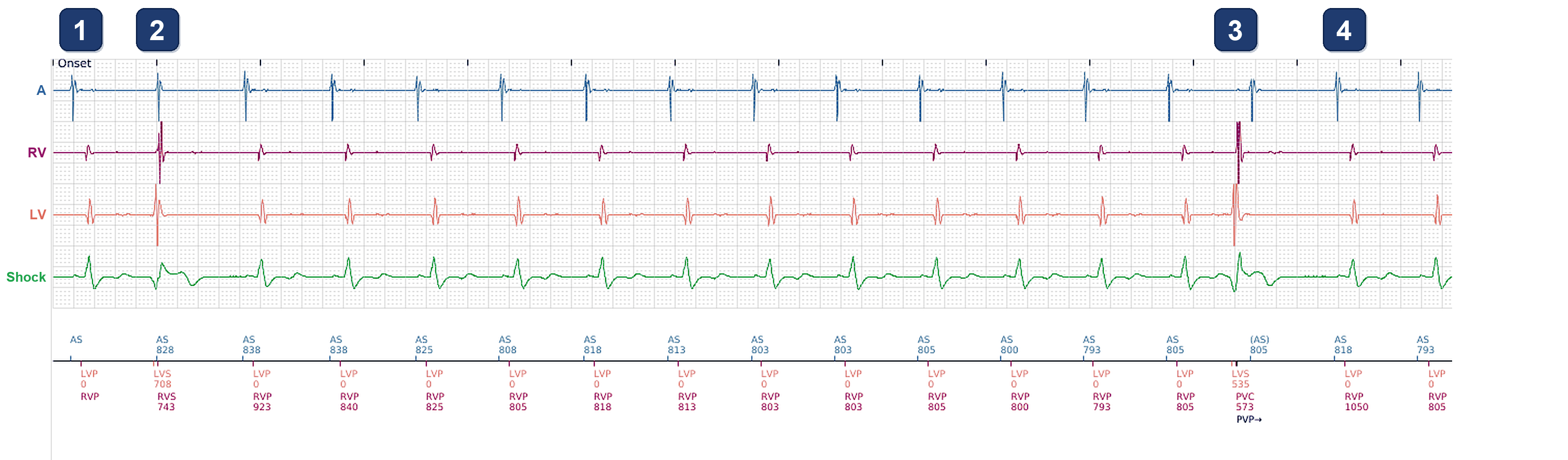
- Presenting EGM, channels A, RV, LV and shock: sinus rhythm at about 72 bpm, each atrial event sensed (AS) and followed by LVP 0 and RVP together: BiV pacing, the same paced complex at every beat
- A PVC that falls with the atrial event: the LV is sensed first (LVS 708), the atrial event about 30 ms later (AS 828), the RV 35 ms after the LV (RVS 743). Large native RV and LV EGMs and another shock EGM: an ectopic beat that reaches the LV lead first. As an AS precedes the RVS, the device marks it RVS, not PVC: a beat without CRT that the PVC counter misses
- A similar PVC, earlier (LVS 535, then the RV at 573 ms): no atrial event before it, so the device marks it PVC and extends the PVARP for one cycle (PVP→). The sinus atrial event 140 ms later falls in it: (AS) 805, not tracked
- The next atrial event is tracked: LVP 0 / RVP 1050 ms after the PVC, and BiV pacing goes on. Two PVCs among the 17 beats of this EGM: 88% BiV, the 89% of the day
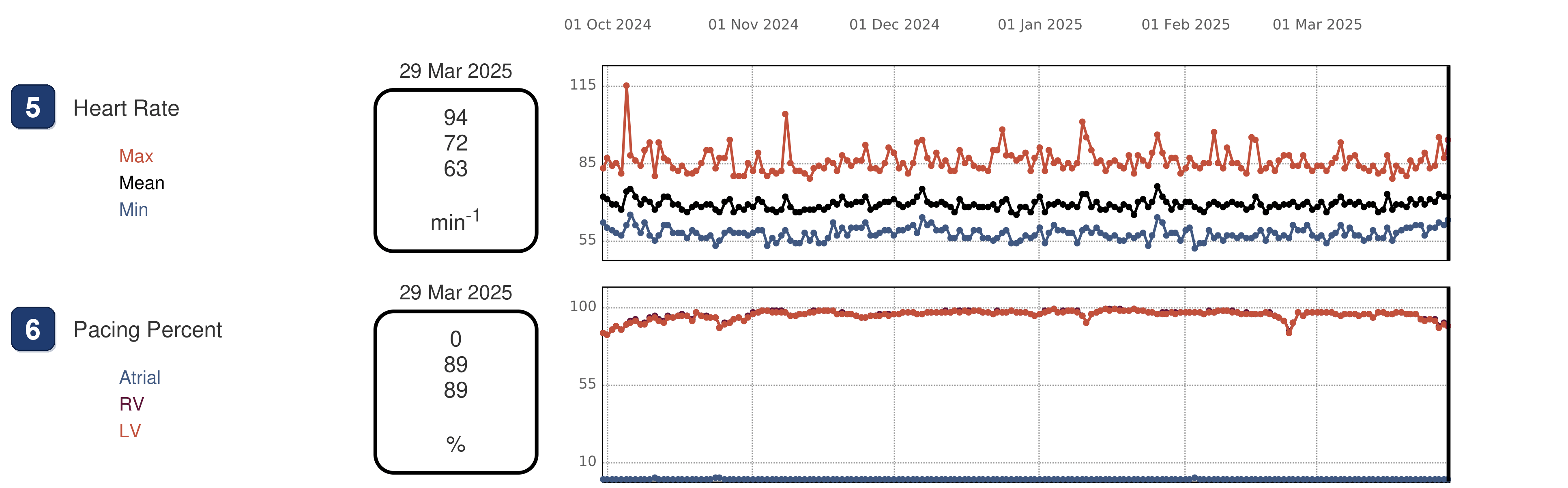
- Remote transmission, 6 months of trends: sinus rhythm, heart rate 63-94 bpm on the last day (mean 72); AT/AF only 0.2 min in the last year (report p6)
- Pacing: A 0% (sinus atrial events sensed), RV and LV together, mostly 95-100% with dips to about 85%, and 89% on the last day: about one beat in nine is not paced
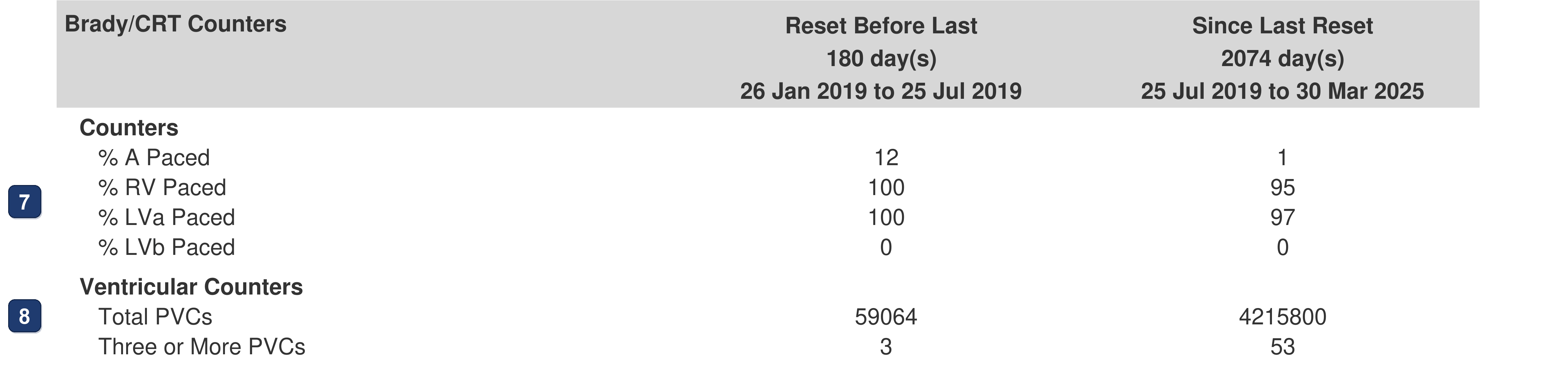
- Counters since the last reset, 6 months after implant (2,074 days): RV 95%, LV 97%; 100% in the 180 days before. Over years, the cumulative counter hides the 89% of the last day
- 4,215,800 PVCs since that reset, about 2,000 a day, against 59,064 in the first 180 days (about 330 a day); only 53 runs of three PVCs or more
Points to remember
- In sinus rhythm with no AF, a drop in BiV pacing points to ventricular beats that come before the BiV pace: here PVCs, each one a beat without CRT (89% BiV on the last day)
- Not every PVC is counted as one: for the device a PVC is an RV sense with no atrial event before it, so a late PVC that falls with the atrial event is marked RVS. The beat is still lost for CRT
- Recognise PVCs on the EGM: large native RV and LV signals, the LV sensed before the RV, and another shock EGM
- The cumulative counter (RV 95%, LV 97% over more than 5 years) hides the current loss: read the daily % pacing trend and the PVC counts (here about 2,000 a day). The remedy is fewer PVCs (drugs, ablation)

Summary
- Frequent PVCs: each one is a beat without CRT, hence 89% BiV pacing in sinus rhythm. The late ones fall with the atrial event and are marked RVS, not PVC, so the PVC counter misses them
Clinical pearl
Each PVC is a beat without CRT, and the PVC counter misses those that fall with the atrial event. When BiV pacing drops in sinus rhythm, look for PVCs on the EGM and treat them
Practice out loud
Just describe the tracing. What do you think is going on? Describing the numbers can help.
00:00
0%
—
From Boston Scientific CRT — clinical cases by M. Strik. Published by Cardiocases. Every numbered marker on a recording is explained in the list beneath it; tap a marker on the trace or an entry in the list.